Unification Church in Japan: After the Dissolution, the Purge — 3. The Government’s “Re-Education” Plan
New state policies introduce school-based programs designed to reshape the thinking of minors from Unification Church families.
by Patricia Duval (Bitter Winter)
Government Plan for De-Indoctrination
The governmental measures adopted in January 2024 implement the following:
- the indoctrination of children in elementary school through cartoons and online discussion forums regarding “abuses” related to religious beliefs;
- “awarenes-sraising” sessions organized as part of human rights courses, including “consumer education” on religious donations—as if donations to a church were a matter of consumer law—particularly regarding the “criminal financial activities” of the Unification Church, to make children “aware” of the problems that may arise from their parents’ membership in that church;
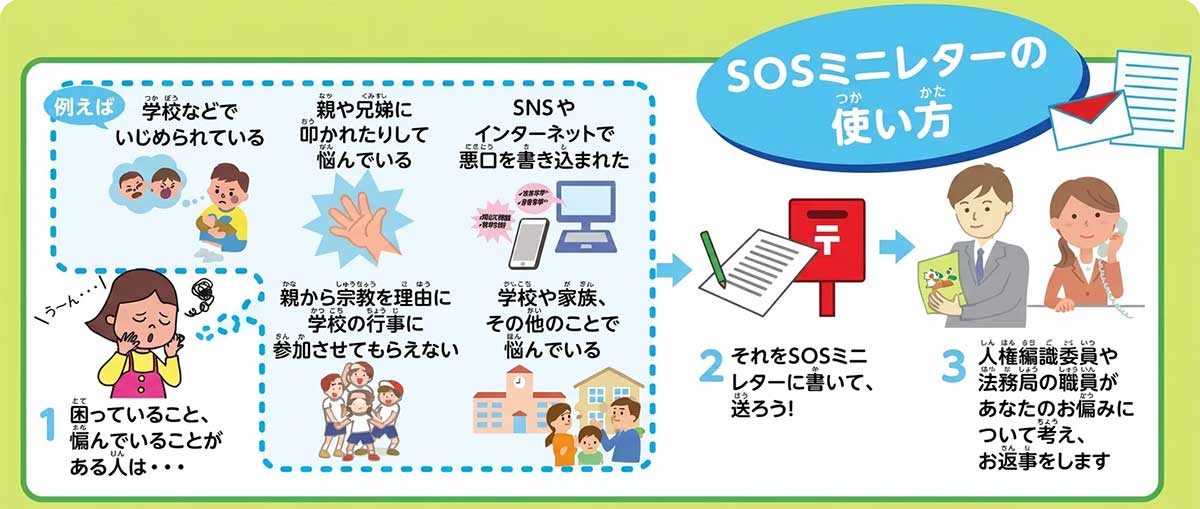
- the distribution of SOS mini-letters to be filled out by children and leaflets with telephone numbers for them to call for further questions and talks with counselors;
- consultation services provided by counselors trained by hostile former members of the Unification Church;
- referral to mental health institutions of children made anxious about their parents’ affiliation; and
- requests for the suspension of parental authority and temporary custody in cases of suspected abuse, as provided in the “Guidelines for Handling Cases of Child Abuse Related to Religious Beliefs,” to remove the children from their parents’ influence.
In summary, the “re-education” provided during the Ministry of Justice’s human rights classes aims at making children realize that, due to religion, their parents have been abusing them since an early age. And by “drawing on the knowledge and expertise of former members,” as the government’s plan stipulates, the training of counselors can only lead to this “counseling” being used to indoctrinate children against their parents’ religious beliefs.
The Guidelines
The Guidelines, titled “Questions and Answers on Responding to Child Abuse Related to Religious Beliefs” (the “Guidelines”), were issued by the Ministry of Health, Labor, and Welfare on December 27, 2022. These Guidelines, intended to serve as a reference for teachers and school counselors, include examples of how to respond to cases of “child abuse related to religious beliefs.” They were the subject of an official UN Communication sent to the Japanese government on April 30, 2024, and signed by four Special Rapporteurs to the Human Rights Council—responsible, respectively, for freedom of religion, freedom of education, freedom of expression, and freedom of association—who expressed their concerns regarding the Guidelines’ non-compliance with international law.
As stated in the Communication, they “were drafted in consultation with the Japanese Society for Cult Prevention and Recovery (JSCPR), whose Chairperson called for the recognition of a new type of child abuse by religious groups in October 2022, and had previously made public statements denigrating the Jehovah’s Witnesses and other religious or belief minorities.” They were “hastily prepared, in just 18 days (December 5–23, 2022), in closed-door sessions with those same anti-cult groups, and adopted without any independent expert review or public consultation” (Jehovah’s Witnesses, Submissions to the Japanese Government, March 2024).
These Guidelines include, among other things, that making a child attend religious services when they do not feel like it or participate in religious activities constitutes “psychological abuse,” and that imprinting continuous fear since childhood through verbal reprimands or references to “hell” constitutes child abuse. Clearly, the focus here is on the religious education that parents may provide to their children, as well as their religious, moral, and ethical values and the religious practice itself.
As stated by the four United Nations experts, the Guidelines “appear to set a lower threshold for the establishment of abuse in religious as opposed to non-religious contexts.” For instance, the Guidelines “assert that ‘forcing a child to participate in religious activities, etc., during hours that may interfere with the child’s schooling or daily life constitutes neglect,’ without clarifying what is meant by ‘forcing,’ nor what distinguishes ‘religious activities, etc.’ in this case from activities such as extra tutorials, music or language lessons, or other secular extra-curricular activities in ‘daily life.’”
The UN Special Rapporteurs concluded that “the Guidelines in their current form may undermine the rights of children to freedom of thought, conscience and religion (Convention on the Rights of the Child, Art. 14.1); and of parents to ensure the religious and moral education of their children in conformity with their own convictions, as set out in article 18, paragraph 4 of the ICCPR.” They added that they “are also concerned that in the context of heightened suspicion of religious or belief minorities, the Guidelines in their current form may facilitate stigma, social pressure, or bullying of children belonging to religion or belief communities.” They called on the Japanese government to review and reconsider certain key aspects of the Guidelines to ensure compliance with Japan’s international human rights obligations.
However, Japan’s authorities never reconsidered the Guidelines. On the contrary, the Guidelines have been widely disseminated to teachers, counselors, and social workers, and training sessions and briefings have been organized to ensure proper awareness so that they can track down cases of “child abuse due to religious beliefs.”
Tracing Children from Religious Minorities
An important phase of the governmental plan concerns the role assigned to teachers, social workers, and counselors in identifying children from Unification Church families who are deemed to need specific “counseling.” These school staff are instructed to act “in the absence of explicit statements from the child,” so their primary mission is to identify those children.
In its opinion submitted to the government, which led to the adoption of the plan, the NNLASS specifies what instructions should be given in this regard: “As a prerequisite for such efforts, it is essential that schools first identify children who are facing problems related to religion or similar belief systems. As an initial indication, a child may speak to school staff about concerns related to their parents’ religious beliefs while at school. It is also possible that teachers may come to recognize the influence of religious beliefs on a child when, for instance, the parent or the child requests certain accommodations in academic or school life based on faith, or when the child engages in behavior at school that differs from that of other students. Given that the conditions of a child’s home life are often difficult for third parties to observe, schools must make every effort not to overlook such signs and to identify children facing second-generation religious issues accurately.”
Therefore, school staff is instructed to take action even in the absence of any request from the child or any indication of problems in the child’s family life. They are instructed to look for signs of religious upbringing and then infer the existence of problems from those signs. Their first step is to spy on the children and identify those likely to come from a Unification Church family. For this purpose, a Guide for Psychological Counseling on cult issues has been provided to them.