
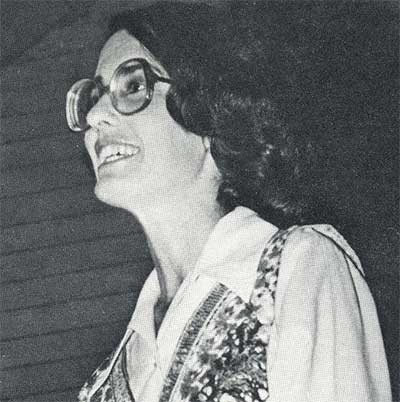
By Mary Bizot
Rarely in life does one’s perspective and perception change so abruptly as it did when I was told of my new mission in Africa. As I left the campus and took the bus home under the crisp, starry Cambridge night, the buildings, people, and cars, seemed already removed, distant. Incredible, but so. I just wanted to burst out, to say to everyone, “I’m going to Africa!” … But what is Africa? I had no idea.
This testimony was written more than 40 years ago in 1981, more than five years after Mary first set foot in her mission country, the Central African Republic.
Part 2 (Click here to read Part 1)
Although certain aspects of the mores were difficult for me to accept, in general, the African way of life, with a strong family tradition, an order of generations, and a great respect for the elders, is most pleasing and edifying. Their Iives are rich in heart, even if their external experiences have been limited. One’s position in one’s family, society, and in the succession of generations is more important than one’s individual self. Because death is never far away—I am almost certain there doesn’t exist an African family where the parents have not lost at least one or two, even six children, usually during infancy—and as life on this earth is relatively short (40-50 years), there does not seem to be great ambition to stand out as an individual, but rather to maintain the tradition and the relationship with the family. These aspects of the culture I find very wonderful, especially now because we have the home church providence—an ideal way, I believe, to restore the strong African family and tradition to the heavenly side.
Spiritual guidance
In Central Africa, and perhaps all through Africa, the spirit world is a reality, not merely a possibility, and it intimately influences everyone’s lives. We as missionaries have experienced the reality of spiritual phenomena many, many times, even daily.
First of all, there are dreams. Since my arrival in the Central African Republic, I doubt that there was a night’s sleep when I did not have vivid, memorable dreams. Sometimes the dreams were high-level inspirations, sometimes less desirable, often warnings or forewarnings of spiritual activities to come. If I was praying deeply or doing some type of condition, my dreams of True Parents were so vivid that I could feel their embracing love even more than when I had been physically present with them so many times before in America. Comfort and hope these dreams would bring: dreams of Father laughing and playing with his grandchildren—many, many grandchildren; dreams of Father and Mother with our Central African family in Bangui; dreams of tremendous light flowing into even the most remote village of Central Africa.
Actually, I did not have any experience of seeing True Parents in a vision, as a substantial entity before me, but I could “see” them through my heart. At times of illness or discouragement, when I was lying on my bed, unable to move or hardly even to sense a desire to go on, I suddenly felt as if my True Mother had entered the room, just quietly peeking in, to see if all was okay and to reassure me to rest quietly until the storm had passed.
On one trip, I had to cross an island on a narrow forest path. The forest was dense, strange animals were crying—a typical African forest scene—and although my desire was strong, my courage wavered just a bit. In that instant, I felt immediately the presence of True Father and realized that, symbolically, at least, this forest path represented the narrow course he has followed, with the strong, evil forces of Satan all around. I felt True Father there with me, ready to walk before, to lead the way, to lead me to safety. It was a very deep and moving experience. Fortified by renewed courage, I did go on.
However, besides dreams and rather dramatic encounters with True Parents or with the power of Heavenly Father, it is just a day-to-day reality that the spirit world works to assist our mission in Bangui.
I know that Father has said many times that if we desire to accomplish ten tasks in one day for the will, but physically there is only time enough for half that number, then Heaven must aid us to accomplish the other tasks. I’ve experienced this so frequently in our mission that now I have the confidence to even command the spirit world to help me with certain responsibilities: to meet a certain person on a given day, to assist in getting into some office, to guide people to come to the center or to cross my path as I make my round of daily responsibilities. Of course, there are certain external advantages in that our city is not so large, and that we are already well known here, but I feel that the largest factor is simply that the spirit world is so close to, so alive to the African people; they often listen to and follow their intuition, so this offers a great advantage to the spirit world in its assistance to us.
I confidently rely on the spirit world now and know that the key is knowing how to control, how to command them to cooperate with us because we are too few in number to accomplish restoration without them. With sincere prayer and the proper conditions, their assistance is always ready, and I feel that in the future the spirit world will enable us to make a spiritual whirlwind and, at last, a substantial victory to lead the people of Central Africa to our True Parents and to final restoration.

The people’s suffering
During the course of the mission in the Central African Republic, the problems of our nation were very intense, but the greatest suffering of the people was always more spiritual than physical. Our nation, located in the true heart of Africa, is a well-watered plateau and grassland region, which can yield food rather abundantly. The climate is tropical and therefore the usual tropical diseases are rampant, but with the effective use of modern health control techniques, these could be eradicated. However, the greatest burdens besetting our nation are in the areas of education and economics.
This lack of freedom in the atmosphere was naturally difficult for me and the other missionaries to accustom ourselves to. However, because of the language barrier during the first year, I feel we were very protected by Heaven from the impact of actually understanding how difficult the situation was. It took quite a while to realize how deep ran the fear and suspicion among the people and how isolated they were from the world and the realities of what was happening around the globe.
This oppression of the spirit, the inopportunity and consequent inability to think or act freely was the most overriding concern I felt as the spiritual parent of the C.A.R. The Central African people seem to be endowed with a rather quiet and passive internal nature as it is, and such a situation served only to inhibit further any latent creativity or desire for free expression. Thus, even though we always witnessed and always taught the Principle and always tried to encourage discussion and thought based on the Principle, it was very difficult for them to understand.
If one makes a tour of the major cities and towns of the Central African Republic, widespread physical suffering is immediately evident. Houses are still mostly of mud; outside the main cities new clothes or household utensils are rare; the people appear obviously tired. Of course, most persons do manage to keep at least one or two fields under cultivation (cotton, peanuts, sesame seed, millet, cassava, or coffee, depending on the region), but the yield is always low since they cultivate by hand and have no access to and little familiarity with the use of fertilizer or insecticides.
Most of the assistance has come from the Christian missionaries. There are both Catholic and Protestant missions scattered all throughout the country; most seem to maintain some type of hospital or dispensary for the people in their area, as well as offering basic health or family education. But these efforts are far from adequate. Also, the education system is very inadequate and existing primary schools serve less than half the population. Less than 20 percent of the people under 40 are able to obtain a high school education and the rate of illiteracy is high. Furthermore, job opportunities even for the educated are extremely limited.
So where to begin? So many evenings I reflected upon these spiritual and physical barriers before the people of our nation. They obviously feel a sense of helplessness and more often than not have reacted simply by putting out a hand and begging, “Donnez-moi” (give me) or “Aidez-moi” (help me). In the past, many groups had responded to such pleas—missionaries, French colonists, the UN—and the habit seems to have become ingrained. Only recently have such organizations as the United Nations adopted a pragmatic philosophy along the order of “lf you give a man a fish, he’ll eat for one day; if you teach a man to fish, he’ll eat for his entire life.”
The dependent attitude seemed to be ingrained in the people from their childhood, as we searched so yearningly to find those able to accept the reality that each person is the responsible partner of God: the Kingdom of Heaven, the ideal world must be built with our own hands. But always we nurtured the hope that it could not be everyone who reacted this way; there must be those ready to shoulder the responsibility and to take the initiative. So, during the first four years, we looked, searched, prayed, and taught the Principle—we tried, but the harvest was meager.
Then in 1979, the situation in the country changed, and hope became a tangible, breathable reality for the first time in longer than many persons could remember.
The crucial need at present is for people to realize that each man and woman must do his or her share to rebuild, reconstruct and seize hold of the future. If dependency can be educated to become initiative, if fear can be transformed into confidence, and especially if selfish or revengeful desires can be overcome, then the growth and future of this young nation can be assured.
Our gratitude goes again to our True Parents for allowing us this precious experience of working as their disciples, their children, and their comrades in this last assault on the satanic forces of the world. We understood so little five years ago, and even now are only at the threshold of realizing what building the heavenly kingdom means; their love and their patience have sustained us and will lead us on forever.
Mary Johnson has remained connected with Africa over the years. After she left the mission field, the US State Department offered her a position based partly on her deep knowledge of the region.