Blog of Unification Theological Seminary
By Henry Christopher
Since the creation of Adam and Eve — according to the Bible, or the evolution of humans, if you prefer Darwin — it seems humankind has been hurling itself towards self-annihilation and the destruction of the planet. Creationists would say that goes back 6,000 years. According to scientists, it’s more like 2-3 million years ago, but it appears the pace has picked up dramatically in the last few hundred years.
Where can we turn to save ourselves and the earth from ourselves? Could a coalition of religion and science lead the way out of our dilemma?
What if they could work together towards a truer understanding of who we are, where we came from, and why we are so torn between destructive behavior and the need to live together in peace and harmony?
An area that clearly needs new understanding and attention, if we are to “save” ourselves, is the creation myths of various religions and early cultures throughout history. They could use some updating.
A good example is the Judeo-Christian creation story in the Bible. God makes Man, and then decides Man shouldn’t be alone, so one night, when Man is sleeping, God opens him up, removes a rib, and makes for him a mate — Eve. They are told not to eat the forbidden fruit, but she is tempted by Lucifer, eats it and gives some to Adam. They are kicked out of the Garden, and told they and their descendants will have to work for a living for the rest of their lives.
Perhaps science can contribute to our common understanding of what this story means, and what really happened in the Garden. It might give us some clues as to how to control our wild, destructive nature.
Science has been trying to shed light on the origin of our species through years of painstaking research and investigation by paleoanthropologists, geologists, archaeologists, and others. This is the story of human evolution.
Religion fiercely resisted at first. But in time most major religions have accepted the scientific theory by adding that God is the force behind evolution.
Today, only a small group of religious fundamentalists cling to creationism — a “literal” understanding of the story in Genesis that God made everything, including humans, whole and complete in one fell swoop in just six days.
Human Evolution from 10 million to 30,000 years ago
Let’s take a closer look at how humans actually developed over thousands and even millions of years. Hopefully it will inform our understanding of how God created us as well as why we are such a conflicted species. An interesting quote from the Rev. Sun Myung Moon, founder of the Unification Church, shows how far back God might have been preparing the evolution of humans.
“It was about 250 million years ago that God created these huge animals [dinosaurs] but this was the foundation needed to create human beings.” (God’s Day Address, Sun Myung Moon, Punta del Este, Uruguay, January 1, 1999)
The evolution of Hominids refers to the scientific classification for the Family of apes, which includes humans. Hominin is the sub-group or tribe of humans and other related species that diverged from chimpanzees between 7 to 10 million years ago, according to DNA evidence.
Paleoanthropologists study the fossilized bones, stone tools, and geology and climate of ancient times in their quest to piece together the puzzle of human evolution. Not long ago, scientists were said to be looking for the “missing link” between apes and humans. After much research, discovery and dating of fossil remains — primarily in Africa — they now believe they have a rather comprehensive timeline of the ancestry of humankind going back to species which descended from the apes.
Much of the study of human evolution focuses on the dramatic changes in the anatomy of the various discovered species. Some of the key characteristics looked for are the changes in leg and foot bones that allowed newer species to be able to become bipedal or walking on two feet. Another is the transformation of the hands with the formation of a thumb that would give humans the ability to hold objects and make tools (try to pick something up or fix something without using your thumb and you will immediately understand how crucial that was).
Other indicators of human evolution are increased braincase, and changes in the jaw and teeth of early ancestors. Over time, they have changed as humans’ diet changed. Scientists also believe that it could have been as early as two million years ago that the larynx in early hominins began to develop, which would eventually give humans the ability to talk, together with advances in cognitive abilities to create language.
These early humans were given names such as Australopithecus anamensis (4.2-3.9 million years ago, or mya); Australopithecus afarensis (3.7-3.0 mya) and Paranthropus boisei (2.3-1.4 mya). Through reconstructing their fossilized bones, scientists determined that all these species walked upright, made tools and had diets of fruit, nuts, plants, and meat. The famous fossil remains dubbed “Lucy” was an Australopithecus afarensis. She was a very significant discovery, as it was believed that this species was a direct ancestor of the genus Homo, which is the family of humans, yet still more closely related to the apes. The find was made in 1973 by American anthropologist Donald C. Johanson in Ethiopia.
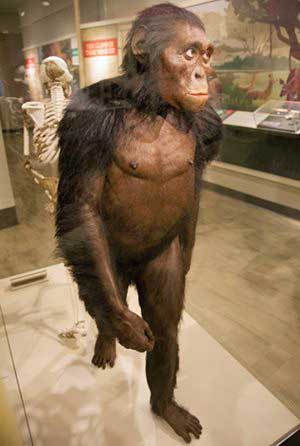
In 1961, renowned British paleoanthropologist Louis Leakey discovered the more advanced tools and fossil bones of a new species in the Olduvai Gorge, Tanzania, which he named Homo Habilis of 2.4-1.6 mya. Scientists say this species descends from Australopithecus, and is the closest ancestor of our genus Homo. In a sense, he could be considered the missing link between apes and humans.
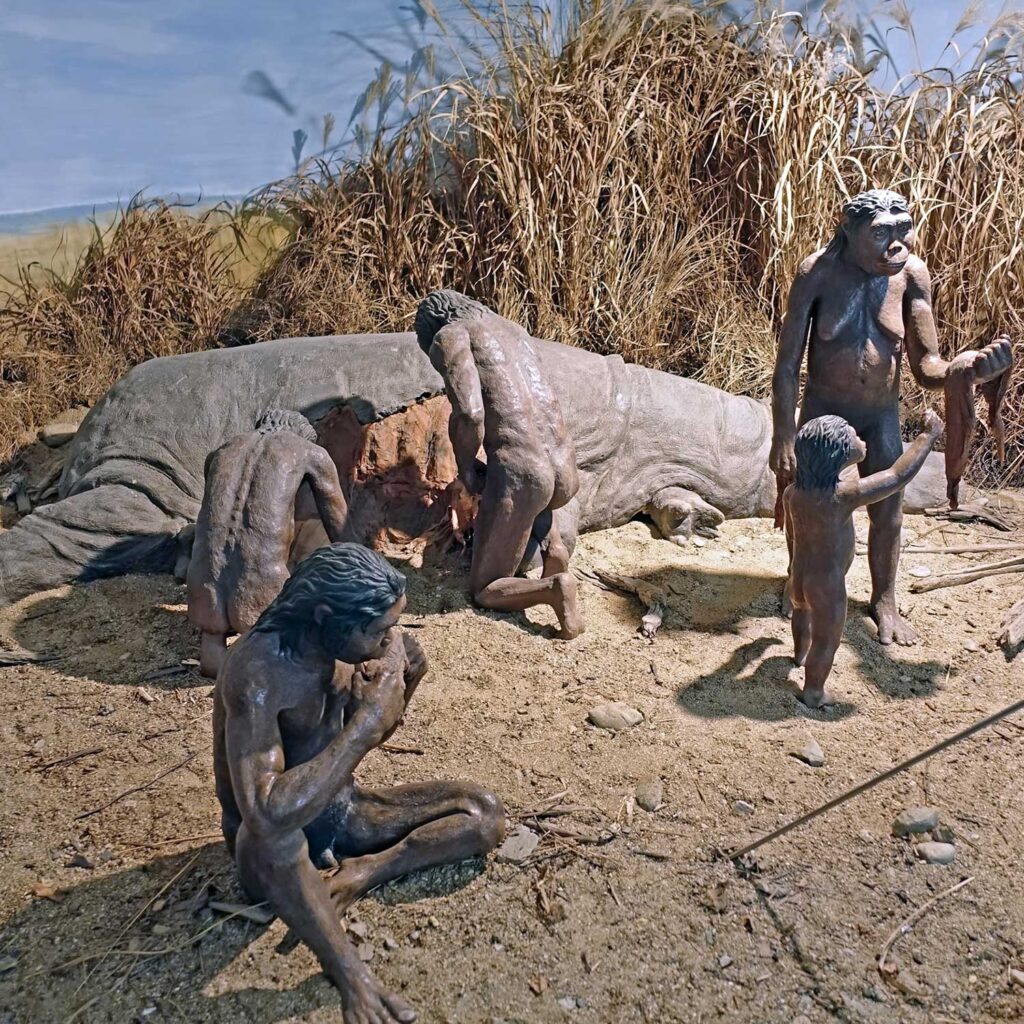
Homo Habilis was nicknamed “Handy Man,” because of the variety of stone tools found with his bones. Scientists say that differences in his teeth and jaw from Australopithecus indicate that he he ate more meat. His body was strong, but lightly built, and more resembling Homo Sapiens than the earlier ape-like species.
Hominins continued to evolve, and scientists continued to discover newer and more advanced species, such as Homo Erectus, 1.8-30,000 ya, who are thought to be the first to use fire around a million years ago.
Between 600,000-450,000 years ago, the species Homo Heidelbergensis — believed to be descendant from Homo Erectus — lived in Africa and migrated to Europe and is considered the direct ancestor of both Homo Neanderthalsis, 430,000-40,000 ya in Europe, and Early Modern Humans, 300,000 ya (Homo Sapiens) in Africa. Homo Heidelbergensis had large brains, strong muscular bodies, and hunted very large herd animals with quite complex stone toolkits. They are the first to make spears.
Homo Neanderthalsis lived primarily in Europe. They were semi-nomadic, following the herd animals, and lived in caves. They were generally shorter than us, but much more solid and muscular. Their life was quite challenging, as they lived in the middle of the Ice Age. They were supreme hunter-gatherers of the Stone Age peoples, dieting on a variety of meat, plants, marine fish, and shellfish. They may also have engaged in symbolic “burials.”
In a wave of migrations out of Africa, scientists say modern humans arrived in the Middle East along the Mediterranean Sea sometime between 90,000-70,000 years ago, and permanently settled there perhaps 50,000 years ago. It is at this time, too, that scientists believed humans developed a spoken language and practiced ritual burials.
This was around the time of the Cro-Magnon peoples, some 40,000 years ago. They were even more highly skilled at hunting than the Neanderthal. They invented the bow and arrow; the sewing needle for making the first real clothes, and many other stone and wooden tools that made them well-adapted to their environment.
The following quote from Rev. Moon’s early disciple, Rev. Young Whi Kim, offers a glimpse from a religious point of view of how God was working in nature to prepare humankind for our role in His creation. Interestingly, it seems to coincide with the scientists’ timeline for the completion of the evolution of Hominins from Homo Habilis to Cro-Magnon:
“Scientists have studied the universe and discovered that the oldest stars are some 12 billion years old, so this means that the universe and God are 12 billion years old. Then how old is the earth? Scientists say it is about 4.5 billion years old. And how old are Adam and Eve? . . .Scientists have worked hard to find out when man came into existence. Of course there is no accurate record, but most scientists assume that a being similar to man existed about 2 million years ago and that modern man first came into existence about 30 thousand years ago. So Adam and Eve are about 30 thousand years old.”
(January 27, 1985, “The Source of Our Happiness (To Blessed Couples)”)
We understand evolutionary theory in terms of genetic mutations developing in a species, and through the unconscious process of natural selection in nature, mutations that are adaptable to the species’ environment will survive, and those that aren’t will not. In this way, a species changes over time, and new species are created.
Nature provides for all species food, clothing (outer skin, hide, hair, fur, feathers, fish scales, etc.) and shelter for raising young and for protection from the elements. Therefore, according to evolutionary theory, for any species to survive, it must adhere to Nature’s rules: Eat the food Nature provides each species with its particular digestive system; wear the “clothes” Nature provides; and use the shelter provided by Nature, according to the adaptability Nature selected for each species.
But in a very strange “quirk of Nature,” early Hominins decided to do it their own way, seeking food (meat) that their bodies weren’t readily adapted to killing, cutting up, chewing or digesting. So they had to figure out how to make tools to kill and cut up meat, and dry it over hot rocks to make it digestible. Then over time, an odd thing began to happen which seems contrary to natural selection and adaptability to the environment. Early hominins began to lose their hairy, thick-skinned bodies and were becoming, as we would say today, naked. In this state, they were compelled over time to learn how to make clothes. Did God intervene in His own process of natural selection with the goal of instilling in hominins the capability of making tools to make clothes, thus bypassing Nature?
Next, instead of being obedient to Nature and being content with adapting to their African environment, they migrated all over the world — even during the harsh Ice Age. Humans weren’t able to live outdoors in all these different environments without adequate clothes and shelter, which nature no longer automatically provided them. So on their own, they adapted by living in caves until they learned how to make houses.
In other words, some force contrary to natural selection seems to have been working to lift humans in our evolutionary journey right out of the domain of Nature — against the process of evolution followed by all other species on earth — to the point that humans could decide to live in any environment on earth, and self-adapt in ways of their own choosing, ignoring the natural selection process of Nature.
I believe this force was God, slowly modifying the genetics, anatomy and consciousness of Hominins for millions of years with the goal of finally removing humans from the controls of Nature, so that what God declared in Genesis 1:28 could be realized:
“Be fruitful and multiply and fill the earth and subdue it; and have dominion over the fish of the sea and the birds of the air and over every living thing that moves upon the earth.”
But this was going to prove to be a proposition filled with great risks. Would they become good or bad lords of the Creation?
Adam and Eve in the “Garden of Eden”
We now arrive in our discussion of human evolution and the biblical creation story at that critical crossroad in human history — the birth of Adam and Eve. It is the final stage of the evolution of humans from the earliest hominins millions of years ago, to Early Modern Man or anatomically modern humans, who migrated out of Africa and settled in the Middle East. It is also the final development of the physical body of humans, which at the time of Adam and Eve needed to be infused with an eternal spirit, to make Early Modern Man fully human in God’s eyes.
We can imagine a place somewhere in the Middle East such as present-day Turkey, where a tribe of Early Modern Humans were living along the banks of a river. A woman is about to give birth to a baby boy. God intervenes and puts an eternal spirit into the baby, and Adam is born. At a later date, another woman is giving birth to a baby girl — God intervenes again, and Eve is born.
Adam and Eve were uniquely different from their parents and the human Stone Age tribe to which they belonged. They were fully human in that they received eternal spirits that would allow them to communicate with God, the angelic world, and become the bridge between the physical and spiritual worlds, and transition into the spiritual world after their deaths. They were to be the Lords of Creation. We can speculate that until their birth, no other Hominin had an eternal spirit, nor did any enter the spiritual world after death.
But sadly, God’s hope, and humankind’s long arduous journey to arrive at this crucial time in our history ended in failure. Adam and Eve, torn between their Stone Age culture, God’s commandment and Lucifer’s evil interference, were unable to open up a new world of love and peace both for themselves, their descendants, for God, and for the whole of creation.
The following quote from Rev. Moon illustrates the awful consequences of Adam and Eve’s inability to fulfill God’s dream:
“Perfected Adam and Eve would have communicated directly with God using their five spiritual senses, and at the same time, they would have freely worked with the creation using their five physical senses. They would have lived as true masters, true parents, and true kings representing both the spiritual and physical worlds.
But, with the fall of the first human ancestors, all humanity descended into a hopeless hell from which they could not escape by their efforts alone. Their five spiritual senses became completely paralyzed. They fell into a state similar to that of a blind man whose eyes only appear to be normal to an observer but do not function at all. Forced to live with just their five physical senses, they became only half human. They could not see God. They could not hear His voice or feel His touch. So how could they experience His love as their own Parent or understand His suffering heart?”
(Sun Myung Moon, “The Messiah and True Parents,” Seoul, Korea, January 27, 2004)
If we go back to Genesis, we can see that some reconstruction is needed to the biblical story written around 1450-1410 BC. That’s nearly 3,500 years ago, in a time when people had very little if any real factual knowledge of past history apart from oral tradition, or any scientific knowledge.
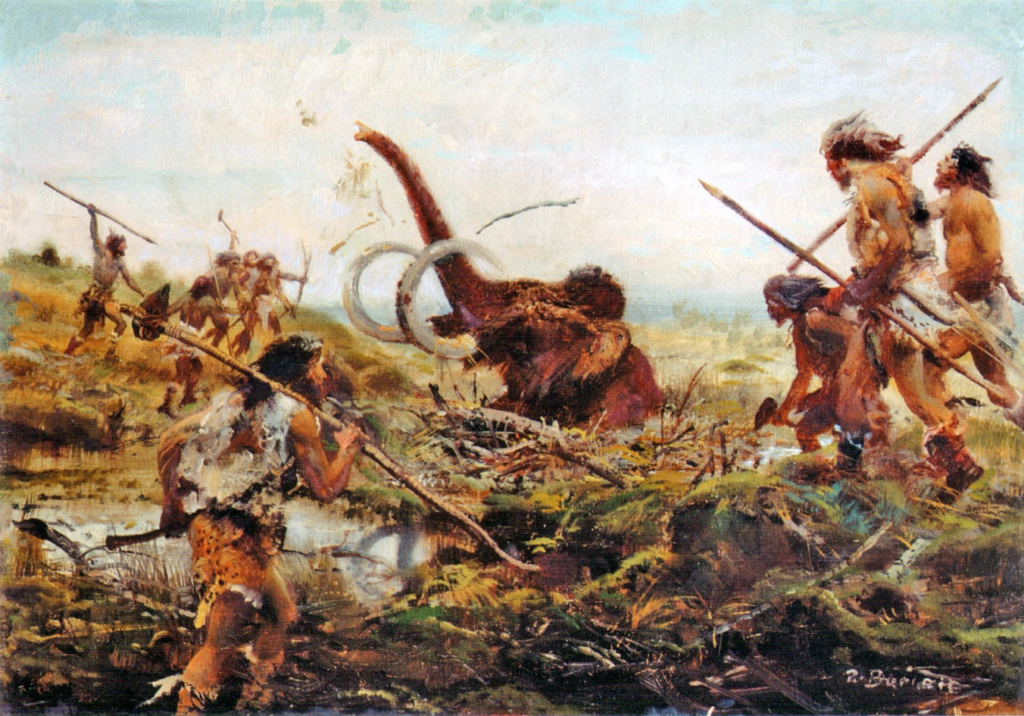
More or less 30,000 years ago would put Adam and Eve’s birth in the middle of an Early Modern Human tribe, perhaps Cro-Magnon. The daily lives of these people was both hard and dangerous. Their lifespan was about 30 years. Children must have been taught at an early age to help in the vital chores that their survival depended upon. The men went on hunting parties and probably brought boys as young as 10 to learn to hunt. The prey were very large and dangerous — animals such as mammoth, bear, elk, buffalo, wild ox, as well as reindeer. As they hunted, they also had to be on the lookout for lions, tigers, wolves, and other predatory animals that roamed the Middle East and Europe in that era, and who were their competition.
Back at camp, the girls must have been helping the women make clothes, cook, etc. By the time they reached puberty, boys and girls were most likely mating and starting new families. The very survival of the tribe depended upon a minimum number of families banded together to share the work and keep themselves fed, clothed and protected.
In this kind of environment, Adam and Eve were born and lived. By no means was it paradise on earth. If God and the angels were communicating with them since childhood, it very likely could have been in a way that conflicted with the lifestyle of the tribe. They must have been under great pressure to play their parts in the life of the tribe, but also comply with God’s wishes, and especially his commandment, “Don’t eat the fruit.”
With the wisdom and knowledge brought to us by the intense and hard work of paleoanthropologists, we can now speculate as to the real nature and risk of God’s efforts to create “man in his image” so that we could inherit the awesome responsibility of becoming the caretakers of the whole cosmos — both the physical and the spiritual worlds.
Only God knows the reasoning behind His decision to develop humankind in the way He did, placing us in a wild and dangerous environment, among predatory animals. It created in early humans a desire to become like them, craving meat, learning to kill, to thirst for blood, and become territorial and extremely aggressive. It might be that God knew that humans needed the special kind of nutrition in meat to stimulate thought and creativity in the brain, and for the changes He required in the human body to give us the dexterity necessary to make tools.
Another reason might be that God knew it would take enormous drive and aggressiveness for humankind to “subdue” the earth and have “dominion” over the creation. Early hominins gained those qualities and they were inherited by their descendants. God’s hope might have been that these animalistic, aggressive traits would have later been tempered by Adam and Eve coming into contact with God’s love as their spiritual senses opened.
It was a great gamble on God’s part, because if Adam and Eve were to fail, they would doom humankind to descending into a life where they were “half-human,” chained to the physical world and its material, predatory instincts, in a manner that made us more cruel than wild animals. That animal instinct is so strong in humankind that for thousands of years, right up to the present, autocratic leaders of nations have acted much like predatory animals, ready to pounce on another nation that it sees infringing on its territory; ready to go to war to protect its possessions; even feeling justified in conquering the territory of weaker nations and enslaving its people. It is relentless and never-ending.
Religion and science have the knowledge and stature to bring humankind to a realization that we belong not to just this earthly realm, but to both the physical and spiritual worlds. As astronomers and astrophysicists investigate black holes in the universe, they are already peering into the spiritual world but don’t quite recognize what they are looking at. Religion can help them understand and broadcast to the world that we are eternal beings.
Religious leaders have been focused perhaps too much on salvation and the afterlife and need the wisdom of science to remind them that God has given us the responsibility of loving and caring for each other while we’re on earth, as well as taking care of our planet.
We need a new, more realistic creation story to help us better understand ourselves, coupled with a realization that we are the bridge between two worlds and must re-envision our purpose while on earth, while looking forward to eternity in heaven.
This realization must be considered as or more important than economic growth, political partisanship, blind greed for material wealth, or the adherence to religious doctrines that promise rewards in heaven.
Just maybe, science and religion can guide us and our higher instincts to truly meet God, open our spiritual senses and become “fully human.” Then we can finally fulfill the dream of a world of peace and love for God, humankind and our planet.♦
Henry Christopher (UTS Class of 1980 and 2006) worked at the Washington Times as a graphic artist from 1982-2002. He spent two years in Seoul, Korea, as director of the GOP program for Western second generation teenagers of the Unification Church. Upon returning to the U.S., he became UTS Admissions Director in 2004, and opened a Community Relations office to create a working relationship with the residents in the hamlet of Barrytown and Town of Red Hook in New York. Presently, he is UTS Financial Aid Director and oversees the affairs of international students studying at UTS in the U.S.
Photo at top: Depiction of Homo Habilis tribe hunting big game animal.