Blog of Unification Theological Seminary

By Laurent Ladouce
A Unificationist heart cherishes reconciliation and abhors accusation.
If we connect with God’s heart, practice true love and attend our Heavenly Parent, we include others. Working to extinguish controversies, antagonism and accusation, we think and work together.
I honestly worry that this spirit of reconciliation may desert our Unification movement. I sadly see that some Unificationists have chosen their camp, loathing others’ opinions and promoting polarization.
We remember the work of CAUSA in the 1980s, where we had a clear enemy (Marxism-Leninism) and a cause. Many Unificationists still seek a crusade against a foe. This takes priority over building the ideal world. I proudly worked for CAUSA International, but I must say, “Times have changed.”
This essay sketches a Unificationist overview of accusation. But to place matters in a certain context, I also explain what happens when the demons of accusation haunt a rational society.
* * * * *
Today, accusation is raging everywhere, fueled by social media. If this culture of indignation becomes mainstream, it may block God’s Providence. Unificationists who love righteousness should offer convincing alternatives to accusation. We should promote a counterculture of I admit where we honestly look at our portion of responsibility, instead of accusing others.
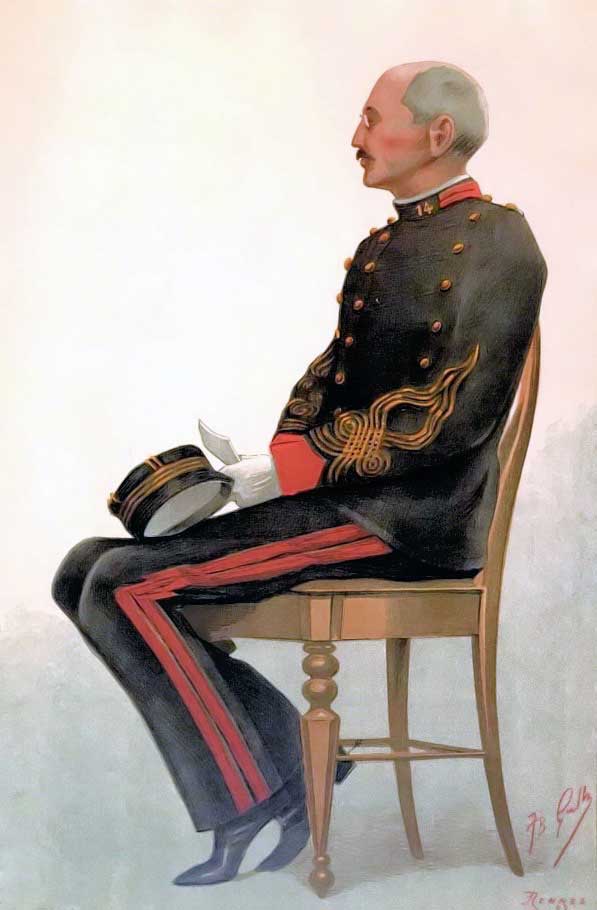
As an example, I discuss Alfred Dreyfus, the falsely accused (but eventually exonerated) French army officer, who became an icon of injustice, steadfastly maintained his innocence but who never accused anyone.
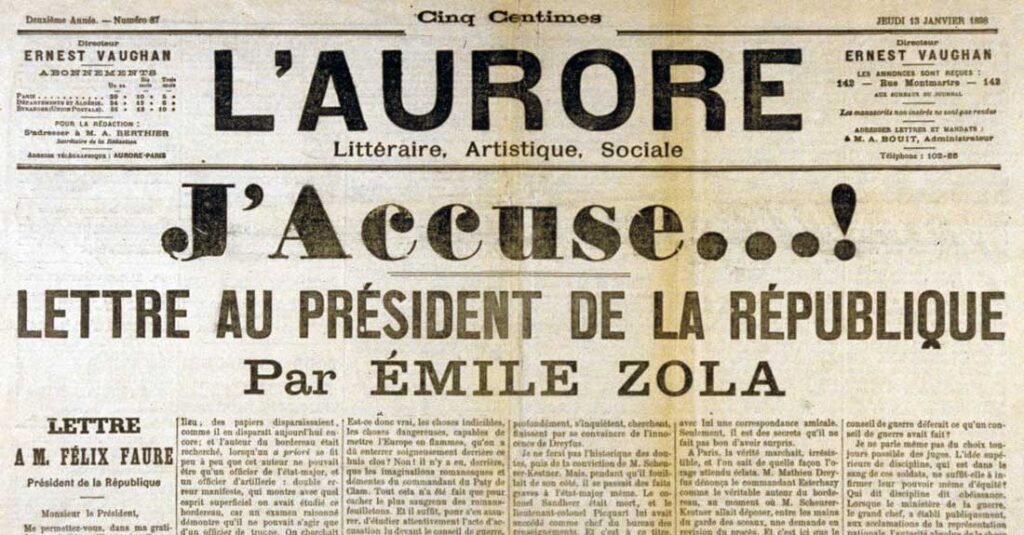
French journalist Émile Zola’s letter, I accuse…! , should be placed in the context of the Dreyfus Affair (1894-1906). In January 1898, L’Aurore (Dawn) published Zola’s open letter to the President of the French Republic. Zola accused several high-ranking officers of the French Army, and other officials, of falsely convicting Captain Alfred Dreyfus and of anti-Semitism, arguing that “the conviction of Alfred Dreyfus was based on false accusations of espionage and was a misrepresentation of justice.”
Zola appealed to international public opinion, using the mass media to defend an innocent man, in a charged atmosphere of nationalism, anti-Semitism and corruption. Zola had great courage. He was convicted of libel for publishing his letter and went into exile in London to avoid imprisonment and a large fine.
I admit versus I accuse
The 20th century was dominated by accusation and indignation. Totalitarian movements, in particular Marxism-Leninism, constantly leveled accusations. When the Cold War ended, the zeitgeist of perpetual accusation should have subsided. It did not.
Many circles still see accusation as the best weapon to defend a cause. Public indignation is thought to liberate us from vice. The legitimate #MeToo movement empowers millions of women worldwide; yet, it may also exacerbate the accusations of resentful feminists against men in general. Young Swedish climate activist Greta Thunberg sharply accuses global elites for their misdeeds against Planet Earth, and her youthful ardor in demonizing them often elicits sympathy. The tragic death of George Floyd only gave new impetus to cancel culture. Consequently, conservative circles also became radical in their accusations. Is this a good thing?
There also exists, worldwide, a movement which maintains, “I will accuse no more. I shall admit my responsibility to solve the problem. I may not cause iniquity directly, but acknowledge and profess my responsibility to build a better world.” Many men show genuine empathy for women. Scores of associations have showed, rather convincingly, that we can protect Mother Earth through constructive gradual steps without casting blame. Regarding racism, many voices plead that invoking cancel culture and emphasizing the notion of white privilege does not help. Prominent Black activists keep their distance from woke-ism and cancel culture. And indeed, Rev. Martin Luther King, Jr., and Nelson Mandela wanted to bring all races together. I have a dream sounds quite different from I accuse.
Dreyfus’ twelve year course
Alfred Dreyfus’ 12 years of ordeal consisted of three stages of roughly four years each:
- Degradation and deportation (1894-98)
- Pardon and bitter freedom (1899-1902)
- Dreyfus’ rehabilitation (1903-06)
Captain Alfred Dreyfus was born in Alsace, eastern France, in 1859. His Jewish family lived on Rue du Sauvage (Savage Street) in Mulhouse. This odd name is all the more striking when we know the awful conditions Dreyfus endured during his four-year internment on Devil’s Island (best known to many from the Papillon films), as he approached the age of 40.
In 1871, Germany annexed Alsace-Lorraine. Alfred Dreyfus was an ardent patriot. He spoke German fluently, but loved the French Republic and dreamed of the day when Alsace would be French again. After graduating from the prestigious École Polytechnique, Dreyfus began a brilliant career in the French Army. He married Lucie Hadamard from a wealthy Jewish family. The couple had two children and the Dreyfus family was happy and successful.
Degradation and deportation (1894-98)
In 1894, Dreyfus was charged with spying for Germany. The real traitor would later be identified as another military officer, Ferdinand Esterhazy, but Dreyfus had the profile to appear to be the traitor. The thin accusation which became central in the whole affair was based on a torn note (le bordereau) found by a French housekeeper spying for the French military in the German embassy in Paris. Initially, experts doubted the handwriting on the document belonged to Dreyfus. High-ranking officers then started to search for experts who were anti-Semitic in order to charge Dreyfus despite evidence to the contrary.
Moreover, anti-Semitic circles exploited leaks in the press to manipulate public opinion. Fearing for his position if the traitor was not quickly found and punished, the chief of staff of the French Army strongly insisted Dreyfus was guilty. After a short military trial, Dreyfus was sentenced to life imprisonment on the infamous Devil’s Island, off the coast of French Guiana.
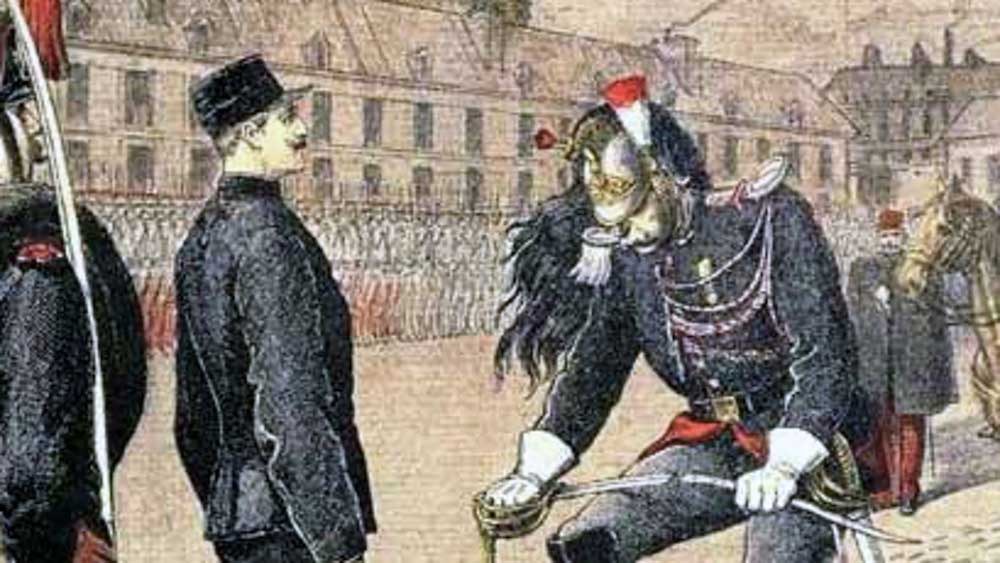
Still, the army hoped to obtain Dreyfus’s confession, but he kept pleading his innocence. He was thus punished even more strongly, during a ceremony of degradation held in early 1895. Before officers and 4,000 soldiers, and as the crowd shouted “Kill the Jews,” Dreyfus stood still, silent and dignified. He was stripped of all his symbols as a captain. The buttons of his jacket were pulled off, and finally a soldier took Dreyfus’s sword and broke it on his thigh. Dreyfus observed this humiliation with stoicism.
In minutes, Dreyfus lost his social dignity. Yet, he maintained impressive moral dignity. After being degraded, he shouted to other soldiers and the crowd his love for the army, for France, as well as proclaimed his innocence. He accused no one.
On Devil’s Island, he had to live in a stone hut, the only prisoner on the island.
His guards were forbidden to speak with him. Initially, Dreyfus could see the ocean through the bars of his window. A high fence was thus built around the hut. He was then completely isolated from the Creation, not only from human beings. Moreover, he often had to sleep on his back, his feet shackled with an iron bar. As he approached the age of 40, Captain Dreyfus was treated like a beast in the hut of a savage.
According to Divine Principle, human beings fell from grace because an angel degraded them and cast them below the level of Creation, i.e., below the level of the plant and animal kingdom. It took thousands of years before the human being could leave the status of slave of slaves and recover the dignity of a slave, and then the dignity of a servant on God’s side. Shortly after they left Egypt, the Israelites received the words of God through Moses.
Innocent of any crime, Dreyfus was accused of being the most evil man. His detractors said he had pretended to be a patriot and a soldier, but only to work against France; this was the essence of the accusation. Dreyfus was born to betray, they said. Radical accusation always states that the enemy is intrinsically evil and is unredeemable.
Starting his journey toward rehabilitation from the rock bottom of hell on Devil’s Island, Dreyfus walked the path to freedom with resilience. This virtuous character was nurtured by the love and loyalty of his wife Lucie, and of Mathieu Dreyfus, his “admirable brother.” According to Divine Principle, Satan began to accuse humankind after two crimes had been committed in the Garden of Eden, one involving a couple (Adam and Eve) and one involving two brothers (Cain and Abel). Unificationism states we shall subjugate our ultimate accuser only by restoring brotherly love and conjugal love. Dreyfus was protected in the Garden of Hell by a wife’s love and a brother’s love, empowering him to read and to write. Indeed, Dreyfus was often weak, sometimes depressed, but he kept reading and writing. He once wrote:
“My dear Lucie, I cannot describe what I endured. Do you remember when I was telling you how happy we were? Everything in life went our way. Then, suddenly, there was a thunderbolt, and my brain is still shaken. A man like me, accused for the most awful crime that a soldier can commit! Still today, I see myself as the puppet of a terrible nightmare. But I keep hope in God and in justice, truth will finally prevail one day.’”
Pardon and bitter freedom (1899-1902)
While Dreyfus was imprisoned on Devil’s Island, Zola unexpectedly published I accuse…!, in January 1898 in Paris. Zola took great risks. The French army could not deter Zola and Colonel Picquart from shouting their indignation. Picquart, the new chief of the French Army’s intelligence section, was originally anti-Semitic and believed Dreyfus was guilty. When Picquart discovered the real traitor was Major Ferdinand Esterhazy, he changed. Esterhazy had been notorious for his life of forgery, debauchery, gambling, and embezzlement. Having accumulated huge debt, Esterhazy sold French military secrets to Major Schwartzkoppen, the German military attaché in Paris.
Whereas investigations into Dreyfus’s family consistently showed he had no vice, Esterhazy had a long record of corruption and immorality. Yet, the army protected Esterhazy and kept charging Dreyfus. But this moral evidence finally turned around French public opinion. Georges Clemenceau was the publisher (who would later become prime minister of France) of L’ Aurore, who, shortly after Zola’s J’Acccuse…!, coined the term l’intellectuel (the intellectual) and wrote, “What stands in the way? Why is Esterhazy, a character of depravity and more than doubtful morals, protected while the accused is not?”
After four years of incarceration, Dreyfus was allowed to return to France. His case was retried by a military court in Rennes, western France, where scores of reporters traveled from afar. The Dreyfus Affair received worldwide attention. Britain’s Queen Victoria and other leading figures in Europe showed sympathy for Dreyfus; even his most adamant accusers felt inner compassion for him. Dreyfus was very sick, yet dignified, and still confident in justice.
On September 9, 1899, Dreyfus was again convicted (in a 5-2 decision) of treason, but “with extenuating circumstances” and sentenced to ten years’ imprisonment. The verdict of “treason with extenuating circumstances” was an invitation for conciliation. Dreyfus was told that if he applied for a pardon (nonetheless an admission of guilt), he would be freed immediately. Dreyfus knew well how his supporters would be frustrated if he asked for a pardon. But he also knew another incarceration would kill him. So he applied to be pardoned and was released from custody.
After experiencing external hell for four years, Dreyfus was no longer in prison, but he could not even serve his beloved country, and felt just “adopted” in his own family. He felt sometimes alienated from his wife, children and friends. He had become a stranger in his own home.
Zola died in 1902. In Unification parlance, this took place at the top of the growth stage in the chronology of the Dreyfus Affair. Over the next four years (1903-06), all charges against Dreyfus were gradually dropped. Internally, Dreyfus had endured all alienation with his resilient conscience. Externally, France was also changing; some demons of the past stopped being fed. The collective mindset was changing, with no need of mutual recrimination.
Dreyfus’s rehabilitation (1903-06)
The end of the accusation came about from thorough investigations, which revealed how many forgeries had been fabricated against Dreyfus. This work was conducted with a rational method, whereas the passions of the street and of the media were receding.
In 1906, Dreyfus was solemnly rehabilitated during a ceremony held in exactly the same place where he had been degraded. He was awarded the Legion of Honor and promoted to major in the French Army.
The end of accusation
What is the ultimate origin of accusation? How can a society blindly accuse an innocent man for 12 years? Why are some minorities accused and discriminated against, when they did nothing wrong? Why did Zola’s letter, I Accuse…!, become more famous than the Dreyfus Affair itself?
The mechanisms of accusation are complex. When God asked Adam, “Who told you that you were naked? Have you eaten from the tree that I commanded you not to eat from?”, Adam declines any personal responsibility. Instead, he blames Eve, in an impersonal and defiant way. “The woman you put here with me — she gave me some fruit from the tree, and I ate it.” Adam simply blames God for the creation of something strange (womanhood), as if he himself had done nothing wrong. Adam felt guilty and ashamed, yet he accused others.
When God asks Eve, “What is this you have done?”, she answers, “The serpent deceived me and I ate.”
There are obvious psychological mechanisms behind human accusation. The root of accusation, however, is fundamentally spiritual and metaphysical. The Principle says, “Satan is constantly accusing all people before God, as he did with Job, in order to drag them into hell” (The Fall, 4.2, pp. 68-69).
Rev. Moon’s early disciple, Young Whi Kim, once made this deep observation:
“Satan’s accusation unto God was that he did not receive the full love of God and the full love of men, the children of God. But by receiving the love of God and the love of Jesus, Satan had to surrender and lost the base for his accusation….” (Divine Principle Study Book, Part 1, p. 140)
Sketching a manifesto of I admit
It is challenging to write an I admit manifesto as powerful as Zola’s I accuse…! Yet, we should try. Most Unificationists dislike French philosopher Jacques Derrida, a father of deconstruction. But, he once wisely advocated for the need for a geopolitics of repentance:
In all the cases of repentance, confession, forgiveness which have been multiplying on the geopolitical scene ever since World War II, we see not only individuals but whole communities, professional corporations, representatives of the clergy, sovereigns and heads of State ask for forgiveness.”
Repenting for one’s mistakes is good, but the best is to admit our sincere desire to adopt a truly positive mindset, where we try to embrace the whole and transcend divided camps. I suggest that a desirable I admit should contain these three ideas:
- I admit that I want, in my deepest heart, to find joy through genuinely loving others. I train myself to love the unlovable, those who are different, who oppose me. My only motive is to increase freedom and joy for a better world. May everyone believe that I endeavor to run the extra mile.
- I admit that I can take more responsibility in public life. I profess that I can learn more, be better informed about issues, and cooperate with others. This training takes time and I shall always see myself as a beginner and seeker.
- I admit that I should follow my conscience, which tells me that no opinion is completely true or completely false. We all are trying to bring pieces together and to express our feelings, thoughts and visions in ways that should be assertive, and we need not become defensive or aggressive.
The Dreyfus Affair shattered French institutions while France was preparing the 1900 Paris Exposition. After their military victory over France in 1871, Germans would mock France as la Grande Nation (“The Great Nation”). France craved to be great again. Obsessed by its rivalry with Germany, la Grande Nation began to get an inferiority complex, and many French freely admitted that Germans had a better life. The desire to be great again is, of course, natural, but should exclude resentment. The Dreyfus Affair was a golden opportunity for many circles to show that the real danger for France was not Germany but a fifth column. Dreyfus became the enemy from within for 12 years.
In itself, “Make America Great Again” is an acceptable slogan, but surely, as has often been said since the 19th century, “America is great because she is good, and if America ever ceases to be good, she will cease to be great.”
The early stages of the Dreyfus Affair revealed that France was not a good nation. Theodor Herzl, the father of modern political Zionism, was horrified to hear that the mob shouted “Kill the Jews” when Dreyfus was degraded. He was devastated when Jewish shops were sacked and burned. Like many, he had believed the country of liberty, equality and fraternity to be a haven for Jews. He completely changed his view, and the first Zionist congress was held in Paris in 1897.
In 2020, a pandemic hit the world. The United States has paid a heavy price with 900,000 deaths to date because of what some officials mocked as the “Chinese virus.” But by the end of 2020, it appeared other viruses were at work. Each camp started to accuse the other of being the fifth column of foreign ideologies or practices that are un-American. No captain was degraded, but statues were removed. There were strong accusations, leading to cries of “Stop the Steal,” and this rage motivated several thousand to storm the U.S. Capitol a year ago.
I plead to my fellow American Unificationists to show how America can become good again. Dreyfus was innocent. Moreover, he was a good French citizen. Let good American citizens hear the Gospel of Unificationism. Let the crowds chant together the prophecy of the Book of Revelation (Rev. 12:10):
“Now have come… the Kingdom of our God, and the power of His Christ; for the accuser of our brethren is cast down, who accused them before our God day and night.”♦
Laurent Ladouce is a French Unificationist who was awarded an honorary doctorate by Unification Theological Seminary in 2017. A prolific author of Unificationist publications, he also published the book, Le Projet Pakxe: une contribution du Laos à l’unité de l’Asie du Sud‐Est et à la Paix Mondiale, describing the rising role of city diplomacy and proposing a plan to make Pakxe, Laos, an international city of peace. He also regularly conducts tribal messiah activity in West Africa.
Photo at top: French journalist Émile Zola’s published open letter, I Accuse…! (J’Accuse…!), was more than just a turning point in the Dreyfus Affair, but “one of the great commotions of history” according to historian Barbara Tuchman. It became a milestone in the role of the angry intellectual to denounce social problems.