Activist journalist sentenced for condescending, defamatory remarks against victim of more than 12 years of inhuman confinement in defamation case
Tokyo, 1st February 2025 – Published as an article in the Japanese newspaper Sekai Nippo. Republished with permission. Translated from Japanese. Original article.
Eito Suzuki’s Remarks Deemed Defamatory – Called Confined Follower a “Hikikomori” on Nippon TV’s Miyaneya
by the editorial department of Sekai Nippo
Prepared by Knut Holdhus
On 31st January, the Tokyo District Court ruled in a lawsuit in which Toru Goto (後藤徹), the representative of the National Association of Victims of Abduction, Confinement, and Forced Deconversion, sought ¥11 million in damages for defamation over statements by journalist Eito Suzuki (鈴木エイト) referring to Goto as a “hikikomori” (social recluse – see editor’s note below). Presiding Judge Yasuhiro Ichiba (一場康宏) ruled that some of Suzuki’s statements constituted defamation and ordered him to pay ¥110,000 [$ 711].
Goto, a follower of the Family Federation for World Peace and Unification (formerly the Unification Church), was confined in a Tokyo apartment for 12 years and 5 months (September 1995 – February 2008) by relatives seeking to force him to renounce his faith.
He had previously filed a civil lawsuit against the involved relatives, anti-cult activists, and a Christian pastor. In September 2015, Japan’s Supreme Court upheld his victory, dismissing an appeal from the pastor and others.
According to the ruling on 31st January, two out of five statements made by Suzuki were deemed defamatory. Specifically: An October 2015 article in the online media outlet Yaya Nikkan Cult Shimbun, where Suzuki described Goto’s experience as a “12-year-long hikikomori lifestyle”.
An 12th August 2022, appearance on Nippon TV’s Miyaneya, where Suzuki stated that Goto was in an “almost hikikomori state.”
The court determined these statements lowered Goto’s social reputation and emphasized that since Suzuki made these remarks after the 2015 Supreme Court ruling, he had no reasonable grounds to believe Goto was merely a social recluse.
However, the court dismissed three other defamation claims, including an August 2023 post by Suzuki on X (formerly Twitter) that said, “It doesn’t matter if antisocial groups play the victim.”
Following the ruling, Shinichi Tokunaga (徳永信一), Goto’s attorney, noted that three of Suzuki’s five statements were not recognized as defamatory. Tokunaga argued, “If we take a strict stance on human rights violations, the court should not have allowed these statements. Journalists and the judiciary must approach such issues with greater responsibility.”
Goto highlighted the widespread issue of forcible faith-breaking through abduction and confinement, stating, “Thousands of people have suffered, yet Japan has not fully recognized this issue. Through this ruling, I hope to raise awareness and prevent such incidents from happening again.”
Both Goto and Suzuki have expressed their intention to appeal the ruling.
[Editor’s note: The Japanese term “hikikomori” (引きこもり) refers to people who completely withdraw from social life, often isolating themselves at home for extended periods – sometimes years. It describes both the phenomenon and the individuals affected by it. Hikikomori typically avoid school, work, and social interactions, often due to anxiety, social pressure, or mental health struggles such as depression. The term is sometimes derogatory but is also recognized as a serious social issue in Japan and other countries.]
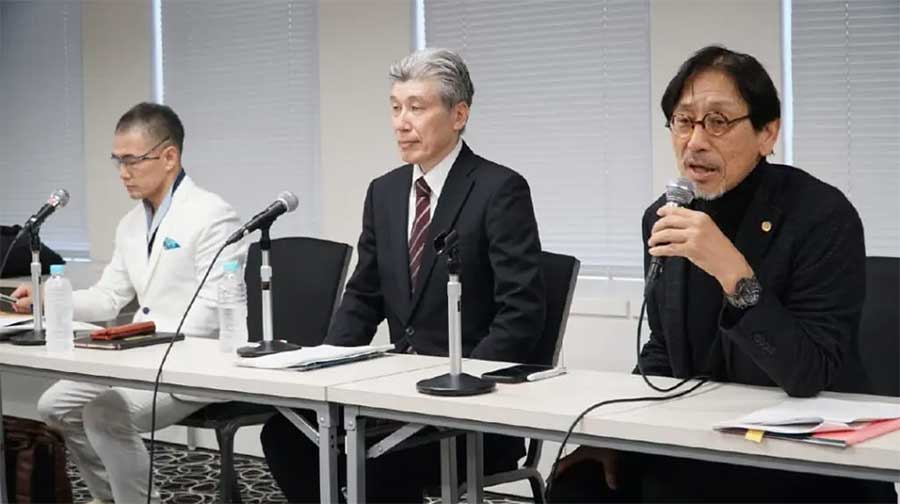
Featured image above: From a press conference on 31st January 2025, Chiyoda Ward, Tokyo, held after the verdict in the defamation case. From the right: Attorney Shinichi Tokunaga (徳永信一), Toru Goto (後藤徹), representative of the National Association of Victims of Abduction, Confinement, and Forced Religious Conversion, and Attorney Tatsuki Nakayama (中山達樹). Photo: Takahide Ishii (石井孝秀)