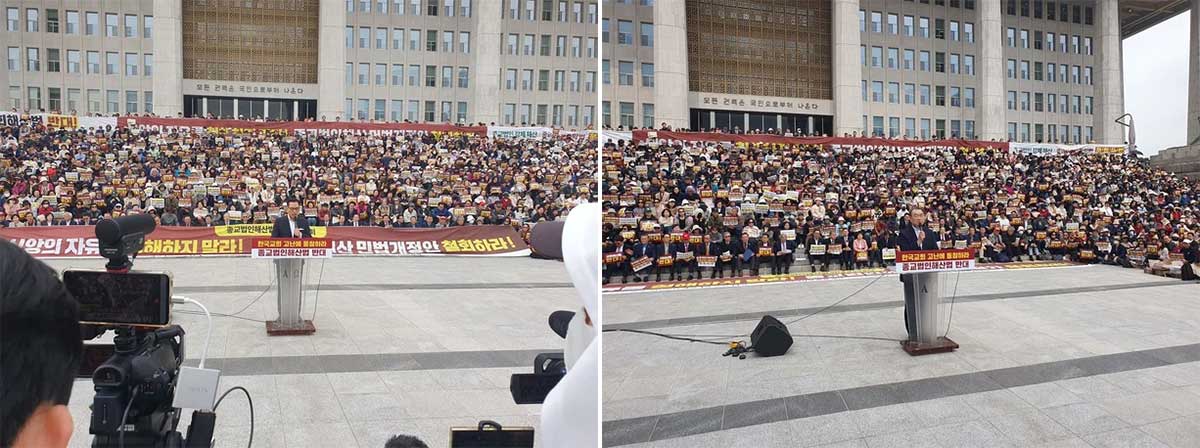
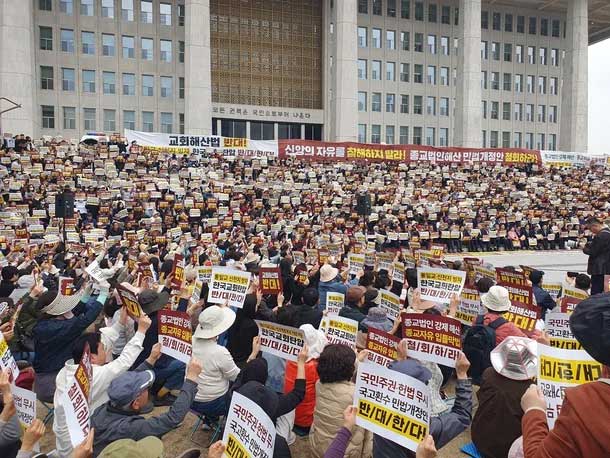
SEOUL — Over 7,000 Protestant clergy and believers gathered outside the National Assembly on April 1 to demand the immediate withdrawal of a controversial civil law amendment. The proposed bill, which grants the government authority to dissolve religious organizations and seize their assets, has sparked a firestorm over potential “religious freedom violations.”
A Broad Threat Under a Specific “Package”
While the bill has been framed by proponents as a measure to target specific groups like the Unification Church and Shincheonji, mainstream Protestant leaders at the rally rejected this narrative.
“It is packaged as a Unification Church and Shincheonji prevention law,” the rally’s closing statement declared. “In practice, it could apply to all religious organizations.”
Key Provisions Drawing Alarm
Critics of the amendment highlight several specific provisions they claim grant the state overreaching powers:
- Warrantless Investigations: Expanded oversight and inspection of religious bodies without traditional legal hurdles.
- Asset Seizure: Mandatory government seizure of all assets upon a group’s dissolution.
- Vague Criteria: Broad, undefined language regarding “political interference” that could be used as grounds for legal action.
Voices of Opposition
Religious leaders expressed deep concern that the bill represents a “slippery slope” toward state-controlled faith.
- Pastor Kim Un-seong (Youngnak Church): Warned that the law is a “dangerous starting point” that could eventually lead to broader societal surveillance.
- Pastor Lee Tae-hee: Drew a parallel to international precedents. “China started with institutional management and developed into a structure that restricts even doctrine and sermons. This law could become the starting line for that kind of control.”
- Pastor Son Hyun-bo: Framed the issue as a direct constitutional violation, noting that “the principle of separation of church and state means the state must not interfere in religion. This bill reverses that.”
Political and Inter-faith Support
The protest saw support from PPP lawmaker Cho Bae-suk, who attended the rally and affirmed that the bill “poses a significant risk of infringing on religious freedom and property rights.”
Organizers are now calling on the Catholic and Buddhist communities to join a united front against the legislation. Protests are expected to continue indefinitely until the bill is officially withdrawn, with critics maintaining that while the bill targets groups currently disliked by the government, its reach will not stop there.