Tokyo newspaper exposes the forces the Japanese media don’t mention in the Family Federation dissolution case even though they were instrumental in bringing about the outcome they have been campaigning systematically for during the last 50 years
Tokyo, 27th March 2026 – Published as an article in the Japanese newspaper Sekai Nippo. Republished with permission. Translated from Japanese. Original article.
The Organization Must Address the Issue of Coercive Faith-Breaking (Forced Renunciation of Faith)
Dissolution Order Against the Family Federation
by Yoichiro Miyata (宮田陽一郎), head of the editorial and commentary department of Sekai Nippo
prepared by Knut Holdhus
On 4th March, the Tokyo High Court issued a decision in the immediate appeal regarding the request for a dissolution order against the Family Federation for World Peace and Unification (formerly the Unification Church), upholding the dissolution order handed down by the Tokyo District Court in March of last year.
As a result, the Family Federation has lost its status as a religious corporation, and liquidation procedures have begun. Churches across the country have been placed under the control of a liquidator, and believers are currently unable to come and go.
Since the 2009 compliance declaration [See editor’s note 1 below], damage caused by donation-related issues within the Family Federation has decreased sharply. Nevertheless, the High Court piled inference upon inference and rejected the immediate appeal, stating that the “possibility” of unlawful acts could not be denied. It must be said that this is an unjust decision, far removed from the principle of adjudication based on evidence. It is only natural that the Family Federation has filed a special appeal with the Supreme Court.
Previously, the requirement under the Religious Corporations Act for issuing a dissolution order – “acts that clearly violate laws and significantly harm public welfare” – had been limited to criminal cases. However, following the July 2022 shooting of former Prime Minister Shinzo Abe (安倍晋三), and amid opposition parties’ pursuit of alleged “ties” to the Family Federation, the then-Kishida administration made a stopgap but significant reinterpretation, stating that “civil torts could also be included” in the requirements. Considering that this led to the High Court’s decision, it can be said that Japan’s “rule of law” is being seriously shaken.
Regarding the High Court decision, the Japanese Communist Party’s newspaper Shimbun Akahata featured the headline on its front page on 5th March: “Unification Church: High Court Also Orders Dissolution” and “Immediate Appeal Rejected; Liquidation Procedures to Begin”. The article also quoted Secretary-General Akira Koike (小池晃), who commented: “Thanks to the truly tremendous efforts of the victims and their legal team over many years, this represents major progress in the form of a dissolution order.”
The Family Federation, together with its affiliated organization the International Federation for Victory Over Communism (IFVOC), has strongly criticized communism, which denies the existence of God. For this reason, the Communist Party has historically regarded both groups as enemies.
In particular, the Communist Party openly displayed hostility after its supported candidate lost the Kyoto gubernatorial election in April 1978, bringing an end to 28 years of progressive prefectural administration. During that election campaign, the International Federation for Victory Over Communism (IFVOC) sharply criticized then-Communist Party Chairman Kenji Miyamoto (宮本顕治) over a prewar “lynching murder incident” [See editor’s note 2 below], contributing to the party’s defeat. Afterward, Miyamoto declared, “Leading the effort to eliminate the Federation for Victory Over Communism will be recorded in history as a ‘holy struggle’.”
Meanwhile, in relation to the Family Federation, there were numerous cases in which believers were abducted and confined by opposing groups and pressured to renounce their faith. Since 1966, more than 4,300 believers have reportedly been confined. Particularly between 1978 and 1986, there were successive cases in which believers were forcibly hospitalized in psychiatric institutions, some of which were affiliated with communist groups.
Additionally, when the Federation for Victory Over Communism promoted a movement in the 1980s to enact an anti-espionage law, left-wing groups including the Communist Party launched a “spiritual sales” campaign to block it. Lawyers with close ties to the Communist Party formed the National Network of Lawyers Against Spiritual Sales.
Relatives of believers, alarmed by media reports about “spiritual sales”, consulted with Christian pastors opposed to the Family Federation, which led to an increase in abductions and confinement cases. Toru Goto, who was confined for 12 years and 5 months, was one such individual, held in a condominium room by family members, pastors, and professional deprogrammers.
On the other hand, the National Network of Lawyers Against Spiritual Sales actively pursued the “destruction of the Family Federation”, including supporting lawsuits for damages filed by former believers who had renounced their faith. These legal battles have, in part, influenced the dissolution order.
Criticizing the Family Federation is a matter of freedom. However, forcing believers to renounce their faith tramples on the constitutionally guaranteed freedom of religion and is absolutely unacceptable. The Family Federation must communicate to the public that such issues lie behind the dissolution order.
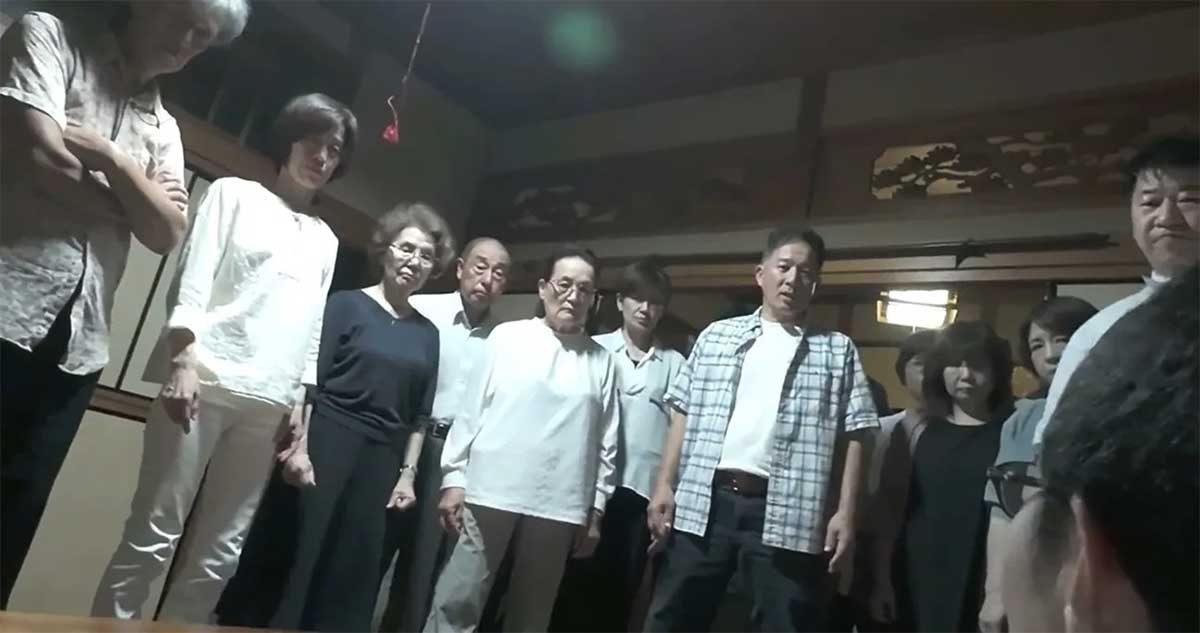
Featured image above: Scene from video with actors enacting a deprogramming (faith-breaking) [See editor’s note 3 below] story from real life in Japan. In this scene, a young man is being abducted by his family and relatives in league with and guided by professional faith-breakers to be brought to a secret location where he will be locked up and subjected to coercive faith-breaking (deprogramming) [See editor’s note 3 below]. More than 4,300 members of the Family Federation in Japan became victims of such inhuman violations of human rights, but the police and authorities turned a blind eye to it. Screenshot from video by the National Association of Victims of Abduction, Confinement, and Forced Conversion.
[Editor’s note 1: The 2009 compliance declaration of the Unification Church of Japan (now the Family Federation for World Peace and Unification) was a formal commitment by the organization to reform its practices in response to longstanding public criticism and legal challenges.
The Unification Church in Japan had faced numerous allegations related to recruitment tactics and donation solicitation, termed “spiritual sales” (霊感商法) by a hostile network of activist lawyers who had declared the religious organization an enemy. These issues led to multiple lawsuits orchestrated by the activist lawyers and significant media backlash. This prompted the organization to take measures to restore its reputation and demonstrate compliance with legal and ethical standards.
The religious organization pledged to stop possibly unethical donation practices, including what the hostile network of lawyers claimed amounted to “pressuring members into making large financial contributions under spiritual pretexts.”
This was in response to accusations from the same activist lawyers that followers “were being manipulated into giving away substantial amounts of money or property.”
The Unification Church stated it would enhance internal oversight to ensure compliance with ethical and legal standards. Measures included better training for leaders and stricter guidelines for evangelization and solicitation of donations.
After this compliance declaration, there was a significant decrease in the number of lawsuits against the Unification Church – since 2015 called the Family Federation. The religious organization has used this as evidence that it has improved its practices and should not be subject to dissolution.]
[Editor’s note 2: The “lynching murder case” (リンチ殺人事件) refers to what is commonly known in Japan as the Japanese Communist Party lynching incident.
In 1933, during Japan’s prewar period of intense political repression, members of the underground Japanese Communist Party abducted and interrogated a fellow party member they suspected of being a police informant. The victim, Takiji Kobayashi (note: the exact victim often cited is party member Yoshio Yamamoto or similar depending on sources), was beaten and tortured during internal questioning. He subsequently died from the abuse, making it effectively an internal “purge killing.”
The incident became a long-standing political liability for the Communist Party. Decades later, critics – especially anti-communist groups – used it to argue that the party had a history of violent internal discipline.
Kenji Miyamoto, who later became a prominent leader of the party, was accused of involvement in the incident as a young activist. Miyamoto denied direct responsibility, and the Communist Party has maintained that the accusations were exaggerated or politically motivated. However, anti-communist organizations have repeatedly highlighted the case as evidence against the party.]
[Editor’s note 3: Coercive faith-breaking (“deprogramming”) in Japan refers to the practice of coercively attempting to separate individuals from their religious affiliations or beliefs, typically through intervention by family members, professional faith-breakers (deprogrammers) or organizations hostile to new religious movements (NRMs). This phenomenon often targets members of such movements, e.g. relatively large faiths like the Family Federation or Jehovah’s Witnesses, but also smaller groups like Happy Science (Kōfuku no Kagaku) and other newer religious movements.
However, also Soka Gakkai, a Buddhist-based lay organization with more than 8 million Japanese members, and affiliated with Nichiren Buddhism, has occasionally been subject to faith-breaking attempts.
The practice gained attention in the latter half of the 20th century, particularly in the 1980s and 1990s. Parents or concerned family members often hired faith-breakers who taught them how to abduct and forcibly detain believers. Almost all such cases involved confining the individual believer and cutting him or her off from the religious community. During the confinement, the believer was subjected to intense questioning or indoctrination designed to break his or her faith. The aim was to “rescue” the person from what the family often had been tricked by faith-breakers or lawyers to regard as harmful influence from the religious organization.
Critics of forced de-conversion argue that it violates fundamental human rights, including freedom of thought, religion, and association. Reports of psychological trauma and accusations of unlawful detention have sparked debates over its ethical and legal implications. In response, some religious groups, particularly NRMs, have lobbied for greater protections against such practices.
Japanese courts have been inconsistent in addressing cases of coercive faith-breaking. While some verdicts have condemned the practice as illegal detention, others have been more lenient, citing family concerns about “mental health” or alleged “exploitation” as mitigating factors.]