The dissolution order preserves private faith and freedom to believe while undermining the communal and public dimensions of religious freedom
Tokyo, 21st June 2026 – Published as an article in the Japanese newspaper Sekai Nippo. Republished with permission. Translated from Japanese. Original article.
[Editorial]
Japanese-Style Religious Persecution
by the editorial department of Sekai Nippo
Persecution refers to the act of suppressing or excluding people through the use of power. Religious persecution is perhaps its most typical form. Not only church facilities but also the lives and property of believers may be violated by the state. In prewar Japan as well, persecution occurred under the Peace Preservation Law. In the case of the Ōmoto movement [See editor’s note below], facilities were destroyed and many senior believers were imprisoned.
Although there has been no such overt repression since the war, it should be understood that its essential nature has not changed. The Ministry of Education, Culture, Sports, Science and Technology (MEXT) has repeatedly emphasized that under the Religious Corporations Act, freedom of religion would continue to be guaranteed for the Family Federation for World Peace and Unification (formerly the Unification Church) even after its dissolution. However, the falsehood of that claim is obvious.
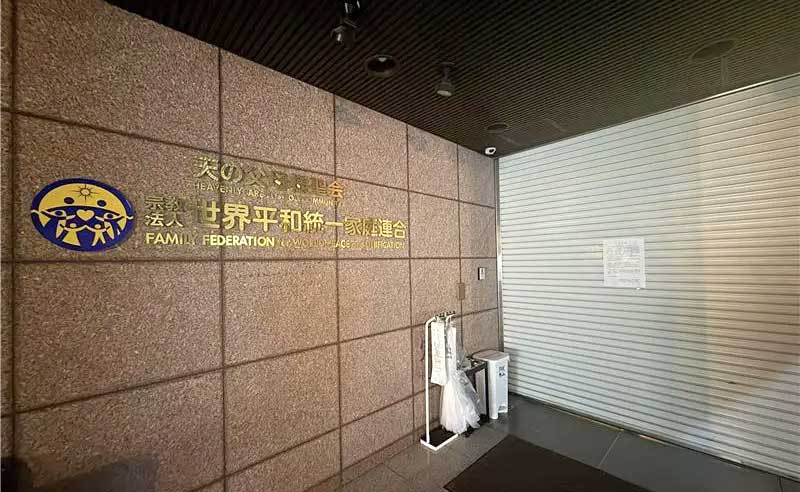
Freedom of religion includes not only inward belief but also gatherings and social activities. Since the dissolution decision, Family Federation facilities have not been permitted for use, and in many cases even the use of public facilities has become difficult.
Believers have complained that “our places of worship have been taken away, and we no longer have places for prayer or community.” Others report that “the change in circumstances has made me lose my appetite” and that they “cannot sleep.”
Yet the reality that freedom of religion is being seriously infringed is scarcely reported at all. There is probably an underlying sentiment that, because the religious organization was subjected to a dissolution order, this is simply the punishment it deserves.
In the Japanese view of religion, emphasis is placed on inward faith, while the social and political activities of religious organizations are subjected to strict scrutiny. This is because such activities are seen as challenges to the established order and, ultimately, to the system itself. As it is said, “Render unto Caesar the things that are Caesar’s, and unto God the things that are God’s” (Gospel of Matthew). Perhaps the application of the existing “rule of law” should itself be called into question.
[Editor’s note: The Ōmoto (Oomoto) religious movement – Omotokyo (大本教). It is a Japanese new religious movement that originated in the late 19th and early 20th centuries. It was founded by Nao Deguchi (1836–1918), a peasant woman who claimed to have received divine revelations, and her successor Onisaburo Deguchi (1871–1948), who played a significant role in shaping the religion’s teachings and structure.
Omotokyo emphasizes universal salvation, spiritual purification, and the ultimate unity of all religions. The religion stresses the importance of living in harmony with divine will and nature.
The Ōmoto Incident (大本事件 Ōmoto jiken) refers to two major crackdowns by the prewar Japanese government against Omotokyo. There were two incidents. The first Ōmoto Incident (1921) was triggered by government suspicion that Ōmoto teachings were socially disruptive. Authorities raided Ōmoto facilities, arrested leaders, and charged them with lèse-majesté (insulting the emperor) for certain religious texts. This was part of a broader pattern of suppressing new religions seen as politically or ideologically threatening.
The second Ōmoto Incident (1935) was far more severe and is usually what people mean by “the Ōmoto Incident”. The military and police launched a large-scale crackdown. Temples and buildings were destroyed (including with explosives). Leaders and many followers were arrested. The state accused the group of subversion, criticizing the emperor system, and spreading dangerous ideas. Essentially, it was an attempt to eliminate Ōmoto as a movement.
It is considered one of the most extreme examples of state suppression of religion in prewar Japan. It’s often referenced today in discussions about religious freedom, state control, and the role of new religious movements in Japan.
Today, Omotokyo remains a small but active religious group in Japan. It has also inspired the foundation of Aikido, the martial art developed by Morihei Ueshiba, who was a follower of Omotokyo.
Omotokyo holds a significant place in the history of Japanese religion, not only as a spiritual movement but also as a symbol of resistance to religious persecution during Japan’s militaristic period.]