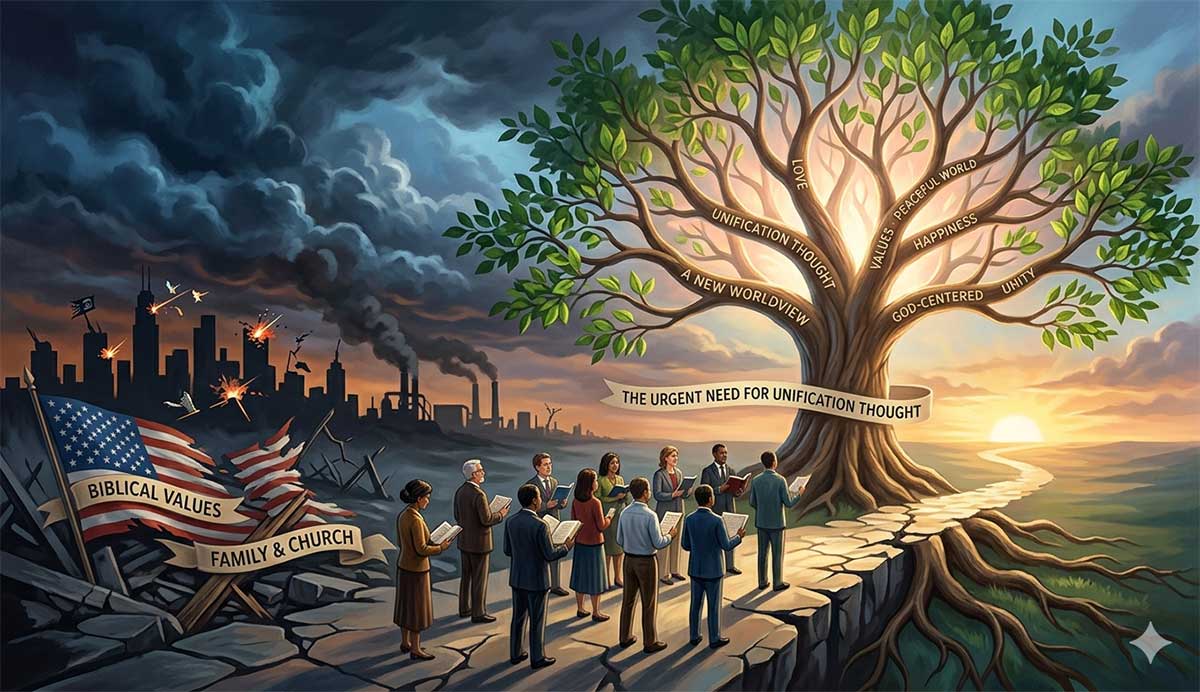
Why Unification Thought is More Urgently Needed for Thought and Life than Ever
By Dr. David Carlson
“I wish to emphasize the urgent need for the worldview of Unification Thought. While much of this chapter is philosophical, this vision is meant to be lived to create a peaceful world. We do not live in a neutral environment; we are in the midst of an intense ‘culture war’ and face tangible global threats. In this climate, Unification Thought is more than a philosophy—it is a necessity. I appeal to leaders, scholars, and people of goodwill across all sectors to study this vision. I believe it alone holds the potential to resolve our current conflicts, clarify essential values, and realize the world of peace for which we have all longed.”
Part 1
1. Introduction
Bringing this chapter to the light of day was not an easy matter. This is not because it was academically difficult, but because there were a number of spiritual struggles involved. I struggled a lot with whether or not I should pen these contents. I have, of late, become a student of culture, and I find cultural studies fascinating. Having reflected upon our modern culture, there was something I wanted to express, but the contents may be rather controversial for some people. Especially, some of my fellow Unificationists and Unificationist friends may feel somewhat uncomfortable, and may not even agree with what I say. A few years ago, at the Unification Thought Symposium, in Tokyo, Japan, a colleague raised some questions about my presentation at that time, which had some similar content, but the more I research and reflect, the more strongly I feel that there are important events happening in our world, events concerning which we must pay very close attention, since we ignore them at our own peril. Thus, I offer this chapter with some conviction, since I feel that what is expressed here is accurate and important, and I sincerely invite you, the reader, to convince me that I am wrong.
The point of this chapter draws upon the sentiment, as Karl Marx famously stated: “The philosophers have only interpreted the world in various ways: the point however is to change it.”[1] It is the “change” part of this statement that is the most worrisome. I think we need to take Marx’s statement very seriously. Marx (along with Lenin) was the founder of the Communist movement, and history is a testimony to the enormous impact which Marxism-Leninism had upon the world. Now, in 2018, it is imperative that we correctly understand what kinds of changes are taking place, and, more importantly, the impetus behind these changes, if we are to be successful in our quest of establishing, or bringing about, an “ideal world.” At the Unification Thought Symposia, scholars present papers, often of a very philosophical nature, and we discuss them to some extent, and then we return to our home countries, and continue our academic careers. I often wonder: do we genuinely understand that Unification Thought is not just an “insightful” philosophy, but that it has an urgent message, and that message is this: we must solve the various problems in our societies as soon as possible if we truly want to realize an ideal world for our posterity. It does not say that we should merely think about, or even just discuss, these problems, but that we must solve these problems. The problems which we face today are unprecedented, in both their severity and their ubiquity. If it were just a matter of solving a few problems “in our spare time” in a “value-neutral world,” making a better world might not be such an urgent demand, but the fact is, we do not live in a value-neutral world. We live in a world in which forces totally inimical to what we are seeking are actively and strategically working against us.
2. Background
To understand more correctly what I intend to say, it will help to consider the historical background and context, specifically the Divine Principle explanation of the providential time of the preparation for the Second Advent of the Messiah. In this section of the Divine Principle, there is an explanation concerning the philosophical developments over the past 400 years, and up to 1918.[2] In the Period of Religious and Ideological Conflicts (1648-1789), various philosophical perspectives were developed, including two schools of modern philosophy, empiricism and rationalism. I mentioned these schools in the early part of this book. Some of these philosophical perspectives eventually “gave birth to a view of life” which played a significant role in drawing peoples’ attention away from God, and more towards the supremacy of human reason. This view of life is thus called the “Cain-type” view of life, because it drew people away from God. This was a very serious development. Deism (founder: Edward Herbert), as well as G.W.F. Hegel, D. F. Strauss, and Ludwig Feuerbach, all played a role in the development of this perspective, which culminated in the thought of Karl Marx and Friedrich Engels, that is to say, “Marxism,” which was to become “the cornerstone of the communist world of today.”[3]
On the other hand, of course, the Abel-type view of life developed and culminated in the Democratic world.[4] Thus, we arrived at the “two worlds” of our modern era. In the Divine Principle view, in Adam’s family, Abel had to subjugate Cain in order to establish the Foundation for the Messiah and, on that foundation, receive the Messiah who comes on behalf of God to restore the world. The ideal, God-centered family has an important role to play in the establishment of that ideal world. Expanding this scenario up to the global level of today, Abel (Democracy) must “subjugate” (win over) Cain (Communism), in order to establish the global Foundation for the Messiah. For that to happen, that is to say, for those two worlds to come into being, two views of life (Abel-type and Cain-type) which would materialize into these two worlds, needed to come into being. This historical emergence of two quite different views of life occurred during the period from 1648-1789. This, in brief, shows us the importance of the last four-hundred years of human history. This is the assumed background of the Unification Thought view of history. What is most important for us to understand, however, is not just to understand how we arrived at this point in history, but to understand what we are responsible to do from this time forth. This is where the worldview of Unification Thought comes into importance.
The democratic world has continued to develop during the past four-hundred years, bringing forth cultures and societies which have opened the way to achieve incredible and unprecedented freedom and prosperity for many people. Individuals who have strongly believed in God have guided and managed good societies. Among the many individuals who might be mentioned, let me refer to the Puritans, and to the father of America, George Washington. Here is what Rev. Moon has stated with regard to such people:
The story of the American Pilgrim Fathers is one of a kind in God’s history. It fits into the pattern of the righteous people of history, such as Abraham, Isaac, and Moses I am sure that the faith of the Pilgrim Fathers touched the heart of God. They never lost their faith in God and their vision of the future God intervened to save His people here in America. This is my belief.
George Washington tasted the bitterness of defeat in many, many battles. When he finally faced the last heart-breaking winter at Valley Forge, he was serious. I am sure George Washington prayed God. You liberated us and gave us freedom Let me give you my pledge. I will build one nation under God the victory won was a victory for God.[5]
There are numerous individuals whom one might mention with regard to the growth and development of the democratic world (the Abel-type world), and the various ways in which God has blessed it. But my purpose in this chapter is to examine the development and fruits of that other world, the Cain-type, or communist, world. We need to become much more aware of its nature and development, especially as to the way/s in which it manifests in our modern times. We might then better understand what situation we are in. We live in, and enjoy the blessings of, the democratic world, but there are many “Cain-type” forces which oppose us. It is this Cain-type world which we of the democratic world must “subjugate” or overcome if we are to see the realization of a better world in the future.
To Be Continued ….
[1] CAUSA Institute, CAUSA Lecture Manual, New York: CAUSA International, 1985, 79. “Marx summed up his view of philosophy as practice when he wrote, as one of his theses on Feuerbach,” this well-known statement
[2] HSA-UWC, Exposition of the Divine Principle, New York: HSA-UWC, 1996, 347-361.
[3] HSA-UWC, Exposition, 355
[4] HSA-UWC, Exposition, 347-361
[5] Sun Myung Moon, Christianity in Crisis: New Hope, 53-7
———————–
- Dr. David Carlson is an educator and author with over 30 years of experience teaching world religions, philosophy, and family values. He holds a Ph.D. from Claremont Graduate University and spent more than a decade in South Korea as a professor of Korean history and culture. Until his retirement in 2014, Dr. Carlson served on the faculty of the Cheongshim Graduate School of Theology. His published works include Sunrise on Christology and The Dawning of a New Culture, as well as serving as co-editor of Explorations in Unificationism. Having held both academic and pastoral positions throughout his career, he currently resides in Indianapolis, Indiana.