Abe, Beloved by Many; Church Dissolution “Tests the Rule of Law” — Eitaro Ogawa Speaks in Sendai
Special Lecture “slicing Through Current Affairs” Held in Sendai: Literary Critic Eitaro Ogawa Speaks on Post-Abe Politics and Unification Church Dissolution (Original Article)
by Yasuhiko Nagano (長野 康彦)
On the 1st, a special lecture titled “Slicing Through Current Affairs” featuring literary critic and chairman of the Japan Institute for Peace Studies, Eitaro Ogawa, was held in Sendai City. Looking back on the four-plus years since the assassination of former Prime Minister Shinzo Abe, Mr. Ogawa discussed the current political landscape and issues surrounding the dissolution of the Family Federation for World Peace and Unification (commonly known as the Family Federation or former Unification Church).
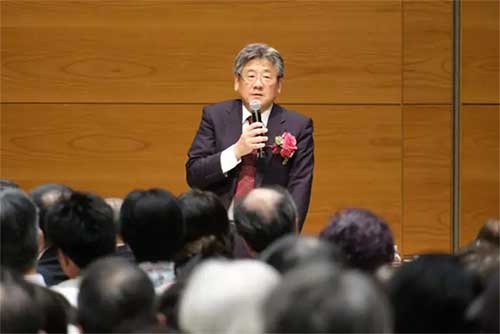
Opening his speech, Mr. Ogawa shared his deep affection for the late prime minister, candidly stating, “Even now, I still dream of Mr. Abe from time to time.” More than four years after the tragedy, Abe’s presence remains as significant as ever within him.
“The Diet Should Investigate the Truth Behind the Assassination”
Mr. Ogawa shared a conversation he had with Mrs. Akie Abe when offering his condolences. Regarding her comment, “My husband died in battle, didn’t he?” Mr. Ogawa remarked that he sees this as “an expression symbolizing the life of a politician who devoted himself to restoring Japan.”
Addressing the assassination itself, he noted that “there are many inexplicable points” and argued that “investigating the truth is a duty that the National Diet should take responsibility for addressing.”
Reflecting on politics after the Abe administration, Mr. Ogawa commended former Prime Minister Fumio Kishida for maintaining the “Abe line” on financial policy, while noting that “the movement to remove Kishida from power was heavily influenced by the Ministry of Finance.” As for former Prime Minister Shigeru Ishiba, Mr. Ogawa recalled that he himself “stood at the forefront of the movement to remove Ishiba,” offering a harsh assessment of Ishiba as “a figure who practiced politics fueled solely by anti-Abe sentiment.”
Conversely, he expressed strong expectations for Prime Minister Sanae Takaichi. He pointed out that her efforts regarding the Imperial House Law revision represent “a major achievement, which is precisely why she faces fierce criticism.” Stating that “the administration’s senior leadership is doing a truly fine job,” he expressed his view that conservative politics is entering a new stage.
Mr. Ogawa also shared personal anecdotes about Abe’s character: “Even those who were anti-Abe would flip entirely after speaking with him just once, saying, ‘I had no idea he was such a wonderful person.'” Reflecting on Abe’s personal charm that drew so many people to him, Mr. Ogawa spoke with deep emotion: “He put his life on the line to rebuild Japan. From that standpoint, seeing the Diet and political parties normalize brings a sense of relief.”
Regarding the passage of the Imperial House Law Revision Bill in the House of Councillors plenary session last month, Mr. Ogawa pointed out that despite an overwhelming majority in favor, major media outlets—including the Yomiuri Shimbun and Nihon Keizai Shimbun—united in opposing it. “Democratically expressed public will has normalized politics, which ironically exposed this underlying issue. It became clear that there are forces within the mass media trying to manipulate public opinion, even if it means recklessly ignoring the will of the people,” he stated, emphasizing that “this marks the start of the next battle.”
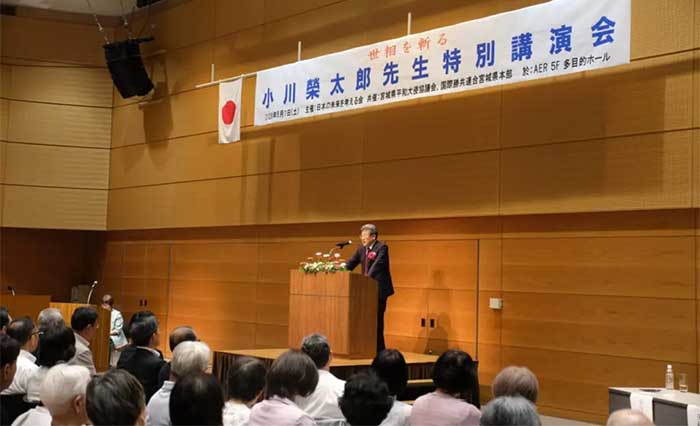
“Church Dissolution Driven by Conformist Pressure”
In the second half of the lecture, Mr. Ogawa devoted considerable time to the series of issues surrounding the Family Federation.
He framed the requests for the dissolution order and the judicial decisions regarding the group not as “merely an issue involving a single religious corporation, but as a test of Japan’s standing as a nation ruled by law.” Referencing his own experience submitting expert opinions on the matter, he remarked, “At first, I intended to keep my distance and observe from the outside. However, the more I researched, the more astonished I became.”
He expressed grave concern over the proceedings taking place in closed courtrooms without sufficient hearing, as well as the actions taken against church facilities. “Mobilizing the police for what felt like a full raid—was such an exercise of power truly justified?” he asked. He further stated that “it is extremely unusual for a modern state’s judiciary to pry into the content of religious doctrine,” calling for a reexamination of constitutional guarantees regarding freedom of religion.
Beyond the judiciary and executive branches, he criticized the stance of the mass media, describing contemporary Japanese society as being in a “boiling frog” state, where peer pressure makes it difficult to voice dissenting views. Citing media coverage surrounding the Hyogo Prefectural administration as another example, he analyzed: “Rather than a grand conspiracy, the issue lies in the elite strata of society failing to fulfill their responsibilities. The courts and the Ministry of Education, Culture, Sports, Science and Technology have become corrupt, and this dissolution order exemplifies that.” He warned, “When the branches of power in a state that should adhere to the separation of powers all lean in the same direction, it is an extremely dangerous sign.”
“The issue of the Family Federation is not limited to religious organizations alone. It must be posed to society as a fundamental question regarding Japan’s Constitution, freedom of religion, and human rights,” he said, expressing his intention to deepen constitutional discussions among experts moving forward.
Concluding his speech, Mr. Ogawa remarked, “Something has been cultivated over these past four years, and starting this July, it has begun to bloom.” He added, “Today, August 1st, marks a new beginning together with all of you,” prompting loud applause across the hall.
The lecture was organized by the Association for Thinking About the Future of Japan (headed by Tetsuo Ando) and co-hosted by the Miyagi Peace Ambassador Council and the Miyagi Headquarters of the International Federation for Victory Over Communism. Approximately 450 attendees gathered at the venue.