U.S. investigating religious freedom in South Korea and Japan
Religious freedom in Japan and South Korea under U.S. scrutiny following arrests of Korean faith leaders and attempt by current left-leaning administration to pass new anti-religious law
Tokyo, 15th July 2026 – Published as an article in the Japanese newspaper Sekai Nippo. Republished with permission. Translated from Japanese. Original article.
Religious Leaders Face Arrests as U.S. Officials Investigate
Religious Freedom Under Pressure in Japan and South Korea
by editorial staff of the Sekai Nippo [See editor’s note below}
Japan and South Korea are both prosperous, successful democracies and key allies of the United States. However, concerns have recently been raised as both countries have shown increasing signs of restricting religious freedom.
In June, Japan’s Supreme Court dismissed a special appeal filed by the Family Federation for World Peace and Unification (formerly the Unification Church) against the government’s March 2025 dissolution order. As a result, the dissolution of the religious organization has become final.
A similar trend is unfolding in South Korea. The Lee Jae-myung (이재명) administration has placed several Christian church leaders under investigation on various charges, and the National Assembly is currently deliberating legislation that would grant the government the authority to dissolve churches.
On 24th June, Lee Man-hee (이만희 – 95), founder of the conservative Christian church Shincheonji Church of Jesus, the Temple of the Tabernacle of the Testimony (Shincheonji), was arrested on suspicion of coercing church members to engage in political activities.
At the end of last year, Pastor Son Hyun-bo (손현보) of Busan Segyero Church (세계로교회) was imprisoned for several months for violating the Public Official Election Act after leading demonstrations opposing President Lee Jae-myung (이재명).
In addition, Hak Ja Han ((한학자 – 83), president of the Family Federation, has been detained since September of last year on bribery charges related to allegedly giving luxury handbags and other gifts to former First Lady Kim Keon-hee (김건희). Han denies the allegations but is currently hospitalized due to heart disease, glaucoma, and injuries sustained in a fall. She may be returned to custody once she recovers.
On 10th July, prosecutors requested a sentence of 13 years‘ imprisonment for Han.
These cases have intensified debate over where the boundary should be drawn between religion and politics.
In South Korea, independent lawmaker Choi Hyuk-jin (최혁진) introduced a bill on 9th January of this year to partially amend the Civil Code. South Korean media have dubbed it the “Church Dissolution Act” because of its contents.
The backdrop to the legislation is the declaration of martial law by then-President Yoon Suk-yeol (윤석열) in December 2024, which led to the collapse of his administration. Since the Lee administration took office, a series of investigations has targeted individuals connected to the former Yoon government.
If enacted, the bill would give the South Korean government the authority to dissolve religious organizations, seize their assets, and regulate their religious activities.
Those opposing the bill are seeking support both domestically and internationally.
The conservative opposition People Power Party told The Washington Times, “Freedom of religion is a fundamental right guaranteed by the Constitution, and we will do everything in our power to prevent the enactment of the ‘Church Dissolution Act.’”
The party’s leader, Jang Dong-hyeok (장동혁), also told the foreign press corps, “Like other democratic nations, South Korea recognizes every citizen’s freedom of religion. However, under the Lee Jae-myung (이재명) administration, this important value has been seriously undermined.”
Earlier this month, U.S. Assistant Secretary of State for Democracy, Human Rights and Labor Riley Barnes, acting Deputy Assistant Secretary of State for DRL Julie Turner, White House Faith Office liaison Belsis Romero, and embassy officials visited Busan Segyero Church (세계로교회) and met with Pastor Son.
The findings of their investigation are expected to be included in a report scheduled for publication later this year.
Chance Son (찬스 손), the pastor’s son, explained that “the momentum behind the bill has temporarily stalled,” but that it remains under review by the National Assembly’s Legislation and Judiciary Committee. He added, “If the bill begins moving forward again, we will respond swiftly in accordance with biblical teachings.” (Seoul / Special Correspondent for The Washington Times)
[Editor’s note: The Sekai Nippo article is an abridged and lightly edited Japanese adaptation of a report by Andrew Salmon published in The Washington Times 10th July titled “America’s leading Asian allies pummel freedom of religion”.]
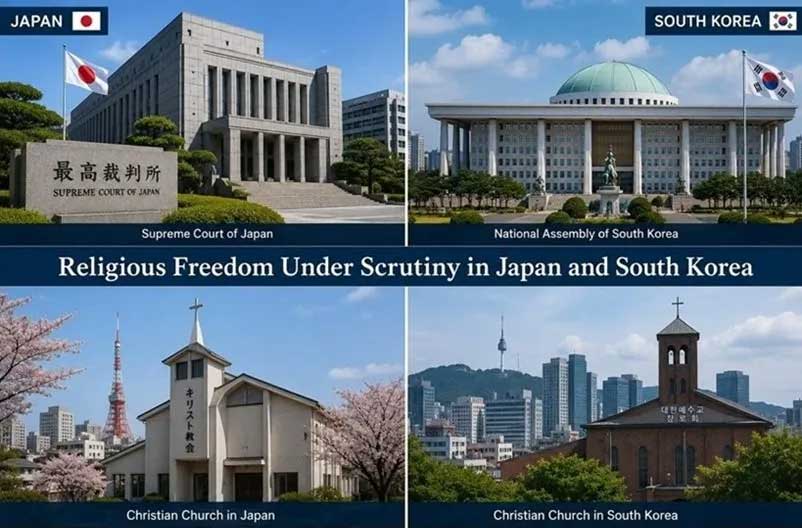
Featured image above: Japan’s Supreme Court and South Korea’s National Assembly making decisions affecting freedom of religion. Illustration: ChatGPT, 15th July 2026.