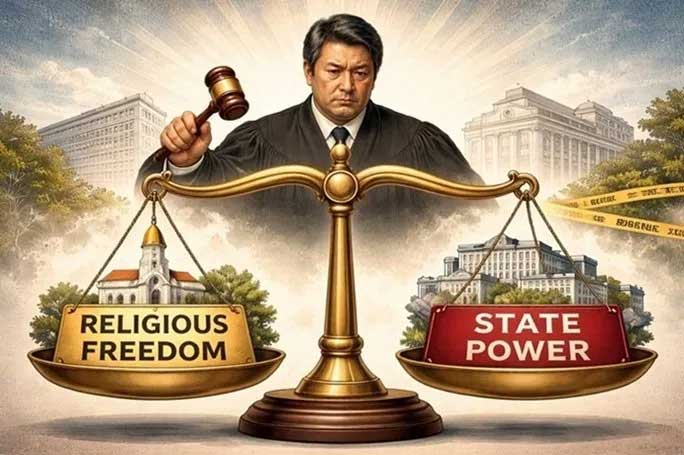
Tokyo High Court ruling 4th March: Dangerous Japanese democratic experiment to let civil liability be sufficient ground to dissolve large minority faith by court order
[Religion column]
Japan’s Rule of Law Put to the Test by Court-Ordered Dissolution of Religious Corporation
“Japan’s Rule of Law Put to the Test by Court-Ordered Dissolution of Religious Corporation” was the headline of an opinion piece by religious affairs reporter Jeong Seong-su (정성수) in the South Korean daily Segye Ilbo on 4th March. The writer describes a major legal decision in Japan the same day that has reignited debate about religious freedom, state power, and the meaning of the rule of law in a democratic society.
Prepared by Knut Holdhus
The Tokyo High Court upheld a lower court ruling ordering the dissolution of the Family Federation for World Peace and Unification – better known for some as the former Unification Church. With that decision, the organization moved one step closer to losing its legal status as a religious corporation in Japan, a process that would ultimately lead to the liquidation of its assets and the effective termination of its institutional existence.
This ruling is extraordinary. In modern Japan, the dissolution of a religious corporation by court order is extremely rare. Globally, it is also unusual for a democratic state to take steps that effectively extinguish a large religious organization through judicial action. For these reasons, the case has drawn intense scrutiny from legal scholars, human rights advocates, and observers of religion-state relations both within Japan and abroad.
At the center of the controversy is a fundamental legal question: On what grounds can a state dissolve a religious organization? In this case, the government’s request for dissolution was not based on a criminal conviction against the organization itself. Instead, it relied on findings of civil liability – specifically, unlawful acts under civil law related to the group’s activities, such as controversial fundraising practices. Critics argue that dissolving a religious corporation without a definitive criminal judgment sets a troubling precedent.
Under constitutional democracies, freedom of religion is considered a core civil liberty. In Japan, as in many other countries, this freedom is explicitly protected by the constitution. Dissolving a religious corporation does not formally ban belief, but it strips the organization of its legal personality. That means it can no longer own property as a corporate entity, operate in the same structured way, or benefit from the legal and tax frameworks granted to recognized religious bodies. In practical terms, it can dismantle the institutional foundation that sustains a faith community.
For that reason, many legal theorists argue that dissolution should be a “last resort”, reserved for situations in which a religious organization has been clearly and conclusively proven to have committed serious criminal acts as an organization. The Segye Ilbo article contends that in this case, that threshold was not met. Instead of relying on finalized criminal verdicts, the court decision was grounded largely in civil disputes and broader social criticism. To some observers, this raises concerns that the judiciary may have been influenced – directly or indirectly – by public anger rather than adhering strictly to narrow legal standards.
The broader social context is impossible to ignore. The immediate catalyst for the Japanese government’s actions was the 2022 assassination of former Prime Minister Shinzo Abe (安倍晋三). The man accused of the crime reportedly harbored deep resentment toward the Unification Church, blaming it for his family’s financial hardship due to large donations made by his mother. In the aftermath of the assassination, intense public scrutiny fell upon the organization, especially regarding its fundraising methods and its connections to politicians.
However, critics of the dissolution order argue that the assassin’s motivations were personal and subjective. They emphasize a foundational principle of modern law: individual responsibility. According to this principle, criminal liability attaches to the person who commits the act, not to a broader community that shares certain beliefs. To attribute the actions of one individual to an entire religious body, they argue, risks reviving a form of “collective responsibility” that modern democratic systems have long rejected.
This concern is not merely theoretical. If a religious organization can be dissolved primarily because of public outrage connected to a crime committed by someone not a member of the faith, it raises the question of where the limits of state power lie. Could other minority groups – religious or otherwise – face similar action if they become unpopular or associated, fairly or unfairly, with social harm?
Some international observers have warned of what they describe as a potential “domino effect”. If broad and somewhat ambiguous standards such as “harm to the public interest” or “antisocial behavior” are interpreted expansively, governments may gain wide discretion to act against groups that diverge from mainstream opinion. The concern is not limited to this particular religious movement. Rather, it touches on a structural issue within democratic governance: the balance between majority sentiment and minority rights.
In classical constitutional theory, the rule of law is not simply the enforcement of popular will. Instead, it functions as a constraint on power, including the power of the majority. Courts are expected to serve as guardians of legal principle, protecting even unpopular minorities from arbitrary or disproportionate state action. The Segye Ilbo article suggests that the Japanese judiciary now faces a profound test: whether it will be seen as upholding neutral legal standards or as aligning itself with prevailing public emotions.
Another dimension of the debate concerns the role of media and digital information ecosystems. The article references reporting that suggests online narratives, social media amplification, and possibly politically motivated information campaigns intensified negative perceptions of the group. In the contemporary information environment, emotionally charged content can spread rapidly, shaping public opinion before detailed legal processes unfold. If courts operate in a climate saturated with such narratives, critics worry that judicial neutrality may be difficult to maintain – even unintentionally.
Beyond institutional and constitutional theory, there is also a human dimension. Tens of thousands of adherents in Japan identify with the Family Federation as their spiritual community. For them, the dissolution of the religious corporation is not merely a legal abstraction. It threatens the stability of their places of worship, organizational networks, and long-standing communal ties. Even if individual belief remains protected, the dismantling of the institutional framework can feel like a profound repudiation of their identity.
Supporters of the court’s decision argue, of course, that the state has a duty to protect citizens from exploitative or harmful practices. They maintain that religious freedom does not provide immunity from accountability. The unresolved tension lies in determining how far that accountability should extend and what evidentiary standard justifies the most severe organizational sanction available under law.
The case is now expected to move to Japan’s Supreme Court, where the final legal judgment will be rendered. At stake is more than the future of a single religious movement. The outcome will likely influence how Japan – and perhaps other democracies – interpret the relationship between religious liberty, civil liability, criminal responsibility, and state authority.
For non-Korean and non-Japanese observers, the controversy may seem distant. Yet the underlying questions are universal. When does the protection of society justify extraordinary intervention against a religious body? How should courts navigate intense public emotion following a national tragedy? And what safeguards ensure that the rule of law remains a shield for minority rights rather than a tool shaped by shifting political winds?
These are the issues that the Segye Ilbo article brings to the forefront – framing the Tokyo High Court’s ruling not only as a domestic legal milestone, but as a defining moment in the ongoing global conversation about democracy, pluralism, and freedom of belief.