Protests and symposia held across Japan to defend religious freedom urging media to listen to current members and rethink the biased portrayal by hostile lawyers and journalists
Tokyo, 1st September 2025 – Published as an article in the Japanese newspaper Sekai Nippo. Republished with permission. Translated from Japanese. Original article.
Family Federation Nationwide Action Against Dissolution Request
White House Faith Advisor Offers Encouragement
Hamamatsu symposium
by the editorial department of Sekai Nippo
prepared by Knut Holdhus
Followers of the Family Federation for World Peace and Unification (Family Federation, formerly the Unification Church), who oppose the government’s request for a dissolution order against the religious organization, carried out nationwide actions on 30th and 31st August. These included protest marches, street speeches, and signature-collecting campaigns.
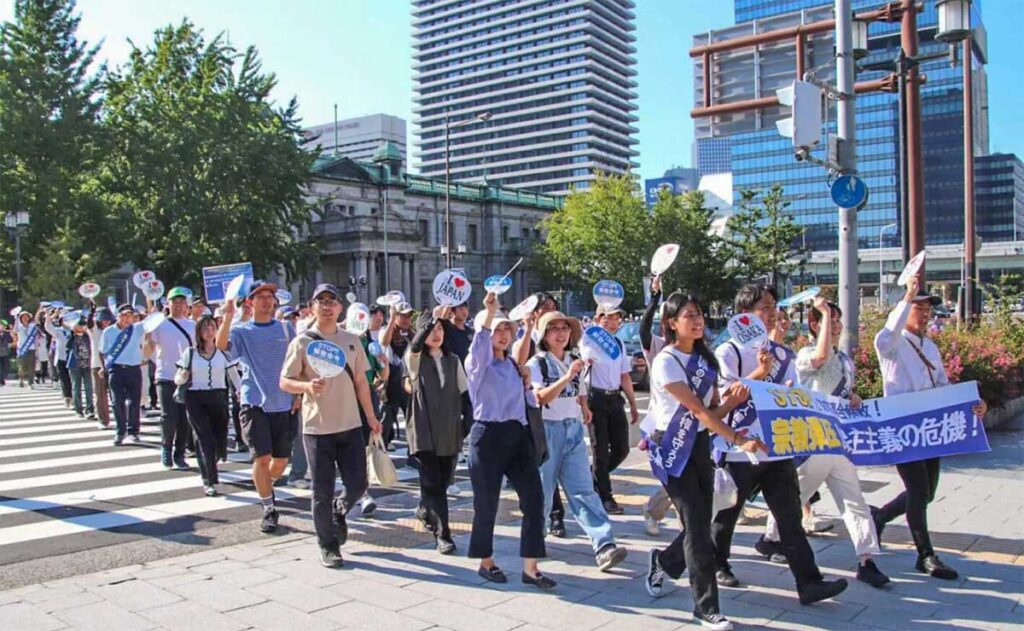
In Osaka City on 31st August, about 600 members marched through the city center for 40 minutes, calling for the protection of freedom of religion and fundamental human rights. Participants appealed to passersby, shouting, “The voices of current members are not reflected at all in the media reports.”
At a rally held prior to the march, freelance writer Masaki Kubota (窪田順生) noted a shift in the media’s stance toward the Family Federation compared to two years ago, when coverage was entirely critical. He revealed that multiple media professionals had begun questioning whether the claims made by opposition lawyers and journalists were always correct. He stressed that “showing your humanity is the most important thing for your group” and emphasized the need to project a positive image to society.
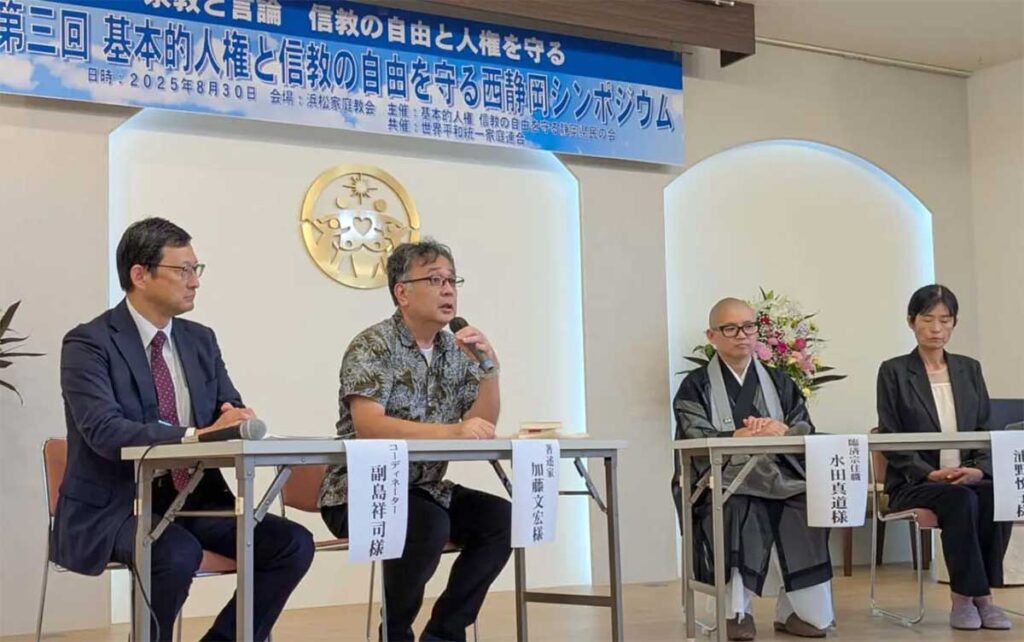
In Hamamatsu City, Shizuoka Prefecture, on 30th August, a symposium on freedom of religion and human rights was held with about 108 attendees.
Writer Fumihiro Katō (加藤文宏) analyzed that most Japanese people are indifferent to religious freedom, regard the religious organization as “something incomprehensible”, and subject its members to insults and abuse. He argued that “a problem that doesn’t exist has been turned into a social issue.” Kato compared the stigma (discrimination and prejudice) against the Family Federation to the situation faced by Fukushima residents after the nuclear accident during the 2011 Great East Japan Earthquake. He advised that the way to counter such reputational damage is “to continue communicating objective facts and evidence to society and increase the number of allies.”
Reverend Shindo Mizuta (水田真道), chief priest of Kongōji Temple (Myōshinji branch of the Rinzai sect of Buddhism, Numazu City), explained: “The essence of Buddhism is that suffering will lessen if you carefully unravel attachments (‘clouds’).”
He appealed that removing such clouds is the only way to change unjust currents.
On 31st August, a lecture was also held in Saitama City, drawing about 180 attendees.
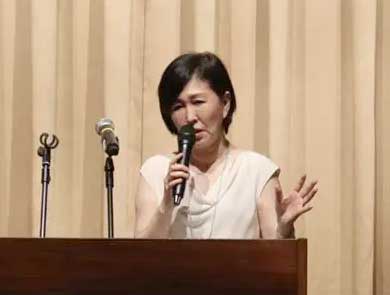
Nonfiction writer Masumi Fukuda (福田ますみ), author of Fabrication (Shinchosha), which was adapted into a film, took the stage. She pointed out the large gap between the religious organization’s actual circumstances and its public image, saying, “There is often a mismatch between media reports and what’s happening on the ground.”
Regarding the dissolution order, she remarked, “The verdict that was handed down was made based on emotional reasoning, and the judiciary lacked logic.”

In Tokyo, also on 31st August, the Family Federation’s headquarters in Shōtō, Shibuya Ward, hosted an online “10,000-Person Worship Service” connecting churches nationwide. Pastor Paula White, senior advisor to the White House Faith Office, delivered an encouraging video message, stating: “If 10,000 young believers rise up as peacemakers, you will change Japan and the nations of the world.”
She expressed her hope for the realization of world peace through religion.
Featured image above: Followers of the Family Federation protesting the lack of neutrality in government and media reporting 31st August 2025, Kita Ward, Osaka City. Photo: Rei Miyazawa (宮沢玲衣)