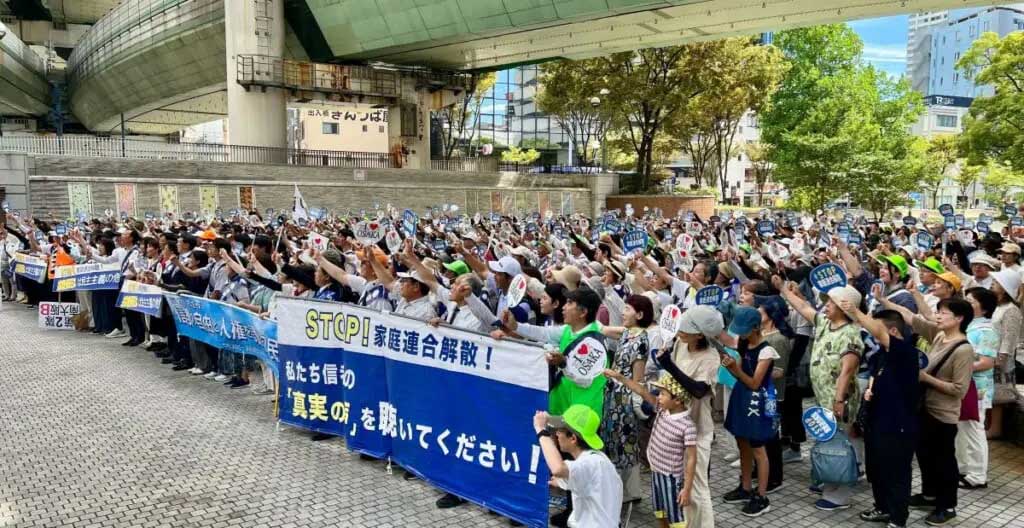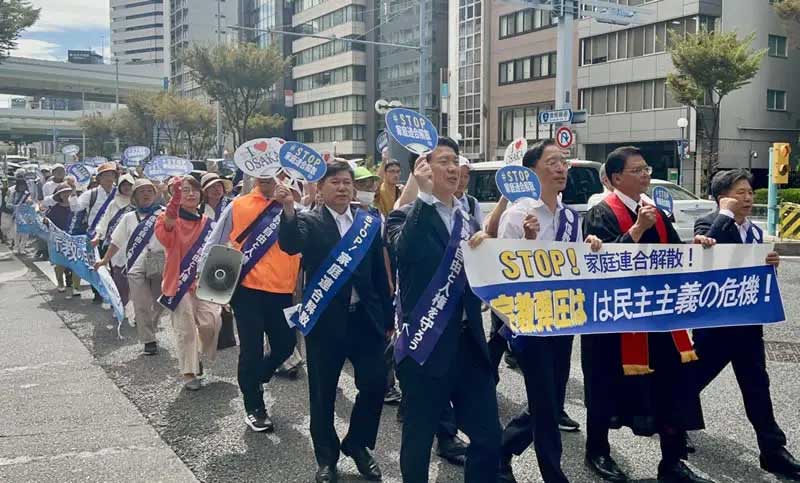
Family Federation backers rally for religious freedom in Osaka, decrying the dissolution order that may have a much wider impact and be used against other faiths
Tokyo, 28th July 2025 – Published as an article in the Japanese newspaper Sekai Nippo. Republished with permission. Translated from Japanese. Original article.
“Dissolution Order for the Family Federation Is Unjust”
1,000 March in Protest in Osaka
by the editorial department of Sekai Nippo
prepared by Knut Holdhus
Approximately 1,000 followers of the Family Federation for World Peace and Unification (formerly the Unification Church) held a protest march in Osaka City on 27th July, calling for the protection of religious freedom. As they marched for about 40 minutes, participants appealed to bystanders along the route, saying, “Just as you all have things you value, we also have a faith that is important to us!”
The protesters claimed that the dissolution order against the Family Federation is unjust.
Prior to the march, a rally was held where Pastor Ryuichi Sunagawa (砂川竜一) of Tsukishiro Christian Church (Nanjo City, Okinawa Prefecture) gave a speech. He apologized for the involvement of Christian churches in cases where members of the Family Federation were allegedly kidnapped and confined with the aim of forcing them to renounce their faith (breaking their faith) [See editor’s note below]. Regarding the assassination of former Prime Minister Shinzo Abe (安倍晋三), he stated, “The perpetrator is Tetsuya Yamagami (山上徹也), and the Family Federation has no connection to the crime.”
Pastor Sunagawa argued that if the Family Federation, which has committed no criminal acts, is forcibly dissolved, then Christian churches could be next under public scrutiny – and eventually, it could even affect Buddhism and the Soka Gakkai. He insisted that this is why the Family Federation must not be dissolved.
After the march, Pastor Sunagawa shared his thoughts, saying that being able to participate in the march with a positive spirit, as befits a religious person, gave him energy.
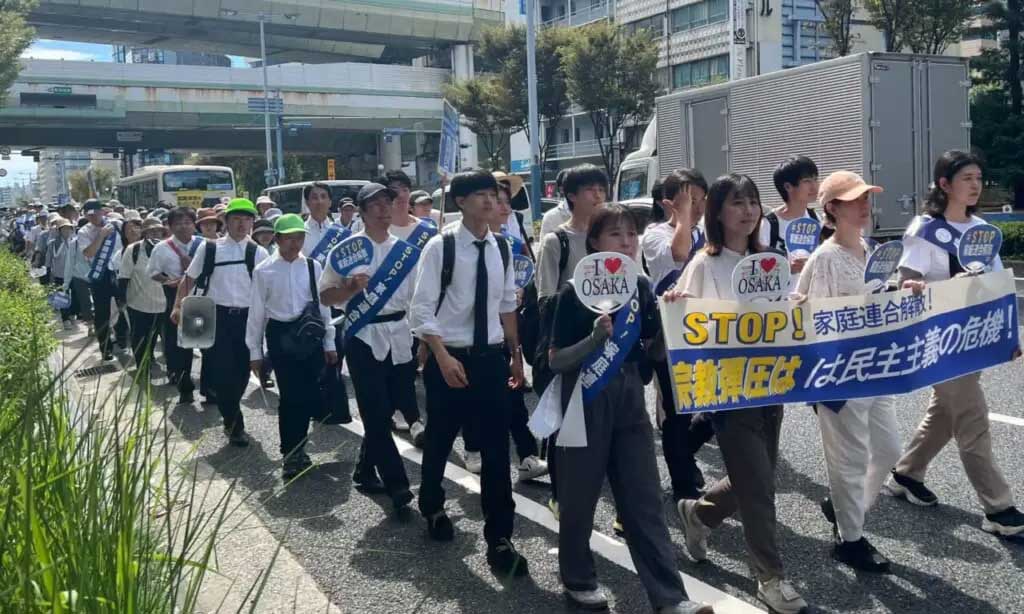
Featured image above: Demonstrators in the protest march advocating for freedom of religion – 27th July 2025, Kita Ward, Osaka City. Photo: Rei Miyazawa (宮沢玲衣)
[Editor’s note: Coercive faith-breaking (“deprogramming”, forced renunciation of faith) in Japan refers to the practice of coercively attempting to separate individuals from their religious affiliations or beliefs, typically through intervention by family members, professional faith-breakers (deprogrammers) or organizations hostile to new religious movements (NRMs). This phenomenon often targets members of such movements, e.g. relatively large faiths like the Family Federation or Jehovah’s Witnesses, but also smaller groups like Happy Science (Kōfuku no Kagaku) and other newer religious movements.
However, also Soka Gakkai, a Buddhist-based lay organization with more than 8 million Japanese members, and affiliated with Nichiren Buddhism, has occasionally been subject to faith-breaking attempts.
The practice gained attention in the latter half of the 20th century, particularly in the 1980s and 1990s. Parents or concerned family members often hired faith-breakers who taught them how to abduct and forcibly detain believers. Almost all such cases involved confining the individual believer and cutting him or her off from the religious community. During the confinement, the believer was subjected to intense questioning or indoctrination designed to break his or her faith. The aim was to “rescue” the person from what the family often had been tricked by faith-breakers or lawyers to regard as harmful influence from the religious organization.
Critics of forced de-conversion argue that it violates fundamental human rights, including freedom of thought, religion, and association. Reports of psychological trauma and accusations of unlawful detention have sparked debates over its ethical and legal implications. In response, some religious groups, particularly NRMs, have lobbied for greater protections against such practices.
Japanese courts have been inconsistent in addressing cases of coercive faith-breaking. While some verdicts have condemned the practice as illegal detention, others have been more lenient, citing family concerns about “mental health” or alleged “exploitation” as mitigating factors.]