Activist lawyers under scrutiny for alleged coerced testimonies behind the dissolution push
Tokyo, 29th April 2025 – Published as an article in the Japanese newspaper Sekai Nippo. Republished with permission. Translated from Japanese. Original article.
Court Rulings Crafted by Apostates [See editor’s note 1 below]
The Dark World of Deprogramming Spreading Amid the Move to Dissolve the Family Federation (4)
by the Religious Freedom Investigative Team of the editorial department of Sekai Nippo
prepared by Knut Holdhus
Almost all of the 32 grounds for dissolution are from the National Network of Lawyers Against Spiritual Sales (NNLASS – Zenkoku Benren)
[Almost all of the 32 civil cases used as grounds for the dissolution (of the Family Federation) were brought forward or based on lawsuits led by NNLASS (Zenkoku Benren).]
“If active members properly assert their claims, it can be shown that their arguments will be recognized. I hope this will serve as some deterrent against unjust trials,” said Kousuke Yamabe (a man in his 60s, pseudonym), a believer of the Family Federation for World Peace and Unification (formerly the Unification Church) living in Sapporo, Hokkaido.
In September 2019, Yamabe’s two sisters and brother filed a lawsuit at the Sapporo District Court, seeking damages on the grounds that Yamabe had “donated” their late father’s inheritance without permission.
Representing the plaintiffs was lawyer Masaki Goro ((郷路征記)) – also written “Gouro” – from National Network of Lawyers Against Spiritual Sales (NNLASS – Zenkoku Benren).
Attorney Goro argued that Yamabe’s “beliefs had been implanted by the Unification Church,” and therefore he lacked the awareness that his actions were unlawful, claiming that Yamabe’s donations were not made of his free will. Furthermore, he argued that the religious organization itself was the true perpetrator, naming not only Yamabe, but also the Family Federation as defendants.
Yamabe strongly countered these claims, emphasizing that his donations were not due to “brainwashing” but were voluntary acts. He made similar statements during his court testimony. Ultimately, the court judged that there was “no sufficient evidence” to support Goro’s claims, and the claims against the church were dismissed.
Although Yamabe eventually reached a settlement with his sisters for 4 million yen, the plaintiffs proposed making his resignation from the religious organization a condition of the settlement, which Yamabe refused. This dismissive attitude toward his faith continued until the end.
Of the 32 civil cases used as evidence by the Tokyo District Court to request the dissolution of the Family Federation, four were cases previously handled by Attorney Goro (Gouro). In each case, he had promoted a similar “mind control theory” argument as in the case of Yamabe.
What significantly differentiates Yamabe’s case from the others is that many plaintiffs in those cases had left the religious organization after experiencing deprogramming – that is, being forcibly “deconverted” through confinement. For example, one of the four cases, the “Return My Youth” lawsuit held in Sapporo, revealed that, upon analysis of the testimonies of the 21 plaintiffs, more than 75% admitted to having been physically restrained during the persuasion process. In total, 18 people (86%) had experienced some form of confinement against their will.
It is known that parents, under the direction of certain Christian pastors and activists opposing the Family Federation, confined their believing sons or daughters and subjected them to a “fumi-e” (test of faith) [See editor’s note 2 below]. Even if a believer professed intent to leave the religious organization, they were often forced to sue it to prove their expressed intent was genuine.
As a result, those who left the organization after being confined and subjected to one-sided critical information inevitably end up giving testimony in line with the intentions of the deprogrammers (faith-breakers) who pressured the believers to abandon their faith, regardless of whether or not they held hostility toward the organization.
In civil cases, unlike in criminal cases, fact-finding is generally less stringent. Particularly in cases involving new religious movements, court judgments are often influenced not by objective evidence but by the voices of those who claim to be “victims” and the tone set by media coverage.
Another notable point is that not only Attorney Goro but also most of the lawyers in the 32 lawsuits were affiliated with the National Network of Lawyers Against Spiritual Sales (Zenkoku Benren), including lawyers such as Masaki Kito (紀藤正樹) and Hiroshi Yamaguchi (山口広). It can be said that people who left the group through deprogramming (faith-breaking) aligned their testimonies with the claims made by these anti-Family Federation lawyers, stating that their past donations were “not made of their own free will” or that they had been “deceived”, thereby contributing to the court rulings against the organization.
If, as in Mr. Yamabe’s case, claims based on disregard for religious faith have become a routine tactic in court, then one cannot help but question whether it is truly a fair and impartial decision for the Tokyo District Court to use such accumulated case precedents as grounds for ordering the organization’s dissolution.
Testimonies by apostates feature not only in these 32 civil lawsuits but also in the court-related documents submitted by the Ministry of Education, Culture, Sports, Science and Technology (MEXT). It has also been found that among 159 former members who submitted testimonial evidence, 121 had experienced or were suspected of having experienced kidnapping and confinement.
Deprogramming (faith-breaking) is considered illegal in places like the U.S. and Europe. Meanwhile, China – itself condemned by a UN report for committing “crimes against humanity” by forcing Muslims in Xinjiang into “re-education” camps to erase their faith – has welcomed the Tokyo District Court’s dissolution verdict via its anti-cult organization under the Chinese Communist Party, praising the NNLASS (Zenkoku Benren).
Effectively, the Tokyo District Court’s decision amounts to an endorsement of deprogramming (faith-breaking). There are concerns that going forward, the state may encourage efforts to “free” individuals from their faith and intensify state support for religious de-conversion.
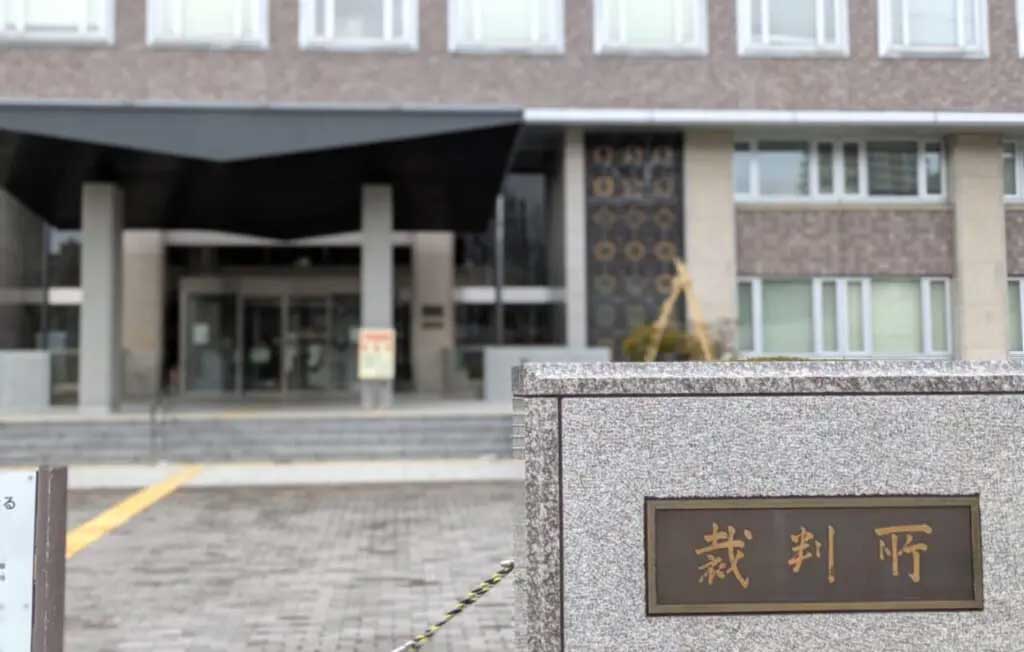
Featured image above: The Sapporo High Court and Sapporo District Court, where the trial of Kousuke Yamabe (pseudonym), a member of the Family Federation, was held. Photo: Takahide Ishii (石井孝秀 )
[Editor’s note 1: Apostate is the translation of the Japanese word 背教者 (はいきょうしゃ, haikyōsha) which is composed of the following elements: 背 (はい, hai): meaning “to turn one’s back on” or “to betray”; 教 (きょう, kyō): meaning “religion”, “teaching”, or “doctrine”; 者 (しゃ, sha): common suffix meaning “person” or “someone who does”.
So, 背教者 literally means: “A person who turns his/her back on his/her religion,” or “an apostate” or “a religious defector”. It generally carries a negative or accusatory connotation, implying betrayal or abandonment of faith – especially from the perspective of the religious group being left.
In the above text, the article’s tone implies that apostates (背教者 – haikyosha) are not just someone who have left the religion, but who are now being used to undermine the group, so there is also a hint of Judas-like betrayal in the context. Of course, “Judas” refers to Judas Iscariot, the disciple who betrayed Jesus to the authorities for 30 pieces of silver. The apostates in the text above are being used by hostile and cynical lawyers for malicious reasons to cause harm to the faith they were forced out of, when they had their faith broken coercively by so-called faith-breakers, working in league with activist lawyers.]
[Editor’s note 2: The illustration to the right depicts a fumi-e (踏み絵), which literally means “stepping-on picture” – typically an image of the Cross, Jesus Christ, or the Virgin Mary. The Tokugawa Shogunate used this practice to identify hidden Christians (known as Kirishitan) and their sympathizers during a time when Christianity was banned in Japan. While the act of stepping on these images was originally called efumi (絵踏), the term fumi-e is now commonly used to refer to both the practice and the object itself.
Those who hesitated or refused to step on the images were suspected of being Christians. They were taken to Nagasaki and ordered to renounce their faith. If they refused, they faced torture – and if they continued to resist, execution, often by burning at the stake.
This systematic persecution began in 1614 and was enforced by regional authorities. By the mid-17th century, the Tokugawa Shogunate had escalated its crackdown, ordering the expulsion of all European missionaries and the execution of Japanese converts. The suppression of Christianity continued for more than two centuries.]