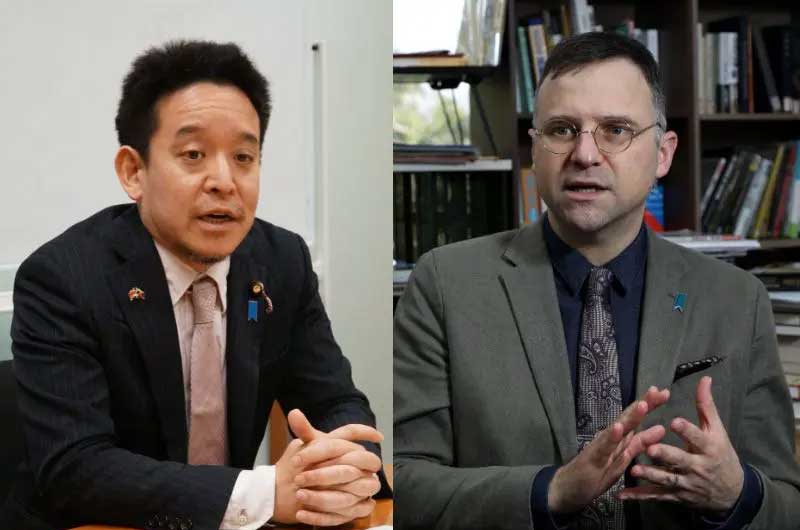
In an interview with Asia Times, Japanese lawmaker Satoshi Hamada spells out the political forces pushing for the dissolution order against the Family Federation
Tokyo, 23rd April 2025 – Published as an article in the Japanese newspaper Sekai Nippo. Republished with permission. Translated from Japanese. Original article.
Japanese Lawmaker Hamada Expresses Concern Over Coercive De-Conversions and Human Rights Violations
by the editorial department of Sekai Nippo
Prepared by Knut Holdhus
On April 21st, the Hong Kong-based online publication Asia Times published an interview conducted by Reitaku University [in Kashiwa, Chiba, Japan] Associate Professor of International Studies Jason Morgan with Japanese House of Councillors (Upper House) member Satoshi Hamada (浜田聡参). The discussion focused on the government’s request to dissolve the Family Federation for World Peace and Unification (formerly the Unification Church). In the interview, Hamada condemned the abduction and confinement used to forcibly de-convert believers of the Family Federation and expressed concern about the widespread biased media coverage surrounding the organization.
Hamada described the forced de-conversion of Family Federation followers as a “grave problem” and stated that “the people of Japan ought to be informed about these things,” emphasizing the background of his efforts to raise the issue in the National Diet (Japan’s legislature).
He also mentioned the existence of individuals known as dakkaiya (“exit counselors” or “faith-breakers”) who are involved in these abduction cases. He singled out Takashi Miyamura (宮村峻), stating that he had contacts with a group of lawyers affiliated with the Constitutional Democratic Party (CDP). Hamada argued that it was problematic for a national political party to be in cooperation with groups that engage in violence and confinement based on religious beliefs.
On the matter of religious freedom, Hamada noted that only a handful of “intellectuals and political commentators are speaking out about it,” and expressed concern that “the mainstream media in Japan are still attacking free-speech advocates in a very aggressive way.” He pointed to continued attacks on intellectuals who question the one-sided reporting related to the Family Federation.
He further remarked that many television networks align with the Constitutional Democratic Party (CDP) and that “International Federation for Victory Over Communism” (IFVOC), an organization affiliated with the Family Federation, is “greatly disliked by the Japanese Communist Party.”
Hamada, who has attended Family Federation events and given speeches, voiced frustration that the media refuses to report on these events despite his outreach. He criticized the media as “very far from fair”, especially for ignoring key facts such as the drastic decrease in refund lawsuits since the Family Federation’s 2009 “Compliance Declaration” [See editor’s note 1 below] following issues related to large donations.
Morgan also raised concerns about the Komeito Party, which is in coalition with the ruling Liberal Democratic Party and has ties to the religious organization Soka Gakkai [See editor’s note 2 below]. Hamada pointed out that, similar to the Family Federation, it has been reported that Soka Gakkai received large donations, suggesting that “Soka Gakkai could meet the same fate as” the Family Federation. He implied that if the dissolution order against the Family Federation is carried out, similar measures might be applied to other religious organizations.
Morgan interpreted the Liberal Democratic Party‘s stance against the Family Federation as a “political calculation” aimed at distancing itself from a religious group that originated in Korea, by labeling it as dangerous. He also emphasized that some lawyers and activists have “made a name for themselves by ginning up hatred against the church and its members.”
Finally, Hamada expressed his concern about the current state of religious discourse in Japan, saying he was “struck by how little concern media and political leaders have shown” to fundamental principles such as freedom of religion and freedom of association, even amid reports of human rights violations against members of the Family Federation.
[Editor’s note 1: The 2009 compliance declaration of the Unification Church of Japan (now the Family Federation for World Peace and Unification) was a formal commitment by the organization to reform its practices in response to longstanding public criticism and legal challenges.
The Unification Church in Japan had faced numerous allegations related to recruitment tactics and donation solicitation, termed “spiritual sales” (霊感商法) by a hostile network of activist lawyers who had declared the religious organization an enemy. These issues led to multiple lawsuits orchestrated by the activist lawyers and significant media backlash. This prompted the organization to take measures to restore its reputation and demonstrate compliance with legal and ethical standards.
The religious organization pledged to stop possibly unethical donation practices, including what the hostile network of lawyers claimed amounted to “pressuring members into making large financial contributions under spiritual pretexts.”
This was in response to accusations from the same activist lawyers that followers “were being manipulated into giving away substantial amounts of money or property.”
The Unification Church stated it would enhance internal oversight to ensure compliance with ethical and legal standards. Measures included better training for leaders and stricter guidelines for evangelization and solicitation of donations.
After this compliance declaration, there was a significant decrease in the number of lawsuits against the Unification Church, which since 2015 has been called the Family Federation. The religious organization has used this as evidence that it has improved its practices and should not be subject to dissolution.]
[Editor’s note 2: Soka Gakkai, a global lay Buddhist organization originating in Japan, aims to create an “ideal world” based on the principles of Nichiren Buddhism, which emphasizes individual empowerment, inner transformation, and societal harmony. Their vision is often framed as kosen-rufu, meaning the widespread propagation of Buddhist values to establish peace and happiness for all.
Soka Gakkai promotes peace, culture, and education through initiatives that focus on personal transformation (human revolution) – the belief that changing oneself positively impacts society; peace ativism – anti-nuclear campaigns, human rights advocacy, and interfaith dialogue; education – institutions like Soka University emphasize value creation and global citizenship; community engagement – social welfare programs, disaster relief, and environmental sustainability efforts.
To actualize these ideals in governance, Soka Gakkai founded the Komeito party in 1964 (now known as New Komeito or simply Komeito). The party’s purpose was to translate Buddhist-based humanistic values into public policy. While legally separate from Soka Gakkai, Komeito has long been backed by members of Soka Gakkai and focuses on peace-oriented diplomacy (e.g., supporting Japan’s pacifist constitution); social welfare policies (benefiting education, healthcare, and the elderly), and grassroots democracy (reflecting the voice of ordinary citizens)
Since 1999, Komeito has been a coalition partner with the Liberal Democratic Party (LDP), influencing policies while maintaining a centrist stance.
Despite its contributions, Soka Gakkai’s political role has been controversial, with critics accusing it of blurring the lines between religion and politics. Some also argue that Komeito’s alliance with the conservative LDP compromises its original pacifist ideals.
Soka Gakkai envisions an ideal world through personal empowerment, education, and political engagement. While its approach is rooted in Buddhist ethics, its political involvement remains a complex and debated issue.]
Featured image above: Senator Satoshi Hamada (left) and Associate Professor Jason Morgan of Reitaku University