Controversial verdict in Tokyo District Court raises concerns over religious freedom as Family Federation condemns ruling as state persecution
Tokyo, 26th March 2025 – Published as an article in the Japanese newspaper Sekai Nippo. Republished with permission. Translated from Japanese. Original article.
First Civil Code-Based Dissolution Order Issued Against Family Federation
by the editorial department of Sekai Nippo
prepared by Knut Holdhus
On 25th March, the Tokyo District Court – with Kenya Suzuki (鈴木謙也) as Presiding Judge – issued a dissolution order for the Family Federation for World Peace and Unification (formerly the Unification Church) in response to a dissolution request filed by the Ministry of Education, Culture, Sports, Science and Technology (MEXT). The Family Federation plans to file an immediate appeal with the Tokyo High Court. This marks the first case of a religious organization being dissolved based on civil law violations. However, concerns remain about the expedited legal process, and as previously reported, suspicions of false testimony in key evidence raise fears that dissolving a religious corporation as a non-contentious case [See editor’s note below] could excessively infringe upon religious freedom guaranteed by the Constitution.
Evidence fabrication allegations kept behind closed doors
Religious organization plans to immediately appeal Tokyo District Court decision
Tetsuya Yamagami (山上徹也), the suspect in the July 2022 assassination of former Prime Minister Shinzo Abe (安倍晋三), allegedly told police that his motive stemmed from resentment toward the religious organization due to his mother’s substantial financial donations. Following this, the media scrutinized the organization‘s ties with politicians. Amid opposition party criticism of the ruling Liberal Democratic Party (LDP) in the Diet, Fumio Kishida (岸田文雄), Prime Minister at the time, declared a severance of ties with the organization. Without cabinet approval, in response to questions in the Parliament, he had reinterpreted the Religious Corporations Act’s dissolution requirements. This led MEXT to invoke its reporting and inquiry rights seven times, culminating in the dissolution request in October 2023.
In the legal precedent set by the Aum Shinrikyo dissolution case, courts were cautious in dissolving the religious corporation, emphasizing that the Constitution protects religious freedom. The dissolution was interpreted as applying only in cases of criminal law violations. However, the courts later expanded this interpretation to include civil law violations, as seen in the appeal decision regarding fines imposed on the religious organization for refusing to respond to inquiries. The Supreme Court finalized this ruling on 3rd March, fueling concerns that the dissolution decision was politically driven.
MEXT justified the dissolution by claiming that since around 1980, the group had engaged in deceptive recruitment tactics and pressured members into making large donations through fear-based tactics, constituting repeated civil law violations. The ministry estimated the number of victims at approximately 1,550, with financial damages amounting to 20.4 billion yen (approximately $135 million), including settlements.
The religious organization countered by arguing that donations are part of religious activities and not a conduit for illicit financial gain. The Tokyo District Court held four closed-door hearings, examining testimonies from both current and former members. During these proceedings, it was revealed that an ex-member who testified for MEXT was unaware of the contents of their own written testimony, raising concerns about the reliability of the evidence. In February, the religious organization released a report titled “Fabricated Evidence by MEXT – The Government’s Grave Crime Exposed in the Dissolution Lawsuit.”
International concerns over Japan’s ruling
Concerns over the dissolution order have spread internationally. On March 24, former U.S. House Speaker Newt Gingrich posted on X (formerly Twitter), warning, “The current attack on the Family Federation in Japan is an attempt to weaken the U.S.-Japan alliance and facilitate reconciliation between Japan and the Chinese Communist Party.”
“A crisis for religion as a whole”
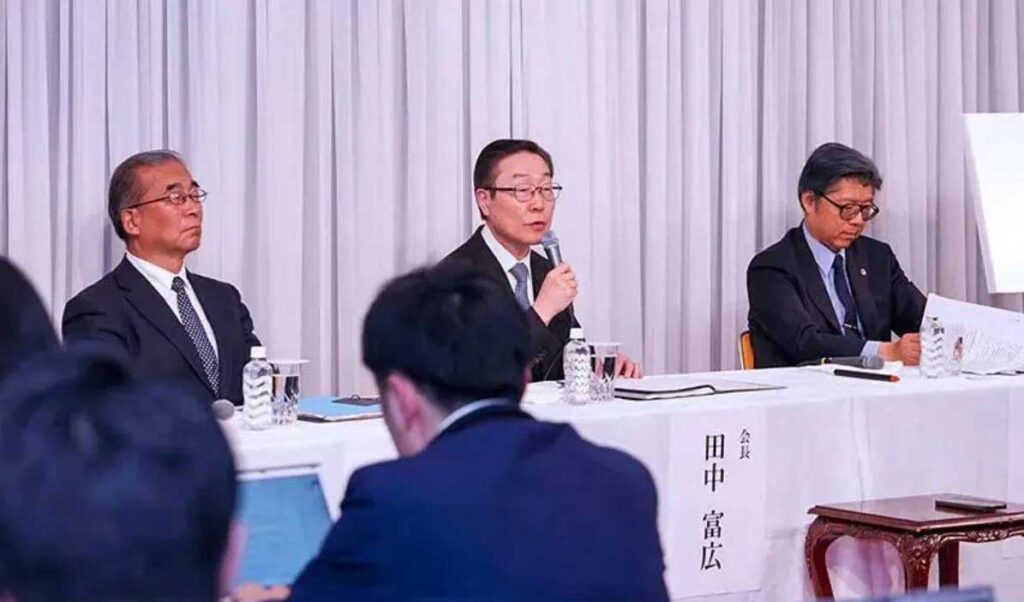
Family Federation President Tanaka holds press conference
Following the Tokyo District Court‘s dissolution order, Family Federation President Tomihiro Tanaka (田中富広) held a press conference on 25th March at the religious organization‘s headquarters in Shibuya, Tokyo. He criticized the decision as “clearly unjust” and argued that “the state persecutes religion, posing a crisis for all religious organizations.”
Tanaka emphasized that the ruling relied entirely on claims made by former members who were allegedly forced to renounce their faith through abduction and confinement, calling it “completely unacceptable”. He warned, “If our assets are confiscated, our activities will be severely restricted.” He vowed to “put forth maximum effort in the appeal process to overturn the decision.”
The organization plans to file an immediate appeal with the Tokyo High Court within two weeks.
The religious organization‘s legal counsel, Nobuya Fukumoto (福本修也), criticized the ruling, arguing that it could lead to the breakdown of families and promote discrimination against believers and staff. “Did the judges consider these consequences? This is an absolutely outrageous verdict,” he said. He further warned, “Very few religious organizations exist without some disputes with members. This is a threat to the entire religious landscape.”
Additionally, he accused MEXT of submitting “fabricated testimonies” in its case against the Family Federation.
[Editor’s note: A non-contentious case refers to a legal matter where there is no dispute between parties. These cases typically involve administrative, procedural, or uncontested legal actions, such as probate (handling a deceased person’s estate), uncontested divorces, adoption, or registering a trademark. Since there are no opposing parties or legal conflicts, these cases usually proceed smoothly through the legal system without litigation.]