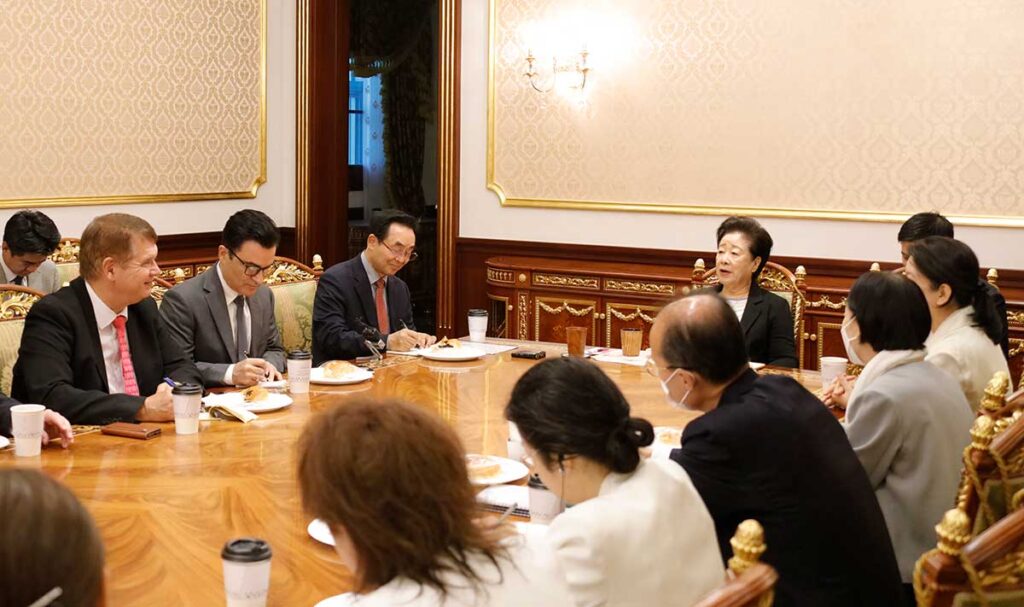
This sermon was given by Dr. Michael Balcomb, the President of the Europe and the Middle East Region of the Family Federation for World Peace and Unification, at the Sunday service in Geneva, Switzerland on October 6, 2024.
You may recognize my title “Yesterday, Today and Forever”. It’s taken from the scripture reading we had, where it says, “Jesus Christ is the same yesterday and today and forever.” (Hebrews 13:8, RSV)
One of my favorites from the Book of Hebrews, is chapter 13, the last chapter, and the final encouragement to the community. […]
As you know, I went to the theological seminary and one of the things we did there was to look into the background of the different books of the Bible. We don’t think about that so much these days, but the Book of Hebrews is a mysterious book. First of all, nobody really knows who wrote it. In the beginning, people thought it must be Paul, because most of the other books of the New Testament are by Paul.
But already, by the first century, people realized it’s not Paul. It doesn’t sound like him. It’s not a letter; it’s really a sermon. And it’s a sermon directed at a very particular group of people. They think they’re Hebrews, meaning those Jews who’d become Christians, probably around 60 to 70 AD. That was the time when Nero persecuted the Christians in Rome and throughout the Roman Empire.
In this book, the author goes through the three stages of that spiritual community, which I think is pretty much the three stages of any spiritual community, including our own.
The first stage is the exciting one, when the community was established by disciples and evangelists who had met Jesus themselves, probably. They were full of the Holy Spirit and came to witness and be missionaries and pioneers.
And there were lots of miraculous works. Today, we might call them “great works”. But people were healed, and there were revelations. People felt this enormous encouragement of the Holy Spirit. And that lasted for a while; we don’t know how long, maybe 5 to 10 years or so.
But then they entered the second stage, and the second stage was much more difficult because they started to receive persecution and attacks.
That wasn’t so bad, because as religious people somehow, we almost expect to be attacked from the enemy. We know that Satan wants the world to remain godless, and so we’re not so surprised then when there are attacks. […]
But then there started to be internal persecution, and the community started to divide. People started having arguments, according to the Book of Hebrews, about things like property and doctrine and who their real leader was.
We’re talking about Hebrews now, not about any other organization you may have heard of that has experienced such problems. This was a time of persecution, but still, because such matters aroused passion, the church moved forward. But now in the stage that the writer is describing, the community has begun to lose power, they have begun to lose their spirit.
And some of them, […] began to think, “I wonder if we should have stayed Jewish.” It was a bit like when the Israelites left Egypt, and halfway they began to think, “I wonder if we should have stayed in Egypt. It seems like it was better there than it is here.”
The author of Hebrews, his mission, or her mission perhaps, was to try to persuade people, “Don’t lose hope, don’t give up, don’t be tempted to go back, don’t settle for the second best, because the real prize is ahead, and we should have confidence in that.”
We too should give each other confidence, because, as you know, once any organization or team loses confidence, everything can fall apart really quickly.
I like football, and I support a terrible team, but they’re winning at the moment. But sometimes they can be winning by a lot, and then something happens. They kind of switch off in their brains, and suddenly they’re losing. And the players are the same, the ball is the same, the opposition is the same, but they’ve lost their confidence. And because of that, everything seems too difficult.
Through much of the Book of Hebrews, the author encourages people, “Actually, what we have in Jesus is much better than anything else that’s ever happened and ever will be. This is it. This is the moment.”
And of course, I would add to this, not “Jesus Christ, the same yesterday, today and forever” – although, of course, that is true – but what I want to talk about this morning is “The True Parents, the same yesterday, today and forever”.
Actually, the next verse is very interesting. It says, “Do not get led away by diverse and strange teachings […]” (Hebrews 13:9, RSV).
I could add here, “nor by idols”. These days, we don’t make idols of stone and wood, but actually, we have many idols in our lives: our careers, our work, our children, and our homes. There are so many things that we’re tempted to start putting ahead of God. We all are susceptible to it.
Also – and it’s been a problem for the last 2,000 years – we tend to be a bit gullible. Do you know what gullible means? It means we believe things too easily without checking to see if they’re true or not. And even if we find out that they’re not true, the residue of that confusion remains.
On the way here, I read a very interesting and disturbing article from America, from the city of Baltimore. […] Baltimore is a big city, halfway between Washington and New York. And historically, a lot of black people live there.
One day there was this bombshell of an audio recording. It said the principal of a local high school was complaining about his students. And in this audio, he was saying, “How long do I have to put up with these ungrateful kids? They come late, they don’t work, and the teachers are not much better either.”
Of course, this spread. And very quickly there was an uproar, and the police had to be called to protect the principal. Pretty soon the whole community was asking, “Hey, how can this be?”
But then somebody started to investigate. They found out this was a deep fake. It wasn’t him at all, actually. It was one of his staff who’d been fired for theft and had used his computer skills to create this entirely false audio. So, it was reported, “Sorry, everybody, it was false. It wasn’t true.”
But actually, six months later, still half the population believed it was true. Because in that first moment, it must have touched something deep inside them that they were already thinking. And it confirmed for them, “We live in a racist town, and our principal is racist.”
Even though it wasn’t true, even though it was proved not to be true, still the poison remained. And if you think about it, this happens a lot. We hear something. We don’t like what we hear. We’re busy, so we don’t necessarily really check it out because we think, “Yeah, I always thought that.”
So here are two things to bear in mind. The background of this message is a community that’s in trouble. They were in trouble from the outside because there’s persecution, as there is, for example, in Japan these days, but also in trouble from the inside because there’s confusion and even fatigue. We have been doing this for a long time, and we begin to wonder, “Did we make the right choice? Are we really heading for the Cheonilguk (Kingdom of Heaven)?”
The True Parents’ message is actually very simple. When you boil it right down, the message is that God is our Parent who wants to live with his and her children and grandchildren in peace forever. It really couldn’t be more simple.
But of course, as we know through the Divine Principle, this dream was lost. And it’s always been lost. There’s never been any human being ever who saw the dream of God. So even to believe that it exists requires effort, right? It requires commitment, “Yes, I believe that dream is true.”
And now True Mother says the time of fulfillment is now. You heard it right here on this video we watched, right? It’s now, not in the distant future. Then you check the date on the video, and you see that was in 2020. That’s already four years ago.
Meanwhile, when we look at our world, what’s going on in Israel, Lebanon, Ukraine, Russia, and Yemen, it takes real effort, actually, to believe that the kingdom is now because it definitely doesn’t look like it. It looks like things are going backwards.
I can’t help remembering when I was working in Israel and Palestine 20 years ago, and the kind of easy, cordial relations – despite everything – that we had with Jewish, Christian, and Muslim leaders – how peaceful it was and how we managed to fill up the park in the middle of Jerusalem with people to crown Jesus. It’s astonishing.
I think that could not have happened today. So, this is a challenge. What we see with our eyes, what we hear with our ears, is not the same as what we profess. Am I the only one who has this doubt?
[…] If you believe that progress is somehow linear, you start low, and you keep going higher and higher and higher. If you then see this sudden drop-off, you will be very disappointed, because you’ll think, “Well, that’s it. We were winning for a time, and now it looks like we’re going backward. And who knows if this will change? Doesn’t look like it.”
It’s possible then, that we start thinking, “Have I made a mistake? Did I join the wrong church, or did I come to the wrong city? Should I have taken that job instead of this job? Should I have become a missionary, or should I have stayed in Japan?”
I think those thoughts are out there. The other great reformer, Martin Luther, not John Calvin, said, “You can’t help it if the birds of temptation and confusion fly around your head. You can’t help it, but if they make a nest in your hair, you can help that.” You have to chase away those thoughts when they come.
These days, there’s a lot of concern and confusion about some new teachings coming from Korea, which we call the Chambumo Ron , and formally and wrongly called “True Parents’ Theology”.
But actually, the “ron” in “Chambumo Ron” means discourse. When the Divine Principle was published in 1966, it was called Wolli Kangron, meaning a “Discourse on the Principle”.
A “discourse” means there’s meant to be discussion, give and take, and debate. It also means that it’s not finalized or settled because it’s a discourse. And out of our conversation, new things may emerge and a new understanding. If you’ll permit me, I’ll briefly speak to this issue, since it’s a hot one in Europe these days.
Making a base for misleading claims first of all, let’s remind ourselves that the Divine Principle itself clearly indicates, right in the very first chapter, that this is not the whole truth. It’s right there. It says that this is just a textbook teaching the truth. And we confidently expect that new things will be revealed.
But very tellingly, it also says it may be displeasing to believers that the truth they now have is not the whole truth. And we always used to think, “Yeah, those mainstream Christians, they should wake up and smell the coffee. New truth has come.”
But I put it to you that for any believer, including a Unification believer like myself, like yourselves, new things, new ideas can be discomforting, especially, and particularly if they challenge things that we’ve already thought. That’s okay. And it takes effort to find out.
You may think, “Well, you’re the continental director, so probably you’re going to set us straight this morning and tell us what’s what.”
Well, I have bad news for you. I’m not going to do that. And in fact, I cannot do that. But one thing I can say is that there’s a lot of incomplete information out there. A lot of statements are being made and people contributing opinions.
Interestingly, in most cases, they haven’t actually been firsthand in touch with True Mother or with the source. So, it’s secondhand. It’s not gossip, but it’s removed by one or two degrees.
I have, of course, had to listen to the Chambumo Ron several times. And also, I’ve had the privilege and the challenge of sitting right opposite True Mother and, hearing from her things that, for me are quite new, making me think, “Really? Is that what you think, Mother? Or is that how you want?”
But I have three simple takeaways, for me. You might say, “Well, Mike, those are your takeaways. You’re you and I am me.”
Yes, absolutely right. These are my takeaways. The first one’s very simple. The first one is that God is a Heavenly Parent.
That’s not new, but when I think about it myself even now, I catch myself saying “Heavenly Father, Heavenly Father” all the time, in prayer and everything. And it’s taken a real effort to start thinking God is also a Mother, as well as a Father, and yet one.
Because this is also challenging for the human brain, right? How can you be a father and a mother? One of my friends, Jin-Choon Kim, who’s also one of the teachers of Chambumo Ron , and a high-energy physicist [Editor’s note: Particle physicist]. I’ve actually found the quantum concept of superposition helpful. Superposition means that something can be two things at the same time that are mutually exclusive. It happens in science.
But anyway, this is the first message of Chambumo Ron: God is masculine and feminine. It’s right there in the Principles. But let’s be honest, it was never really explored or discussed.
And I’m a man, and I freely admit it’s taken me a long time to even begin to understand the world of women, even though I have three younger sisters and two wonderful daughters and one wonderful wife. But if you ask them how well I understand the realm of women, I don’t think I’ll be getting an A grade at all. In fact, my wife says, “You’re a very clever man, but sometimes you’re so stupid?” Anyway, she’s not here today.
The second takeaway is that it’s through True Mother, the daughter of God, that we can most fully understand the Heavenly Mother. True Mother, because she’s a woman, and a very special woman, is able to explain this characteristic of God better than Father ever could, because Father‘s a man. Father never gave birth to any children, never experienced the pain of childbirth or miscarriage or any of those things that women endure.
Likewise, men can talk to men about things that women don’t understand. But generally, history has been, and our movement has been, very centered on men. Still, when we have meetings in Korea, […], it takes enormous effort to let even one woman speak. […]
The third takeaway is that we have to look to the future because the past is behind us, and it can’t really be changed. We can try to understand it, but we should not permit ourselves to get lost in disputes about things from a long time ago because we have to look to the future now.
I want to be honest, not everyone who’s been exposed to these ideas in Chambumo Ron has had the same experience. […]
Of course, it doesn’t help that at this moment there is no authoritative text to study. It would be different if I could pull out this book and say, “Here it is: Chambumo Ron ! Read it yourself and make up your own mind.”
But actually, there is no such book. There’s a book in preparation. I understand the Korean version is already on version 10, but it hasn’t been published once because there’s such intense dispute about what should be in it.
And there’s a set of lectures that’s circulating which I only saw myself for the first time yesterday, which are also not authorized. And yet people are using them to teach their version of the Chambumo Ron. So that’s a problem.
Again, I’d like to say sorry that I haven’t been able to produce something more tangible for you to get your teeth into, but that’s the reality.
But anyway, […] I think the key controversy among all these things is that the allegation that the Chambumo Ron teaches that Father made some serious errors in his lifetime, key among which was he didn’t wait until he was 40 years old to marry True Mother. Another allegation is that those “mistakes” are the reason why Father had to go, for example, to Heungnam death camp, to Seodaemun prison, why he was tortured and suffered, not, as we have traditionally believed, to take on responsibility for the sins of humanity, but because of his own mistakes – rather than providential matters – that led him to do what he undeniably did, which was to endure torture, betrayal, beatings, imprisonment.
Many people feel very indignant about such a suggestion, and I would say rightly so. If you don’t feel that about True Father, there’s something wrong. I felt very angry when I thought that that was what was being said. […] This is wrong, and we should not be teaching it.
And there’s one huge problem: The Chambumo Ron does not say it. It does not say it. [Editor’s note: does not mention the above-mentioned allegations]
So again, like that deepfake audio in Baltimore, it’s going to be difficult to undo this because the misinformation and the confusion is already out there.
[…] Two weeks after Father ascended, True Mother called me to Korea. I was working at that time in the USA. I didn’t know why I was going, but she called me and sat me down about one or two meters away. She looked at me and said, “So, you’re Michael Balcomb, are you?”
“Yes,” I replied.
“I understand you have a PhD from the seminary. That’s not why I called you,” she continued.
She proceeded to give me a lecture, an education about what in Korean is called “hyojeong” [Editor’s note: filial heart, serving one’s parents devotedly with love and respect], about what it means to be a filial son.
And of course, she was also talking about the role of America, the “elder son nation”. It was a simple message, and it boiled down to this: The elder son has two jobs. One, to try to fulfil his parents’ dream, not to take it over, not to tell them, “Your dream is no good; I have a better dream. Let’s do this instead of that.”
Rather, he is even willing to sacrifice his own career, thinking, “I’m going to let my parents dream be fulfilled. They’re older than me. They don’t have so much time. I have more time.”
Earlier in my life, my parents did everything for me, particularly my mom. She fed me. She wiped my butt. She did everything. So if my mother asked me to do something now, how can I not say, “Okay, mom, I will do that.” […]
What actually is Mother asking us to do? Let’s put aside this question of whether we think this or think that for the moment. The first thing is that, as you know, right now, Mother‘s main focus is the Cheonwon Temple (Palace).
Recently, I was there twice. First, I went there, I saw it, and I flew back to England. And on the way, Mother said, “Come back. I’m not finished with you yet. I want to show you more.”
And so I came with Demian Dunkley – the president of the Family Federation in the USA, and my successor there – together with the president of the Japanese movement. We were the only three non-Koreans.
Mother called us […] to come and have breakfast with her. And there weren’t enough seats at the table, so Demian and I hung back towards the back because we didn’t like to push and elbow. But suddenly we heard Mother said, “Hang on, everybody. I want Mike and Damien to sit at the front because I want to talk to them.”
And she asked me, “So, what do you think? Is this palace better than the palaces of Europe?”
Well, you don’t get to be continental leader unless you’re ready to answer that kind of question. So I said, “Yes, Mother. And the reason I think it’s better is because this palace is founded on love.”
I’ve been to many palaces throughout Europe, and honestly speaking, many of them have a bit of a shady history. They were places of power and authority. Often they have prisons underneath. In the case of Britain, sometimes the kings were locked up in the towers and palaces and were never seen again. The fallen history of palaces is actually a bit grim.
So I told Mother, “I feel this place is really different because it doesn’t come on that foundation. From the very beginning, the idea has been to glorify God.”
Of course, there were many cathedrals in Europe as well. Some of them are bigger than the Cheonwon Temple (Palace), let’s be honest. But with the cathedrals, too, there’s been something of a difficult history along the way. There were fights, sometimes there were killings over who was right and who was wrong. […]
I shared this, and Mother said, “Interesting.” And she asked, “What would you do to improve it?” I said, “Well, Mother, one thing that I don’t notice, but I would like to see is something that honours the other religions and faiths. As I understand it, this is a place for all the people of the world to come and worship God in their own way and from their own tradition. And so far, I don’t see much visually to encourage that kind of thinking. I was wondering if there couldn’t be some sculpture or maybe a labyrinth or maybe the sayings of the saints?”
And she said, “Yes, interesting. Why don’t you in Europe take responsibility for that, since you had the idea?”
So, on your behalf I said, “Yes, I think, Mother, we’d like to do that, because, after all, we have a long history in Europe, both of religious conflict and of religious harmony.”
So that’s the building. The second thing she’s really thinking about is the day when that building is consecrated to God. As you know, she says that this will be the day that God comes down. I’ve given another sermon about that, expressing my own questions, “Really? Does God need a building to come down, or does he already come down inside our hearts?” So, I won’t repeat that today, but the fact is that that day, and indeed the whole week surrounding it, are pretty important. […]
And, of course, most of all, we want God to be happy and Mother to be happy. So, there’s the building and then there’s the people who come there and how they are.
And then finally, and perhaps the biggest thing is what next? What’s afterwards? When we have this building, when it’s there, is it empty? Is it full? Who’s using it?
Mother answered this. She said, “By the way, this is yours. The day after it’s consecrated, it’s yours. It’s not mine.”
So that’s also a challenging thought. If this is our building and our palace, how are we going to use it?
So, on those three questions, let me challenge you. How are we doing towards those three things that Mother is concerned about?
First of all, about the building, is it finished? No. There’s still a desperate need to raise the money to finish the building. And there are two ways to do that. One way is to sell off our other assets, of which the Family Federation has many.
The better way, though, is where the whole community really rises to the challenge and donates liberally, generously to make it happen.
The second thing is attending the event. Mother is hoping that all of us will make the pilgrimage, like the hajj, to the Cheonwon Temple (Palace).
And of course, we can’t all fit there on the opening day or even the opening week. So it’s okay to make plans to go at another time. You have to use, you know, your common sense. You might have exams or some absolutely important commitment at that time. It’s all right. Not everybody goes on the pilgrimage to Mecca at the same time.
But I think we should be thinking, “I do want to go there. I do want to pray in that sanctuary. I do want to see with my own eyes what True Mother has been building and appreciate it.”
And she’s also asked us, as you know, to prepare ourselves internally. And one of the things she’s asked us to do is study the Chambumo Ron [Editor’s note: Literally, Discourse on “True Parents”]. Study. Not necessarily believe every word or drop everything else. Study. Our Mother is asking us, “Would you please study this? Because I’m trying to share something new.”
So, you know, I would say that as sons and daughters with “hyojeong”, why couldn’t we do that? if indeed each community wants to discuss it and share, there are good things there that really are very helpful. And there are some things that are very challenging.
In my view, theology can be […] a bit of a sidetrack, actually, because what’s important is what we do. We’re 8 billion people on earth. We all have unique minds and brains and hearts. It would be very strange if we all believe the same thing. In fact, I think I would hate it. Actually, I kind of like it to be diverse.
But that does not give us permission to separate, to attack each other, to start being vicious. What we do is not free. We should act like a family. We should live like a family. But you can understand and think as you like. And if you struggle, we should discuss it and share it like we do with other things.
Anyway, let’s come back to this point “Yesterday, Today, and Forever.” I believe God is the same forever. We may not have understood all about God. We may now be understanding about the female side for the first time. But it was always there.
The True Parents are the victorious True Parents. There’s only one set of True Parents – and there only ever will be. They want us to join them in the dream of God. That’s all. And they don’t want us to come alone. They want us to come with as many people as we can, and then we can live happily forever.
Please join me in a prayer, “Our most loving, Heavenly Parent, we want to greet you on this day, October 6. It’s a beautiful autumnal day, the time of harvest and the time of fruition.
Our True Mother and our Father in spirit world totally, completely believe that this is the time of fulfilment. You’ve already waited too long. And that just over the horizon is a world that we have never seen, a world of peace and reconciliation and love.
Yes, the world is in war right now, but all the resources for peace are available. Communication prepared men and women of all faiths and backgrounds. The physical resources are there.
All that’s missing, and it’s a big thing, is our connection to you, which means our connection to each other as well.
We’re a small number here, but nevertheless, we do not want to be like that community in Hebrews, who lose their power and energy and begin to wonder about going back. No, that’s not us. We are going forward.
We are reaching not just to April 13 and that wonderful, joyful day of entrance, but beyond. And we’re ready to take ownership. We’re ready to take the burden from our True Parents and share it amongst each other till it becomes so light that we can hardly feel it.
And that you may at last have your home on earth. Thank you for gathering us together here today. […]”
I really like this message. I feel the authenticity of our brother, Michael Balcomb. In addition, I appreciate you, Mike, for sharing your personal experience of dialogue with True Mother Han. For me, it always comes down to, “What is my relationship with God?” And, “What am I doing about that?” I think you are challenging us to ask these types of questions. So, thank you for doing this. Thank you.