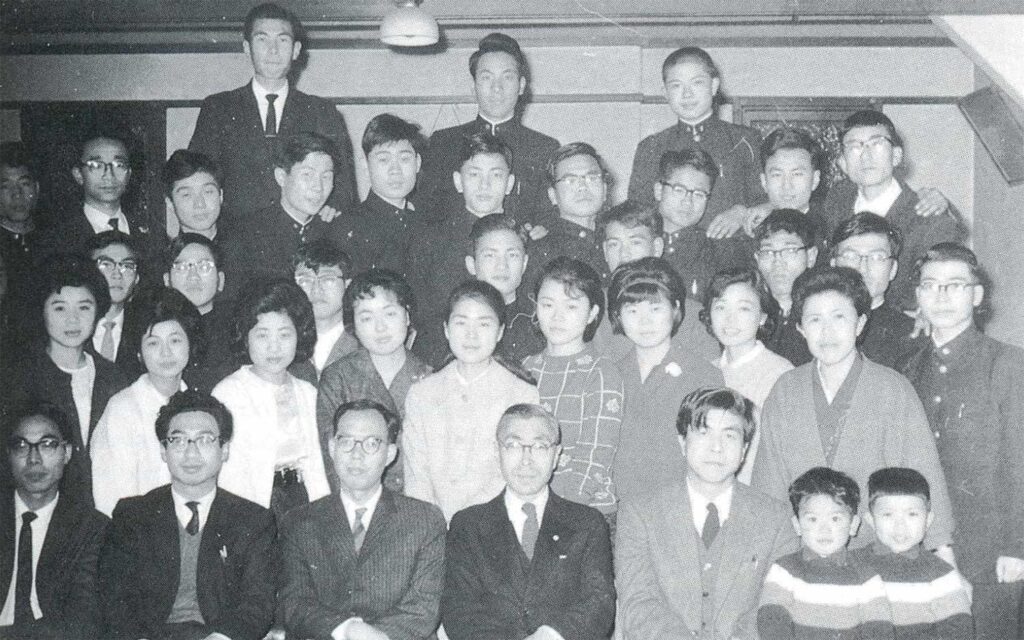
Hideo Oyamada, former National Leader of Japan
This fascinating life testimony was given almost 30 years ago on October 27, 1992 in Kodiak, Alaska at the missionary workshop in the presence of True Father and many missionary brothers and sisters.
Part 2 (click here to read Part 1)
Every day I would read five kinds of books. I made a list of all the great books, such as books on history, philosophy, literature, and especially autobiographies.
In junior high school the competition was severe in the entrance examinations for high school and college. At that time of my youth, the most important thing for me was to make a wonderful future, but that meant always competing with the other students.
Introduction to philosophy
When I was in high school, a few teachers taught me about philosophy and about the deepest aspects of history. I learned about Immanuel Kant, the famous German philosopher at the beginning of the nineteenth century. When I heard a few of the ideas contained in his famous book, Critique of Pure Reason, my whole body trembled. I bought his Critique of Practical Reason and tried to read it when I was in high school, but it was so difficult.
I became pessimistic. My teacher was worried about me and said, “You are so young, but so pessimistic. Be careful, otherwise you may commit suicide. You had better not read Oriental books; read Western books.” He introduced me to Michel Montaigne, a French humanist philosopher of the Renaissance.
I started exploring Western thought systematically; first I read Plato’s Republic, then Aristotle and Augustine, while I was still in high school. However, there was always a wide gap between my ideal and reality; the two were always fighting. I was always conscious of this struggle. Martin Luther wrote, “Every human being is a genius at loving himself.” This is because of our fallen nature.
I studied and studied. My major should have been philosophy, but at the end of high school I became acquainted with the works of Johann Pestalozzi, a Swiss educational reformer of the eighteenth century who is well known in Germany and France. After France defeated Germany, there were many orphans, and Pestalozzi built a great school for war orphans and took care of them in a family atmosphere.
When I read about that, I thought,
“Okay, that is my mission: education. Not in some big city, but in a far-away mountainside or in a village. I will dedicate my whole self to that.” That became a practical task for my whole life, but at the same I loved truth. Philosophical thinking was combined with religion within myself.
Communists…and a Christian
Originally I had wanted to go to school in Tokyo, but my family was very poor. I realized how hard my parents and elder brothers and sisters were working. If I went to school in Tokyo, it would have been a big financial burden to my parents. My mother is more philosophical, a deep thinker and spiritually inclined. My father always loved the future, sometimes neglecting present reality. My mother said, “Please don’t say no with a big mouth.” She always had a universal, historical way of thinking, but the reality was so poor. Because of that, I moved to Sendai, but I was so grateful.
An aunt of mine is a very spiritual lady. Before I decided whether to go to Tokyo or Sendai, she prayed. A revelation came to her, and she said to me, “If you go to Sendai instead of Tokyo, you’ll meet someone special—a special teacher, a best friend.” So, at the last minute I changed from Tokyo to Sendai. I chose educational philosophy as my major.
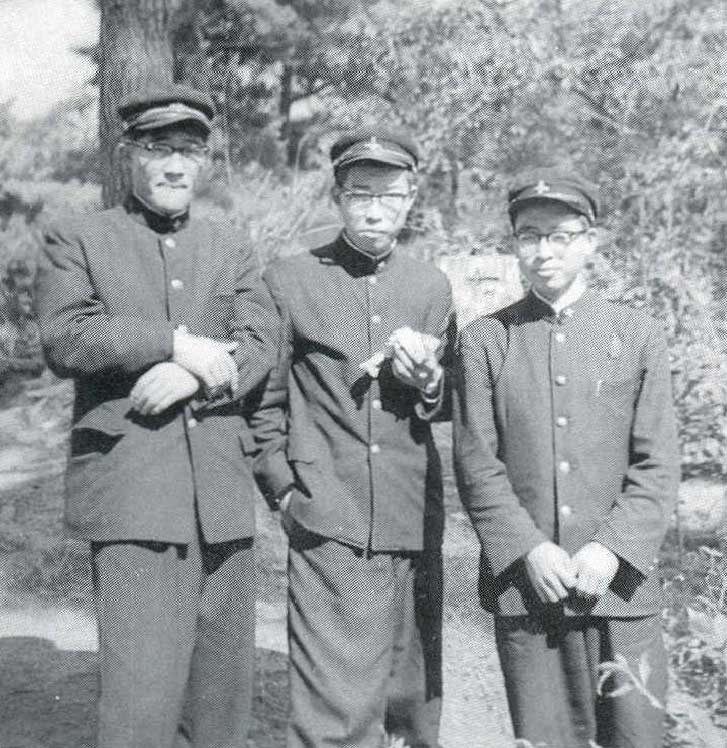
I entered the university in 1960, during a time of gigantic demonstrations by radical students in opposition to the United States-Japanese treaty of mutual cooperation and security under Prime Minister Nobusuke Kishi. All over Japan, the university campuses were completely influenced by communist and radical students. Every day, from morning to night the students were out in the streets fighting with the police. I did not get involved, because I felt those things were not important. I was sacrificing my parents and felt that the time was too precious.
In those circumstances, I became isolated. I had no connection with political movements, least of all with communists. The surrounding circumstances pushed me in front; but my goal was to study. The communists took away our books. The teachers’ labor union joined the radical students, and communist agitators invaded the classrooms. They especially came to my classroom, because I was studying education and intended to become a teacher.
Because of so much fighting perpetrated by the communists, that year was a complete disappointment for me. Even the university could not teach me the truth I was seeking. Therefore, I decided to study by myself. I went to the library, especially on Sundays, since at that time I didn’t go to any church. I would also go far away to the mountainside or the seashore, praying and contemplating, seeking truth and a teacher.
In the Department of Philosophy, students needed many foreign books, especially German and English ones, which were very expensive. Since my family couldn’t afford such expensive books, I got a job from Monday to Saturday teaching younger students.
One of my students was a thirteen-year-old girl from a Catholic family. A little before Christmas she was studying the Catholic catechism and she asked me, “Teacher, why don’t you go to church?”
“I don’t believe in God,” I answered.
“Why don’t you believe in God?” she persisted.
“I am a student of philosophy,” I replied. Then, starting from Greek philosophy, I talked to that young girl for thirty minutes about the historical debates over God’s existence. She didn’t understand much of what I was saying, but then she said, “If you deny the existence of God, that is a very awful thing, isn’t it?”
“Oh, you are talking nonsense,” I said. “If I just understand the concept of God, I don’t have to worry about such troubles.”
Still she insisted, almost crying, “Why don’t you go to church? God does exist!”
Researching Christian churches
On my way back to my dormitory, I thought to myself, “If I could believe something, I would be so happy.” My brain and heart were always so full of doubt, questioning everything. “I will try to go to church,” I decided.
Until then I had been studying the Bible but didn’t go to church. I was taking a Bible correspondence course. I knew about God, sin, resurrection and Jesus Christ. I continued to study the Bible, but knowledge alone doesn’t work.
“How many churches are there in Sendai,” I wondered. I found more than sixty of all kinds and decided to check each of them, one by one. There were Wednesday evening services, Saturday Bible classes, and Sunday services. I planned to check three churches a week, and in two months, I would finish all the churches on my list.
I began visiting churches at the end of my freshman year. In one of these churches, the minister was a wonderful preacher. There was an odd-looking guy sitting beside me, an American Protestant missionary named Carl Schweitzer. He was a very special person, unmarried, and a teacher of theology and English literature. He said to me, “You are a new face here. Why did you come to the church?” This Sunday speech was so nice; I was very moved, almost to tears. “Japanese sermons are too passionate, lacking reason,” he told me, making objective criticism. What he was talking about was risei, which is the Japanese concept of reason. There should in theory be a harmonized unity between reason and passion, risei and kanjo. That is correct, because passion or faith without reason is very weak when persecution occurs. I learned that point.
Then he criticized me: “You should know objectively what Japan has in opposition to the West.” He introduced me to the works of Ruth Benedict, a famous American anthropologist. Benedict never visited Japan, but she wrote a famous book about Japan, The Chrysanthemum and the Sword: Patterns of Japanese Culture (1946). It is a pioneer comparative study of the differences between Japanese and Western civilization. Benedict shows that the standard of Western civilization is “sin culture,” while the standard of Japanese people is “shame culture.”
Therefore, I learned many things while visiting churches. I read mostly Western literature, seeking to understand the roots of Western civilization. My brain became more westernized, although my way of life was Japanese. Therefore, East and West were fighting within me, and from Monday to Friday the communist movement challenged me at school.
Continued next week….