Press release on Supreme Court ruling that echoes views of anti-religious lawyers group exploiting donations to religious organizations
Official statement regarding the Supreme Court ruling dated 11th July 2024 in an appeal case
prepared by Knut Holdhus
Press release 12th July 2024, by the Public Relations Department of the Family Federation for World Peace and Unification of Japan, translated from Japanese. See the Japanese original version.
Regarding the Supreme Court’s ruling on the appeal yesterday, 11th July 2024, we are posting the views of the Family Federation of Japan.
Yesterday, the Supreme Court handed down its ruling in a case about claims for damages related to donations. In the current three-tier judicial system, we take the Supreme Court’s decision seriously. However, we also believe that there are problems with the content of the ruling in the following areas:
This ruling:
- Invalidates the portion of the notarized memorandum (念書) from the notary office that indicates an agreement not to prosecute.
- Requires the High Court, which is the second instance, to reconsider whether the donations made by the believer constitute “damage” due to an unlawful act, as the criteria used by the High Court were deemed unreasonable by the Supreme Court.
Regarding this Supreme Court ruling, we consider it unjust for the following reasons. Below, we present our organization’s views on the two main points of contention.
1. The validity of the memorandum
Regarding the validity of the memorandum, the Supreme Court made the following judgment:
(Believer A), for about ten years, faithfully followed the teachings, made substantial donations exceeding 100 million yen, traveled to South Korea numerous times to participate in ancestor liberation ceremonies, and was under the psychological influence of the defendant, the Family Federation. Thus, it can be argued that Believer A was in a situation where objectively assessing the pros and cons of the proposal from the Family Federation was difficult.
However, adhering to religious teachings and making donations, as well as participating in religious rituals, are acts based on faith. Labeling this as being “under the psychological influence of the Family Federation” denies the individual’s genuine faith and implies a form of “mind control” by the religious organization. The concept of “mind control” has been thoroughly debunked as unscientific by academic circles and courts in Western countries. Although the Supreme Court avoided explicitly stating this, adopting such a perspective is extremely unjust.
Additionally, as a reason for invalidating the memorandum, the Supreme Court stated:
The content of the non-prosecution agreement in this case stipulates that Believer A will not pursue any claims for damages based on unlawful acts, despite making substantial donations exceeding 100 million yen. This results in blocking the means to recover damages from the solicitation activities, and considering the amount of the donations, the degree of disadvantage to Believer A is significant.
However, at the time of creating the memorandum, Believer A had no awareness that making donations constituted a form of harm. What exactly do “damage” and “disadvantage” mean in this context? The case has been remanded to the High Court, and the determination of whether there were unlawful acts and whether there was any “damage” is left to the retrial. Yet, the Supreme Court, without waiting for this, invalidated the memorandum on the assumption that “damage” had occurred. This is nothing short of “putting the cart before the horse”.
Additionally, despite being bound by the factual findings of the lower courts (1st and 2nd instances), the Supreme Court’s ruling contradicts these findings. The factual determination – the fact that Believer A wrote the written agreement and its content reflected Believer A’s intent – was disregarded. Instead, the Supreme Court indicated that the creation and content of the written agreement were proposals from the Family Federation and that the non-prosecution agreement was concluded under the leadership of the Family Federation’s believers. This deviation from the factual findings constitutes a violation of civil procedure law.
2. Unlawfulness of the donation solicitation activities
Secondly, regarding the original court’s judgment that the donation solicitation activities in question were lawful, the Supreme Court ruled that only some of the circumstances to be considered were addressed and thus judged that the “trial was insufficient.”
However, the considerations highlighted by the Supreme Court include not only the circumstances of the donor at the time of making the donation but also events occurring years after the donation. Determining the unlawfulness of accepting donations based on circumstances that the recipient was unaware of or could not have known presents significant issues.
Unlawful acts require subjective intent on the part of the actor, and assessing deviations from social acceptability regarding facts unknown to the actor goes beyond the framework of tort law [Editor’s note: Tort law is the branch of law that addresses the majority of civil lawsuits. Its purpose is to remedy wrongs committed against individuals and offer relief from others’ wrongful actions, typically through monetary compensation. The primary goal of tort law is to fully compensate for proven harms.]
Holding someone liable for consequences resulting from facts they were unaware of would be unjust.
Furthermore, despite the fact that the lower courts (1st and 2nd instances) did not establish specific details of the solicitation for donations (such as when, by whom, and how), the Supreme Court stated that “each donation was made in response to solicitation by believers of the Family Federation.” This assertion contradicts civil procedure law and is clearly unreasonable.
In summary, this judgment appears to prioritize a predetermined conclusion over principles such as private autonomy and respect for factual findings made by the lower courts.
July 11, 2024
Legal Affairs Bureau, Headquarters of the Family Federation for World Peace and Unification
Click here to read more on Religious Persecution
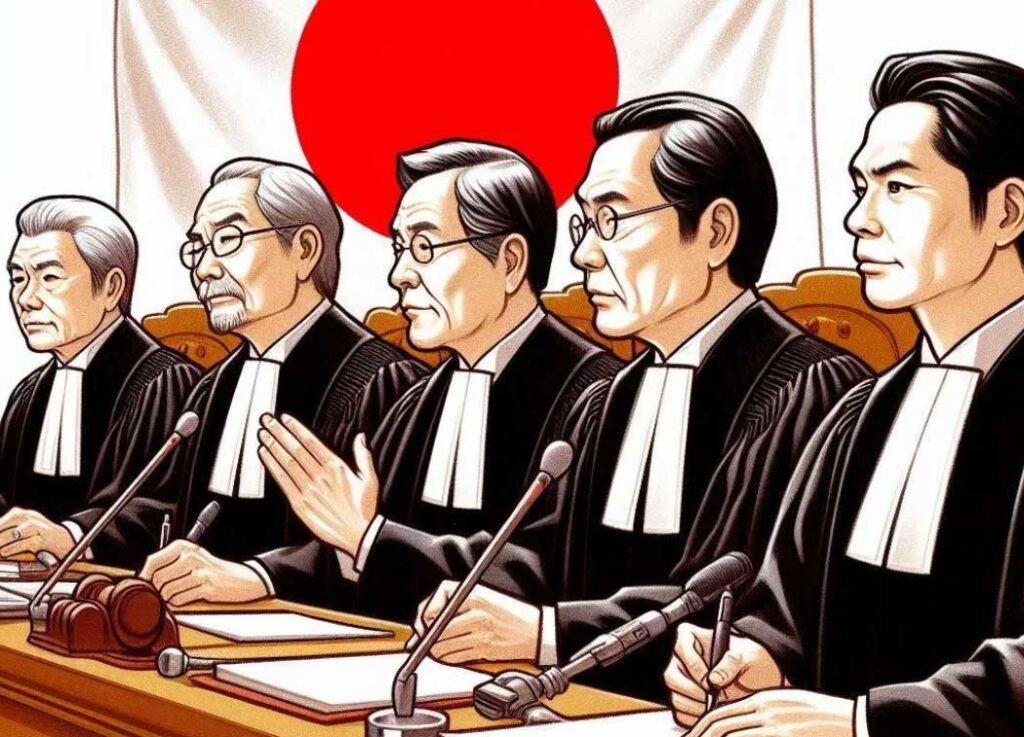
Featured image above: Five judges of the Japanese Supreme Court issuing a verdict. Illustration: Microsoft Designer Image Creator 14th July 2024.