Tokyo symposium hears pastor’s confession and how the many victims of coercive faith-breaking may restore the broken bonds to abusive parents and pastors turned deprogrammers
Tokyo, 2nd March 2025 – Published as an article in the Japanese newspaper Sekai Nippo. Republished with permission. Translated from Japanese. Original article.
A Believer Gives a Lecture on Efforts to Repair Parent-Child Relationships Broken by Abduction and Confinement
“I Didn’t Want to Confine Them” – A Pastor’s Confession
by Yasuhiro Uno (宇野泰弘)
Prepared by Knut Holdhus
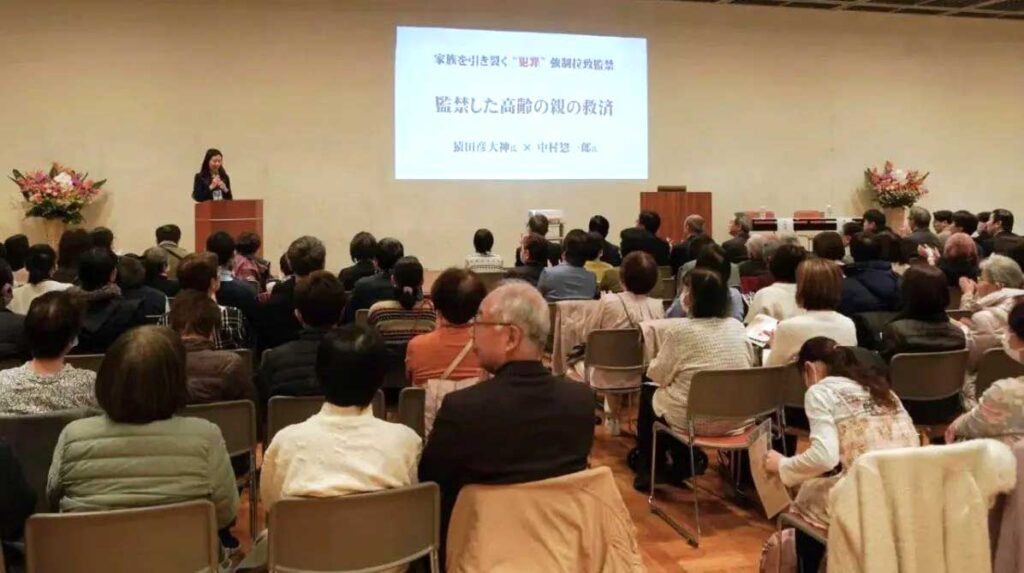
A symposium discussing the issue of abduction and confinement of believers of the Family Federation for World Peace and Unification (formerly the Unification Church) was held on 2nd March 2025 in Kita Ward, Tokyo. Ōkami Sarutahiko (猿田彦大神), co-representative of the “Heaven’s Eight Paths Association” (天の八衢の会), which works to restore parent-child relationships torn apart by such incidents, delivered a lecture stating, “To resolve the issue of abduction and confinement, we must support not only the parents but also the pastors involved.”
Having been a victim of abduction and confinement three times, Sarutahiko explained the mindset of his mother, who carried out the act: “She felt something was wrong when she was told to do it, but she stopped thinking. She felt she had no choice but to go through with it.”
Following his experiences, Sarutahiko found that his relationship with his parents had been severely damaged. He engaged in prolonged conversations to rebuild their bond, believing that “restoring parent-child relationships is impossible without understanding the feelings of the parents who confined their children.”
During his lecture, Sarutahiko also shared an episode about the late Pastor Keiko Kawasaki (川崎経子) of Tanimura Church, United Church of Christ in Japan. Kawasaki had been involved in coercively breaking the faith of Family Federation believers for many years. However, Sarutahiko began engaging with her, believing that “rather than confrontation, dialogue and understanding were necessary.”
One day, Kawasaki tearfully confessed to him, “I never actually wanted to confine anyone. I got involved because I was told it was a bad organization.”
Later, as their trust deepened, Sarutahiko asked if she would help in restoring parent-child relationships. She responded, “I would gladly do so.”
Regarding the issue of abduction and confinement, Sarutahiko pointed out that both parents and pastors involved in coercive faith-breaking [See editor’s note below] likely acted based on preconceived notions that “the Family Federation is evil,” formed from secondhand information from third parties. As a result, they may have felt compelled to take action.
Featured image above: The symposium venue was packed with attendees – 2nd March 2025, Kita Ward, Tokyo Photo: Yasuhiro Uno (宇野泰弘)
[Editor’s note: Coercive faith-breaking in Japan refers to the practice of coercively attempting to separate individuals from their religious affiliations or beliefs, typically through intervention by family members, professional faith-breakers (deprogrammers) or organizations hostile to new religious movements (NRMs). This phenomenon often targets members of such movements, e.g. relatively large faiths like the Family Federation or Jehovah’s Witnesses, but also smaller groups like Happy Science (Kōfuku no Kagaku) and other newer religious movements. However, also Soka Gakkai, a Buddhist-based lay organization with more than 8 million Japanese members, and affiliated with Nichiren Buddhism, has occasionally been subject to faith-breaking attempts.
The practice gained attention in the latter half of the 20th century, particularly in the 1980s and 1990s. Parents or concerned family members often hired faith-breakers who taught them how to abduct and forcibly detain believers. Almost all such cases involved confining the individual believer and cutting him or her off from the religious community. During the confinement, the believer was subjected to intense questioning or indoctrination designed to break his or her faith. The aim was to “rescue” the person from what the family often had been tricked by faith-breakers or lawyers to regard as harmful influence from the religious organization.
Critics of forced de-conversion argue that it violates fundamental human rights, including freedom of thought, religion, and association. Reports of psychological trauma and accusations of unlawful detention have sparked debates over its ethical and legal implications. In response, some religious groups, particularly NRMs, have lobbied for greater protections against such practices.
Japanese courts have been inconsistent in addressing cases of coercive faith-breaking. While some verdicts have condemned the practice as illegal detention, others have been more lenient, citing family concerns about “mental health” or alleged “exploitation” as mitigating factors.]