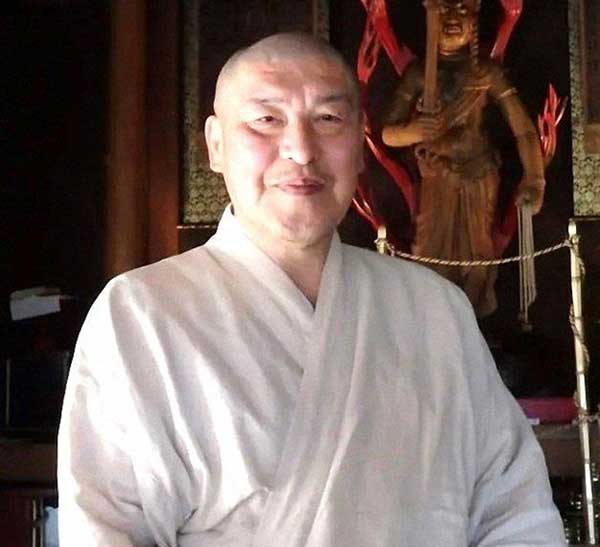
Buddhist chief priest points to the Japanese government’s handling of religious minority as evidence of current authorities’ general mistrust of religion
Tokyo, 26th November 2024 – Published as the 40th article in a series in the Japanese newspaper Sekai Nippo. Republished with permission. Translated from Japanese. Original article
Chief Priest of Chogyoan (聴行庵) Buddhist Temple, Wako Higashi (東和空)
Freedom of religion ties together state and individual
by the editorial department of Sekai Nippo
Prepared by Knut Holdhus
First, as a Buddhist, I have been mindful not to irresponsibly voice opinions on matters without fully understanding the facts. In a sense, I have questioned the veracity of reporting that, in its approach, seems to belittle the personal faith of individuals and opportunistically broadens issues related to certain organizations without due consideration.
Against this backdrop, I cannot help but feel a tinge of unease at the prospect that this series of government procedures may reveal political motives targeting religious corporations. It raises a concern that this might well run counter to the lofty divine or spiritual intention behind the concept of “freedom”, which is a profound blessing bestowed upon human society.
For example, I sensed political motives behind the timing of the government’s request [Editor’s note: request for a court order to dissolve the Family Federation], which coincided with an upcoming extraordinary Diet session and by-elections for the House of Representatives [Editor’s note: Lower house in the national parliament] and the House of Councilors (upper house), as well as in their apparent intent to show a firm stance toward the religious organization in question.
Additionally, one approach to determining whether to issue a dissolution order considered the existence of criminal cases as a criterion. But it seems there now also exists a theoretical framework to justify the request for a dissolution order by directly applying civil law in order to highlight unlawful actions by the organization.
Furthermore, it was decided not to open the Religious Corporation Council [Editor’s note: The Religious Corporations Council in Japan is an advisory body to the Minister of Education, Culture, Sports, Science and Technology (MEXT). It plays a role in overseeing and advising on matters related to religious corporations. The council is composed of experts, academics, and representatives from diverse fields, including legal scholars, sociologists, and individuals familiar with religious practices. Its members are appointed by the Minister of MEXT. The Council is meant to ensure that any government intervention respects the constitutional guarantee of religious freedom while maintaining public welfare.] to the public and not to disclose the minutes of the meetings.
This could be seen as a political disregard for religion. Therefore, it is essential to clarify the process and reasoning for calling into question – based on an arguably naive assumption of innate goodwill – the suitability of a religious corporation. Unless this is clarified to the roughly 650,000 religious instructors in Japan, the impression of mistrust of religion will be difficult to erase in the future.
For this reason, I sincerely hope that this series of deliberations and the public’s interest in them will adhere to the fundamental principle of “freedom of religion” and be conducted with full democratic control and transparency.
In Buddhist teachings, ‘freedom’ means relying on oneself. It refers to a way of living that maintains relationships with the external social environment without being swayed by it – a state in which one’s personal convictions are firmly established. While we are inherently free, we become trapped, biased, and fixated on ourselves, others, and our surroundings, which causes suffering.
In this context, the government’s recent handling of religion in contemporary society has left a significant message about our freedom to pursue happiness. As we reflect on whether religion, which has historically served as a bridge between the nation and the individual, has upheld the spiritual freedom of human beings, we must also ask whether the state has truly respected freedom of thought, conscience, and religion. Additionally, has the press refrained from overreaching into matters of free expression and academic freedom?
Understanding that human ideals and happiness rely on the ability of free individuals to maximize their potential within society, I, as a Buddhist monk, feel deeply the need to reconcile the enormous gap between these ideals and the current reality. This disparity significantly reduces the level of happiness of the Japanese people.
If this sense of stagnation or unease could be alleviated through the influence of religion, it would involve enhancing happiness through means beyond income or material wealth. Factors such as societal freedom, tolerance, and the absence of corruption play significant roles in this endeavor. Observing the ongoing individualization of society and the evolving personal nature of religious practice, it becomes clear that a warm-hearted freedom is increasingly intertwined with personal happiness.
When considering individual freedom, we must ask whether it is a freedom recognized by others, a freedom that does not harm either party, or a freedom that contributes to national interests. At the same time, it is crucial for society and organizations to recognize that the freedom of individual consciousness is inherently linked to the broader social freedom in parallel worlds [Editor’s note: In Buddhism, “parallel worlds” can be understood as multiple coexisting realms of existence, infinite world-systems in the cosmos, or subjective realities created by karma and perception], and to be aware of the interdependent nature (interconnectedness) of all living beings.
To comprehend the true freedom and order that the divine and Buddha espouse amidst the chaos (entropy) of conflicting interests and impermanent activities, we pray not only to win by majority rule. Instead, we should aim for gradual reconciliation, where both sides stand on equal footing, respecting essential order and national interest with dignity. May this process lead to a harmonious resolution.
Sincerely, with hands joined in prayer,
Wako Higashi (東和空), Chief Priest of Chogyoan (聴行庵) Temple.
Click here to read more on Religious Persecution
Featured image above: Wako Higashi in January 2024. Photo: Sekai Nippo