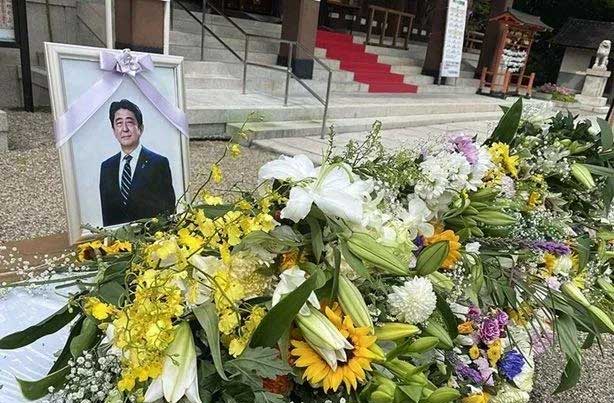
Three years since the murder of former Prime Minister Abe, there are many missing answers as society is effectively playing into the hands of terrorists who sought to influence the public
Tokyo, 8th July 2025 – Published as an article in the Japanese newspaper Sekai Nippo. Republished with permission. Translated from Japanese. Original article.
[Editorial]
Three Years Since Abe’s Assassination: Where Are the Politicians Who Will Inherit His Vision?
by the editorial department of Sekai Nippo
Prepared by Knut Holdhus
It has been three years since former Prime Minister Shinzo Abe (安倍晋三) was struck down by an assassin’s bullet and met an untimely, tragic death. As domestic and international affairs grow increasingly chaotic, the magnitude of his loss is becoming ever more apparent. This moment calls for renewed reflection on the significance of the incident, as well as a remembrance of Abe’s political legacy and ideals.
The LDP’s core conservative base is drifting away
Abe’s greatest legacy was the creation of a new international political framework led by Japan to defend freedom – embodied in the “Free and Open Indo-Pacific” initiative and the Quad (Japan-U.S.-Australia-India strategic dialogue). Today, countries around the world, including Japan, are struggling to cope with U.S. President Trump’s aggressive tariff policies. Abe, who earned Trump’s trust more than any other world leader, is clearly a global loss. Politicians must learn from Abe’s diplomacy and negotiate with Trump with the same sense of scale.
Advocating for a “departure from the postwar regime”, Abe promoted key conservative initiatives such as laws paving the way for constitutional revision and security legislation. While he also implemented many centrist policies, they were grounded in a firm national vision. Even when compromise was necessary, he remained anchored by a solid core. This consistency supported the longest and most stable administration in Japan’s constitutional history.
With Abe’s assassination, Japan lost a politician who had both a firm ideological backbone and the capacity to pragmatically handle reality. The Liberal Democratic Party’s conservatism has since been hollowed out, and the party is beginning to lose support from its once rock-solid conservative base. Meanwhile, parties like the Sanseito and the Japan Conservative Party – who appeal to dissatisfied conservatives, have gained seats in the Diet, but their proliferation gives the impression of fragmented mini-parties.
Conservative sentiment is on the rise, and many voices are calling for someone to carry on Abe’s ideals. The real issue is that no politician has emerged as a unifying figure to fulfill that role.
A democratic society undermined
Initially, when former Prime Minister Abe was shot while campaigning for the Upper House election, politicians and the media harshly condemned it as “a grave challenge to democracy”. However, when it emerged that the suspect, Tetsuya Yamagami (山上徹也), was motivated by resentment toward the Unification Church (now known as the Family Federation for World Peace and Unification), which his mother had joined, media coverage shifted to a more sympathetic tone. The focus turned to the religious organization itself, and the relationships between LDP politicians and the organization came under fire.
In response, the government filed a request for the dissolution of the religious organization, which is now under judicial review. But in doing so, society is effectively playing into the hands of a terrorist who sought to influence the public and settle a personal grudge by assassinating a high-profile political figure. This is not merely a challenge to democracy – it amounts to a hijacking of a democratic society.
The truth behind the incident must be investigated
The police pursued the case as a lone-wolf act by Yamagami. The first trial is scheduled for 28th October, and it is expected that the facts of the case will not be contested, with the focus instead on sentencing based on the defendant’s background and circumstances.
However, since the beginning, many have questioned whether this was really a solo act. There are serious, reasonable doubts that cannot be dismissed as “conspiracy theories” – such as the significant discrepancies between the medical opinion of Dr. Hidetada Fukushima (福島英賢) of Nara Medical University Hospital, who treated Abe, and the official autopsy report by the Nara Prefectural Police; or the fact that the fatal bullet has never been recovered.
Given the profound societal impact of the incident, we must reinvestigate the connections behind it and uncover the full truth.
Featured image above: On 8th July 2023, a flower offering stand was set up at Osaka Gokoku Shrine for the first anniversary memorial (isshuuki) of former Prime Minister Shinzo Abe. Organizer: The Itagaki Taisuke Memorial Association (a general incorporated association). Photo: Photo memories 1868 / Wikimedia Commons.