Forgery scandal as members and ex-members accuse government ministry of evidence fabrication in bid to dissolve Family Federation
Tokyo, 9th September 2025 – Published as an article in the Japanese newspaper Sekai Nippo. Republished with permission. Translated from Japanese. Original article.
“I Never Said That,” Says Former Believer; Ministry of Education Staff Accused Over Statements
Request for Dissolution of the Family Federation
by the Religious Freedom Investigative Team of the editorial department of Sekai Nippo
prepared by Knut Holdhus
In connection with the Ministry of Education, Culture, Sports, Science and Technology’s (MEXT) request to the court for a dissolution order against the Family Federation for World Peace and Unification (FFWPU, formerly the Unification Church), several former members filed a criminal complaint on 5th September against six ministry officials, including the former head of the Religious Affairs Division of the Agency for Cultural Affairs. They allege that written statements submitted as evidence of legal violations justifying dissolution were fabricated.
The charges filed with the Tokyo District Public Prosecutors Office include forgery of private documents with official seals and use of forged documents. This sheds light on misconduct by the ministry that had been hidden behind closed-door proceedings.
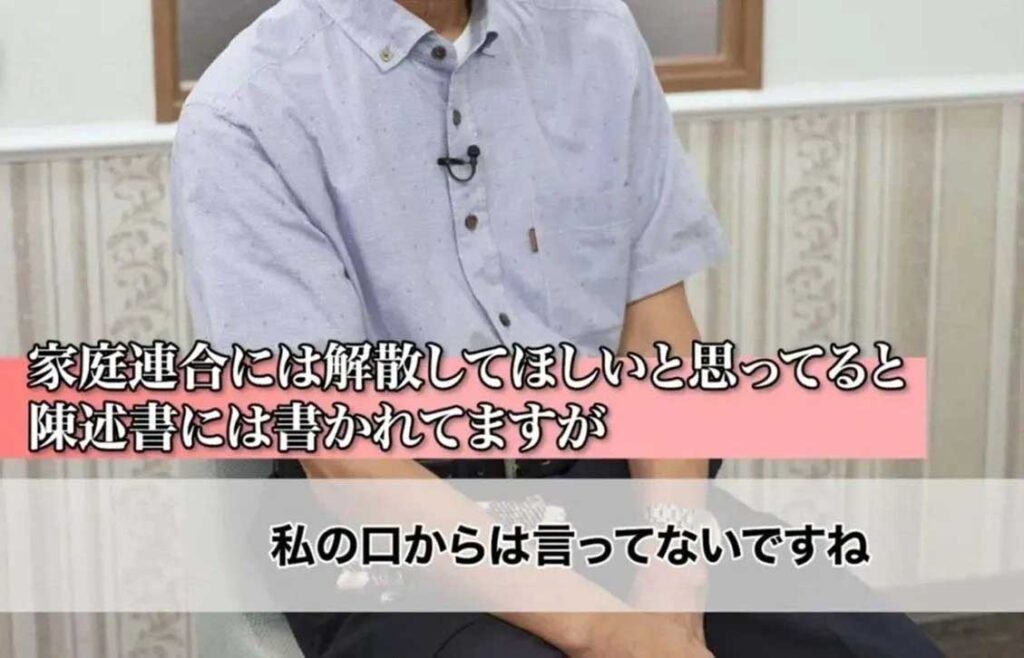
One of the complainants, a former male believer referred to as Mr. A, testified via video at the press conference that discrepancies existed between what he had actually said and what was written in his statement. Mr. A explained that he joined the church after being advised by relatives, as he was the eldest son of a farming family and had difficulty finding a marriage partner, and he studied the teachings with the purpose of finding a spouse.
However, the written statement submitted to the court by MEXT claimed he had participated in a mass wedding after being told that “joining would absolve the misdeeds of his ancestors,” and that he had been made anxious and pressured to participate. It also described him as having been threatened with talk of ancestral sins and “squeezed for donations.” But Mr. A insists he had no such perception.
While he did exchange documents with the ministry for confirmation purposes, he later discovered that wording he did not recall ever saying – such as “I want the church to be dissolved” – had been added. “I never said that. It wasn’t even in the documents that MEXT sent me,” he said, expressing deep distrust.
Another complainant, a former female believer referred to as Ms. B, was also troubled by fabricated content. Her statement included a passage claiming she “was persuaded by her daughter to make donations.” But her daughter, Ms. Oyama (pseudonym), who had actually joined the church at her mother’s invitation, denied ever saying such a thing when she spoke with her mother about the statement: “What is that? Where did it come from?” Ms. B herself had no memory of making such testimony, and when her daughter explained the details of the statement, she was shocked.
Ms. B had been interviewed by phone by MEXT officials around November 2023. Her statement, under her name, was 34 pages long in small 9-point font – too difficult for an elderly person to check thoroughly on her own. No reading aloud or confirmation work was conducted. The complaint asserts, “From the beginning, there was no intention of having Complainant B confirm the content,” and harshly criticizes the ministry’s sloppy procedures.
As a co-complainant, Ms. Oyama spoke at the press conference: “Donations are branded as shady, and as people age, religious practitioners are dismissed easily. Watching my mother, it feels like her whole life is being denied. I want to stop a society where such injustice prevails.”
Another complainant, Mr. Hiroshi Ogasawara ((小笠原裕 – 62), a current member living in Yachiyo City, Chiba Prefecture, also attended. He had filed a complaint in December last year over suspected forgery of two statements discovered during questioning procedures at the Tokyo District Court. Former believers whose statements had been submitted testified in court but repeatedly gave accounts contradicting the written statements or said they had “no memory” of the contents.
Of the 123 statements prepared and submitted by MEXT, four have now come under suspicion of fabrication based on the testimony of the supposed authors, leading to the complaints. To ensure fairness, the defense argues, all 123 authors should be called to testify. Attorney Shinichi Tokunaga (徳永信一), representing the complainants, declared: “This suggests systematic involvement. If the government fabricated evidence, it would be a huge scandal.”
Meanwhile, Education Minister Toshiko Abe (阿部俊子)argued at a February press conference that publicizing the alleged forgeries “goes against the purpose of keeping proceedings closed” and deemed it inappropriate. However, she avoided commenting on the truth of the forgery allegations.
Attorney Tokunaga stressed, “This must never be buried in history. It should become a case studied in textbooks.”
Featured image above: On 5th September 2025, Mr. A, the complainant, testifies via video during a press conference on the criminal complaint against Ministry of Education staff. Screenshot from YouTube channel “Association of Second-Generation Members for the Protection of Believers’ Human Rights.”