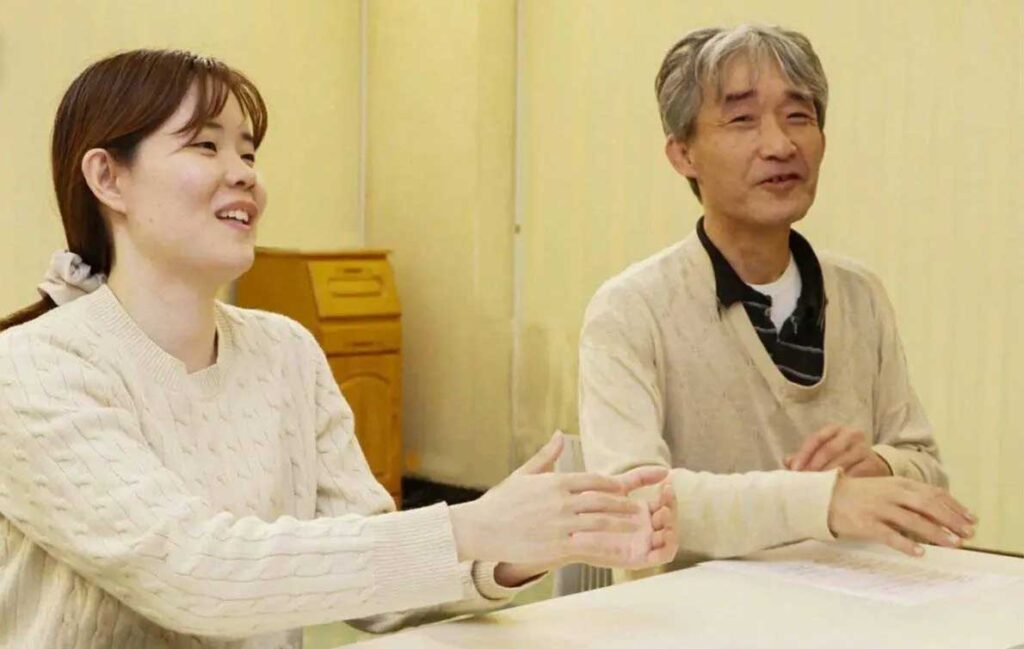
Engaging in a larger battle – Interview with former and current members brings up new ideas for the way ahead after the dissolution order verdict
Tokyo, 19th May 2025 – Published as an article in the Japanese newspaper Sekai Nippo. Republished with permission. Translated from Japanese. Original article.
Voices of Former and Current Believers
Court Order to Dissolve the Family Federation
by Yasuhiro Uno (宇野 泰弘)
Prepared by Knut Holdhus
“Learn from other religions” – Masaki Nakamasa (仲正昌樹)
“The religious organization must engage with society” – Nozomi Kojima (小嶌希晶)
Masaki Nakamasa – Born in 1963 in Kure City, Hiroshima Prefecture, received his PhD from the University of Tokyo in 1996, currently a professor of law at Kanazawa University, specializing in the history of political thought and social philosophy. Major works include Postmodern Nihilism (Sakuhinsha) and Beyond Hegel (Kodansha).
Nozomi Kojima – Born in 1995 in Hokkaido. A second-generation member of the religious group Family Federation for World Peace and Unification (formerly the Unification Church). She is the head of the “Association of Second-Generation Members for the Protection of Believers’ Human Rights”. Advocates for freedom of religion and the rights of religious minorities hold symposiums and lectures across Japan.
The trial for the dissolution order against the Family Federation for World Peace and Unification (formerly the Unification Church) has moved to the Tokyo High Court. Regarding the decision by the Tokyo District Court and the issues facing the organization, we spoke with Masaki Nakamasa (仲正昌樹), a former member and professor at Kanazawa University, and Nozomi Kojima (小嶌希晶), a second-generation member and representative of the Association of Second-Generation Members for the Protection of Believers’ Human Rights.
Interviewer: Yasuhiro Uno (宇野 泰弘)
– The District Court’s decision is quite harsh for the religious organization.
Kojima: I couldn’t accept it at all – it was shocking. From the perspective of current believers, the religious organization has clearly improved. However, in today’s Japan, it’s become harder for people of faith to live freely. While we must take the decision seriously, I also wonder if the trial was conducted fairly.
– The dissolution order includes cases that were already settled. What are the problems with this?
Nakamasa: Even people with no connection to the religious organization are saying it’s strange to include settled cases as grounds for dissolution. It’s common sense that once a case is resolved, it shouldn’t be re-litigated or used later by a judge to say, “Actually, this side was at fault.”
– Your media appearances have decreased since the assassination of former Prime Minister Shinzo Abe. Why is that?
Nakamasa: Public interest in the Unification Church issue has gradually waned. Also, from the media’s perspective, people like Eito Suzuki (鈴木エイト) – who make stronger statements – might be more convenient.
– The religious organization now focuses on abduction and confinement issues and appeals for religious freedom. How do you see that?
Nakamasa: There’s no doubt that deprogramming through abduction and confinement is a problem. But it’s important to communicate how the everyday lives of believers are not that unusual. They should ask, “Is it really necessary to dismantle us?” There’s an impression they want to solve the issue by “taking down the central enemy,” but that’s not how reality works.
– There’s a public perception that believers blindly follow the religious organization’s leadership.
Nakamasa: People see the religious organization and its members as unconditionally obeying Hak Ja Han Moon, but that’s not entirely true. Like how Catholics don’t necessarily obey the Pope blindly, that nuance should be conveyed.
There’s also a strong lingering belief in Japan that the Japanese church should shoulder the financial burden of the global organization. Even if that’s no longer the case, admitting it once was could add credibility. They should clearly explain that they no longer siphon off believers’ assets to send to Korea. Veteran leaders could say, “We overextended ourselves in the past, but we wouldn’t let our children do that now.”
– You’ve also said the religious organization is too obsessed with “defeating communism”, leading to further isolation.
Kojima: The religious organization is trying hard to adopt a victim narrative now, but I find that a bit off. While it’s true the organization and its members have suffered – from things like being abducted and held captive – it’s also true that, over its 60+ year history and nearly 290 churches, our immaturity and overly strong faith have hurt former members.
Nakamasa: Thriving religions often adopt the stance: “Even if we disappear, it’s okay – as long as our ideals survive.” I remember in my time, the religious organization used to say things like, “There are people in real pain. We fight to protect them. It doesn’t matter what happens to us.” That spirit seems lost. Now they’re just focused on self-preservation, which is not a good reason to keep going.
– You’ve mentioned arrogant comments by believers on social media.
Kojima: I often hear members of the religious organization say, “Japanese people don’t understand religion.” But the general public’s resentment is not toward religion per se – it’s toward the Family Federation. Most Japanese people respect traditional religions. Blaming the dissolution order on “Japan’s lack of religious understanding” comes across as arrogant. Some might even say the Family Federation is the very reason Japanese people misunderstand religion.
– As a second-generation member, what do you think the religious organization should become?
Kojima: Since the dissolution order was filed, I’ve felt keenly the lack of allies. It’s painful to be misunderstood. I hope the religious organization will learn to engage with society and listen to painful criticism.
Nakamasa: That’s probably the key point. In times of crisis, an organization must be able to value that kind of engagement, or it won’t truly survive.
Kojima: Maybe our role is to engage in dialogue with society and deepen mutual understanding. Regardless of whether the dissolution happens or not, we should focus on communication.
Nakamasa: It’s important to identify what ideals members themselves have, aside from the goals handed down from the top. They should ask, “Besides protecting the religious organization, what do we really want to do?” Maybe they could hold open discussion forums to explore this.
– In other words, believers should express their own dreams and ideals in their own words.
Nakamasa: Exactly. It shouldn’t be just for the sake of the religious organization. If they could return to the attitude of “fighting for persecuted and suffering religions and cultures,” it might resonate more. They need to rethink what “fighting” really means.
– Are there other challenges the religious organization faces?
Nakamasa: Put simply, religions that restrict thought through rigid rules tend to self-destruct. Instead, they should liberate thought.
Kojima: Originally, the religious organization had a doctrine of “interfaith unity” (超宗教 – cho shukyo – transcending religious boundaries). We aren’t reprimanded for attending events held by other religious groups. When you think about it, the way of thinking is supposed to be something open and inclusive. But somewhere along the way, we started trying to force our thoughts into rigid molds of our own making. As a result, each of us may have unintentionally narrowed our own thinking and let things drift in the wrong direction. It was supposed to be more open and free.
Nakamasa: I feel the same way, as a former believer. They should actively go out and learn from other religions – saying, “Please teach us your views.”
Featured image above: Dialogue between Masaki Nakamasa (right) and Nozomi Kojima in Shinjuku, Tokyo. Photo:Reika Kato (加藤玲和)