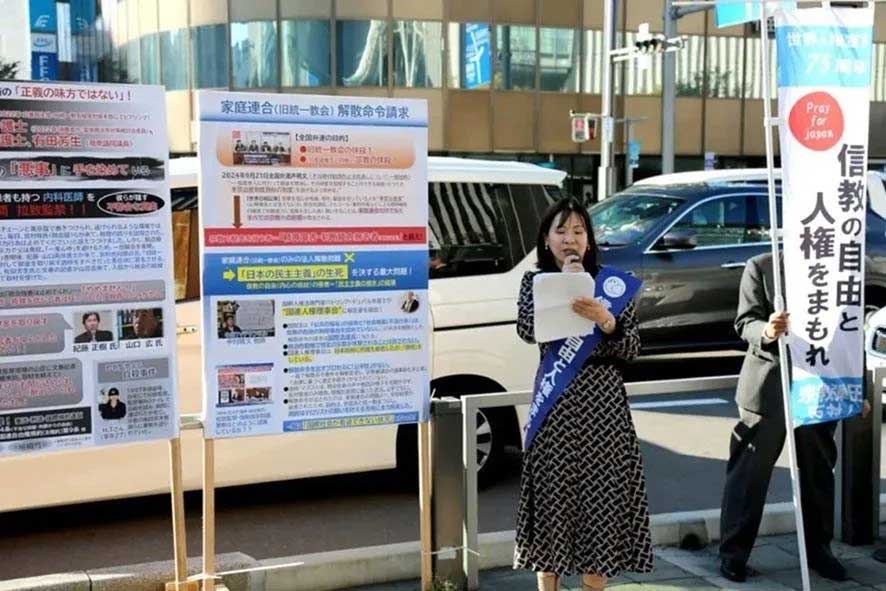
Demonstration against the business of faith-breaking where “faith-breakers received rewards in the millions of yen per case”
Tokyo, 7th November 2024 – Published as an article in the Japanese newspaper Sekai Nippo. Republished with permission. Translated from Japanese. Original article.
Forcible Faith-Breaking as a Business to Get Members Out
Family Federation Believers Hold Panel Campaign on Kidnapping and Confinement
by the editorial department of Sekai Nippo
Prepared by Knut Holdhus
A display was organized on 3rd November 2024, in front of the Japanese Railways (JR) Hakata Station, Hakata Ward in Fukuoka City, to inform citizens about the reality of forcible faith-breaking carried out on members of the Family Federation for World Peace and Unification (formerly the Unification Church).
The event, organized by the Fukuoka Prefectural Association for the Protection of Fundamental Human Rights and Freedom of Religion, featured a display panel on the issue of “kidnapping and confinement”. Six individuals distributed flyers while alleging the illegality of the faith-breaking activities, mentioning cases such as “There were victims who took their own lives in the bathroom of the apartments where they were confined. Some were forcibly hospitalized in psychiatric wards and administered drugs.”
One man campaigning at the event said tearfully, “Some may wonder whether these kidnappings and confinements truly occurred, but I am a victim myself.”
Another woman asserted, “Faith-breakers received rewards in the millions of yen per case. This is nothing more than a business to force people to leave the Family Federation.”
[Editor’s note: The forced deprogramming of members of the Family Federation for World Peace and Unification (previously known as the Unification Church) in Japan represents a huge human rights issue. Since the 1980s, thousands of Family Federation members have been subjected to deprogramming – coercive efforts led by professional deprogrammers, often involving family members, to force an individual to renounce his or her faith. This process typically includes physical confinement, intimidation, and psychological pressure, sometimes lasting months. In such cases, individuals have reported being held against their will, deprived of basic freedoms, and subjected to mental abuse.
Critics of these practices argue that they violate fundamental human rights, including freedom of religion, freedom of expression, and the right to be free from arbitrary detention, as enshrined in international agreements like the Universal Declaration of Human Rights. Although deprogramming practices have subsided in most parts of the world, they have persisted in Japan, reportedly fueled by widespread social stigma against the Family Federation. Many families, concerned about the group’s perceived influence and practices, enlist the help of third parties to “rescue” their loved ones. However, members argue that this justification does not excuse unlawful confinement and forced de-conversion efforts.
While Japanese authorities have faced international pressure to intervene, the issue remains contentious. The Family Federation has called on the Japanese government to protect its members and respect their rights to religious freedom, but police and courts in Japan have been criticized for their refusal to prosecute cases of forcible faith-breaking. Human rights organizations and advocacy groups have also condemned these practices, urging Japan to align its policies with international human rights standards. Despite this, the stigma and fears surrounding so-called “cults” and unconventional religious groups contribute to ongoing tolerance of forced deprogramming practices in Japan.]
Click here to read more on Religious Persecution
Featured image above: A female believer appealed to the public, using a panel display to highlight the illegality of “kidnapping and confinement”, 3rd November 2024, in front of JR Hakata Station, Hakata Ward, Fukuoka City, Kyushu, Japan. Photo: Sekai Nippo