Human Rights Advocates Condemn Japan’s Dissolution of Family Federation at Brussels Press Conference
Tokyo, 30th June 2026 – Published as an article in the Japanese newspaper Sekai Nippo. Republished with permission. Translated from Japanese. Original article.
by the foreign news department of Sekai Nippo
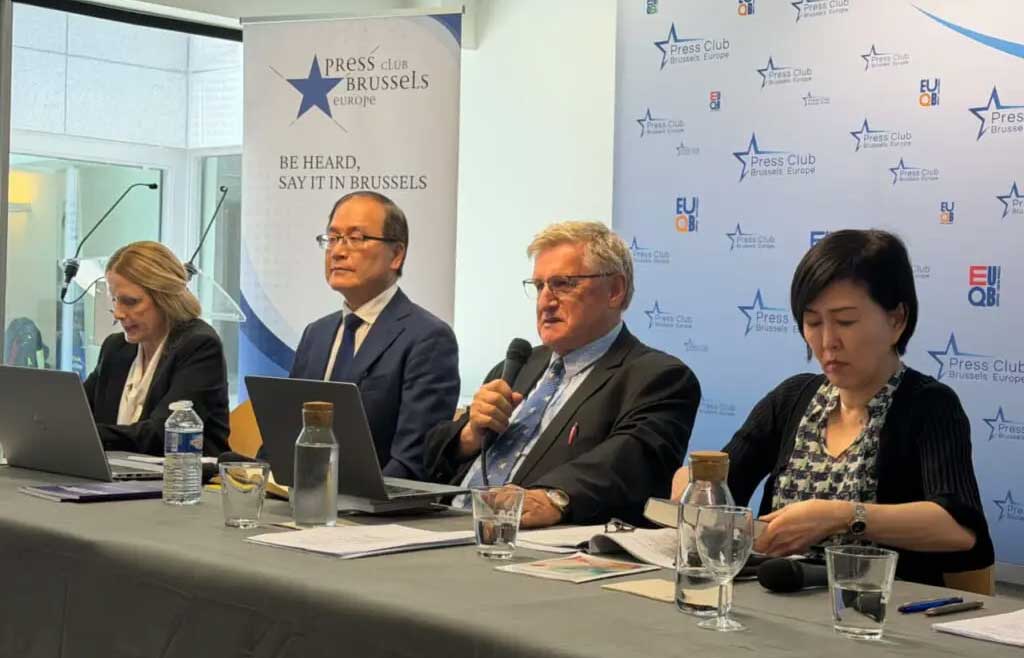
A press conference protesting what participants described as the unjust dissolution order against the Family Federation for World Peace and Unification (formerly the Unification Church) was held on 29th June at the Press Club in Brussels, Belgium. Along with nonfiction writer Masumi Fukuda (福田ますみ), representatives of international human rights organizations criticized the dissolution of the Family Federation and expressed serious concerns about the state of religious freedom in Japan.
Fukuda, author of The Sacrifice of the State (国家の生贄), a book addressing the issues surrounding the dissolution order against the Family Federation, criticized the ruling, saying, “This dissolution decision is unjust and cannot be regarded as the result of a rigorous trial based on evidence.”
She further argued, “Although the existence of illegal conduct was never proven, the decision was nevertheless handed down because of biased media coverage portraying the Family Federation as a ‘cult’.”
When asked why Japanese politicians have been reluctant to speak out on the issue, Fukuda replied that “simply defending the Family Federation has become taboo.”
As the reason for this, she pointed to the National Network of Lawyers Against Spiritual Sales (Zenkokubenren), a left-leaning lawyers’ organization politically opposed to the Family Federation. She stated that “for many years the lawyers’ network has spread the social stigma that the Family Federation is a problematic organization,” adding that society as a whole has been strongly influenced by this perception.
Willy Fautré, director of the international human rights organization Human Rights Without Frontiers, said, “For a nonviolent religious organization to be dissolved by court order constitutes one of the most serious interferences with freedom of religion in a democratic country.”
He continued, “Such measures have traditionally been viewed as problems associated with authoritarian states. However, Japan’s decision could have repercussions for other countries as well.”
French international human rights lawyer Patricia Duval stated that the dissolution order against the Family Federation “is not merely the dissolution of a legal entity; it is an issue concerning the eradication of a faith.”
She further claimed that there are efforts within the educational system to separate children from their parents‘ religion, adding, “This could be described as a form of deprogramming under another name – a serious interference with religious freedom.”
Norishige Kondo (近藤徳茂), who formerly served as deputy director of the church’s Legal Affairs Office, criticized the Supreme Court’s 22nd June decision to reject the religious organization‘s final appeal, thereby making the dissolution order final, saying that “there are serious problems with the court’s factual findings.”
He emphasized that the number of unlawful acts had declined substantially after 2009, and that by the time the government filed its petition for dissolution, such incidents had become extremely rare. Nevertheless, he argued that “the Tokyo District Court found unlawful conduct based on speculation without sufficient concrete evidence.”
He added, “Despite this being contrary to the principle that judicial decisions should be based on evidence, both the High Court and the Supreme Court upheld those findings.”
In addition, Kimihiro Okamitsu (岡光君啓), a second-generation member of the Family Federation and former head of a facility of the religious organization in Tokyo’s Shinjuku (新宿) district, delivered a video message describing the events on the day of the Tokyo High Court‘s ruling in March.
“Just 15 minutes after the judgment was handed down, the court-appointed liquidator demanded that we vacate the premises immediately,” he said.
“That was not simply a matter of real estate – it was the moment when the foundation of our faith was trampled upon.”
He questioned whether “a measure that deprives believers of their places of worship and their religious community can truly be regarded as a guarantee of freedom of religion.”
Featured image above: Participants at the press conference criticizing the dissolution order against the Family Federation for World Peace and Unification (formerly the Unification Church) at the Brussels Press Club on 29th June 2026. From right: nonfiction writer Masumi Fukuda; Willy Fautré, director of the international human rights organization Human Rights Without Frontiers; Norishige Kondo, former deputy director of the religious organization‘s Legal Affairs Office; and international human rights lawyer Patricia Duval. Photo: Sekai Nippo