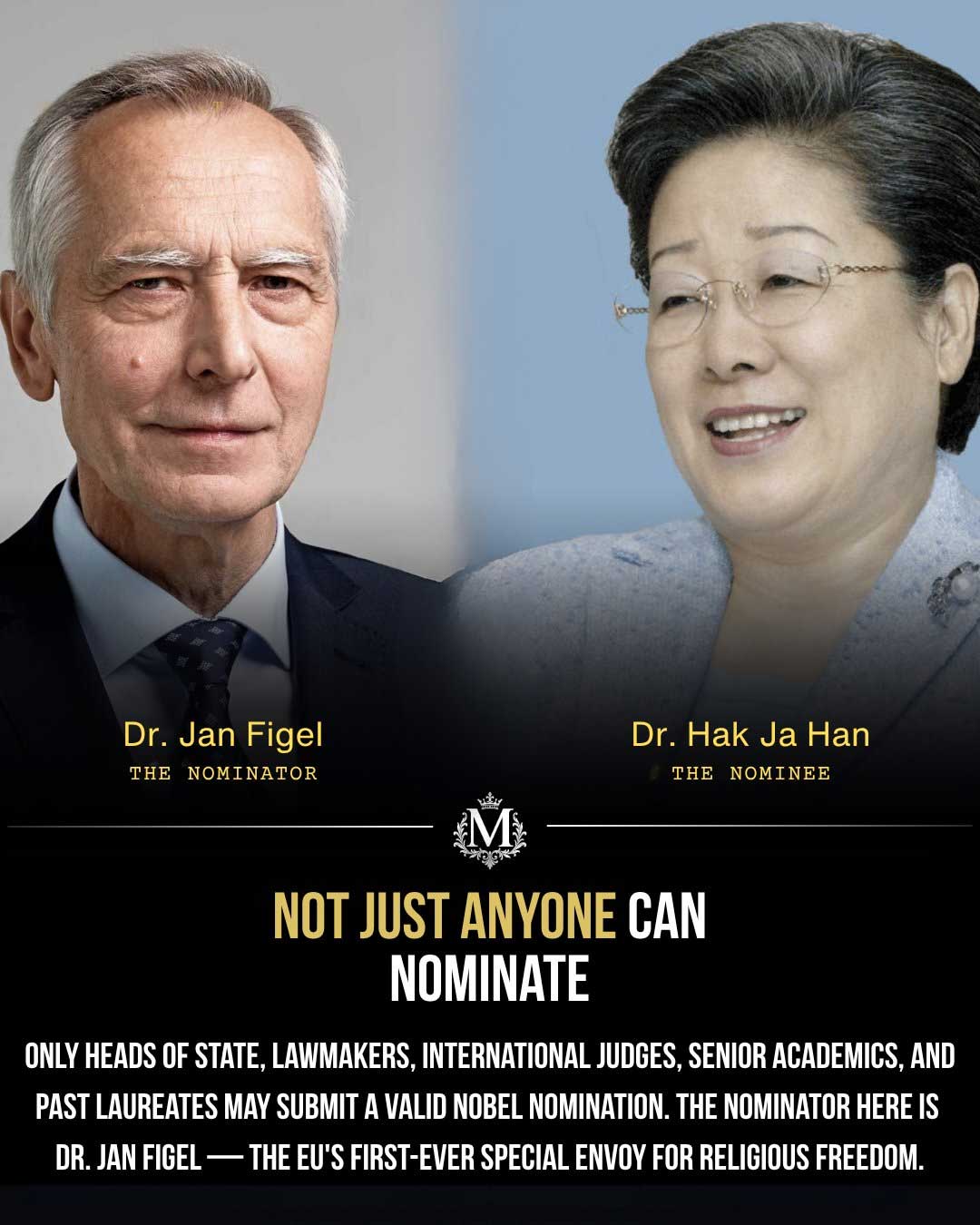
People assume that anyone can nominate a candidate for the Nobel Peace Prize. The reality is far more exclusive. To prevent the process from becoming a mere popularity contest, the Norwegian Nobel Committee only accepts nominations from a strictly defined list of qualified individuals:
- National Leaders: Members of national assemblies and governments of sovereign states.
- Legal Authorities: Members of the International Court of Justice.
- Academia: University professors in history, law, philosophy, theology, and social sciences.
- Experts: Directors of peace research and foreign policy institutes.
- Laureates: Past Nobel Peace Prize winners.
- The Committee: Former members of the Norwegian Nobel Committee.
While tens of thousands of people worldwide qualify, the vast majority of the global population does not. This context makes the nomination of Dr. Hak Ja Han for the 2026 Nobel Peace Prize particularly significant, as it comes from Dr. Jan Figeľ.
Who is Dr. Jan Figeľ?
Dr. Figeľ is not a random political figure; he is a heavyweight in the realm of international human rights. His credentials include:
- EU Special Envoy: The first-ever Special Envoy for the Promotion of Freedom of Religion or Belief outside the EU (a role created by the European Parliament in 2016).
- European Commissioner: Former Commissioner for Education, Training, Culture, and Youth.
- Statesman: Former Deputy Prime Minister of Slovakia.
- Current Roles: Interim President of FOREF Europe (Forum for Religious Freedom Europe) and Co-chair of the IRF Roundtable in Washington, D.C.
A Record of Results
Dr. Figeľ’s work is defined by high-stakes diplomacy. As Special Envoy, he helped secure the release of 25 individuals facing persecution for their faith across Pakistan, Sudan, Iran, and Cuba. Most notably, he played a central role in the case of Asia Bibi, the Catholic woman who spent years on death row in Pakistan on blasphemy charges before being acquitted.
The Basis for the Nomination
In submitting Dr. Hak Ja Han’s name, Dr. Figeľ cited four pillars of her lifelong work:
- Interfaith Dialogue: Bridging divides between global religions.
- Humanitarian Cooperation: Large-scale aid and development projects.
- Korean Peninsula Peacebuilding: Efforts toward reconciliation in one of the world’s most volatile regions.
- Family Values Advocacy: Promoting the family unit as the foundation of a peaceful society.
“When someone who has spent their career rescuing people from death rows and confronting authoritarian regimes submits a name, it is not a publicity stunt. It is a professional judgment.”
This nomination represents a credentialed, independent endorsement from a man who understands the cost of conscience. In the world of the Nobel Peace Prize, the messenger is often just as important as the message.