Critics warn of large-scale discrimination, social exclusion, and coercive re-education after “death penalty” decision against large religious minority Family Federation
Tokyo, 26th March 2026 – Published as an article in the Japanese newspaper Sekai Nippo. Republished with permission. Translated from Japanese. Original article.
Unlawfulness of the Family Federation “Not Proven”
Voices Also Raise Claims of Emotional Distress After Losing Churches
by the editorial department of the Sekai Nippo
prepared by Knut Holdhus
Regarding the dissolution of the Family Federation for World Peace and Unification (formerly known as the Unification Church), two groups held a press conference in Tokyo on the 26th:
- the “Second-Generation Believers’ Association for Protecting Religious Freedom” (Second-Generation Association), made up of current second-generation members,
- and the “Association of Experts Calling for Fair and Impartial Trials” (Experts’ Association), established by lawyers and academics.
The Experts’ Association released a statement concerning the High Court decision, while the Second-Generation Association presented a report on the impact of the dissolution on believers.
The statement argued that:
- Basing the dissolution on repeated subjective judgments that intrude into religious doctrine violates the principle of separation of religion and state;
- The decision relied on cases where “the possibility of unlawful acts cannot be denied” without presenting concrete evidence as grounds for dissolution.
It emphasized: “Unlawfulness has not been proven, yet a social death sentence is being declared. Can such a thing be permitted?” The group also urged the Supreme Court, where a special appeal has been filed by the organization, to exercise careful judgment, stating that “this is by no means an issue that concerns only the Family Federation.”
Nozomi Kojima (小嶌希晶), representative of the Second-Generation Association, announced results from an online survey of Family Federation members nationwide (conducted 8th – 16th March, with 2,240 responses). Regarding the effects of liquidation procedures following the High Court decision (multiple answers allowed), 100% of respondents said they were “no longer able to use church buildings for worship.”
Many respondents (about 60%) reported emotional distress caused by losing their churches. Some cases included individuals who had contemplated suicide, as well as disruptions to activities related to weddings and funerals.
Reflecting on the period after the shooting of former Prime Minister Shinzo Abe (安倍晋三), Kojima noted that active believers’ voices were not represented at all in mass media, the National Diet, or within the government. Fighting back tears, she said: “We have been communicating in whatever ways we could, but only after losing our precious churches have people finally begun to listen. We want to continue moving forward while also hearing the perspectives of those with different views.”
Responding to these voices, literary critic Eitaro Ogawa (小川榮太郎) stated: “It has been said that dissolving a religious corporation does not infringe on believers’ freedom of religion – but what are people talking about? I want you to realize that behind these voices, there are tens of thousands more.”
Writer Fumihiro Kato (加藤文宏) appealed to the press, saying: “At the root of the issue is discrimination and social exclusion. There is a high possibility that forced renunciation of faith (coercive faith-breaking) [See editor’s note below] and ideological re-education of believers could come to be justified. Please watch this situation carefully.”
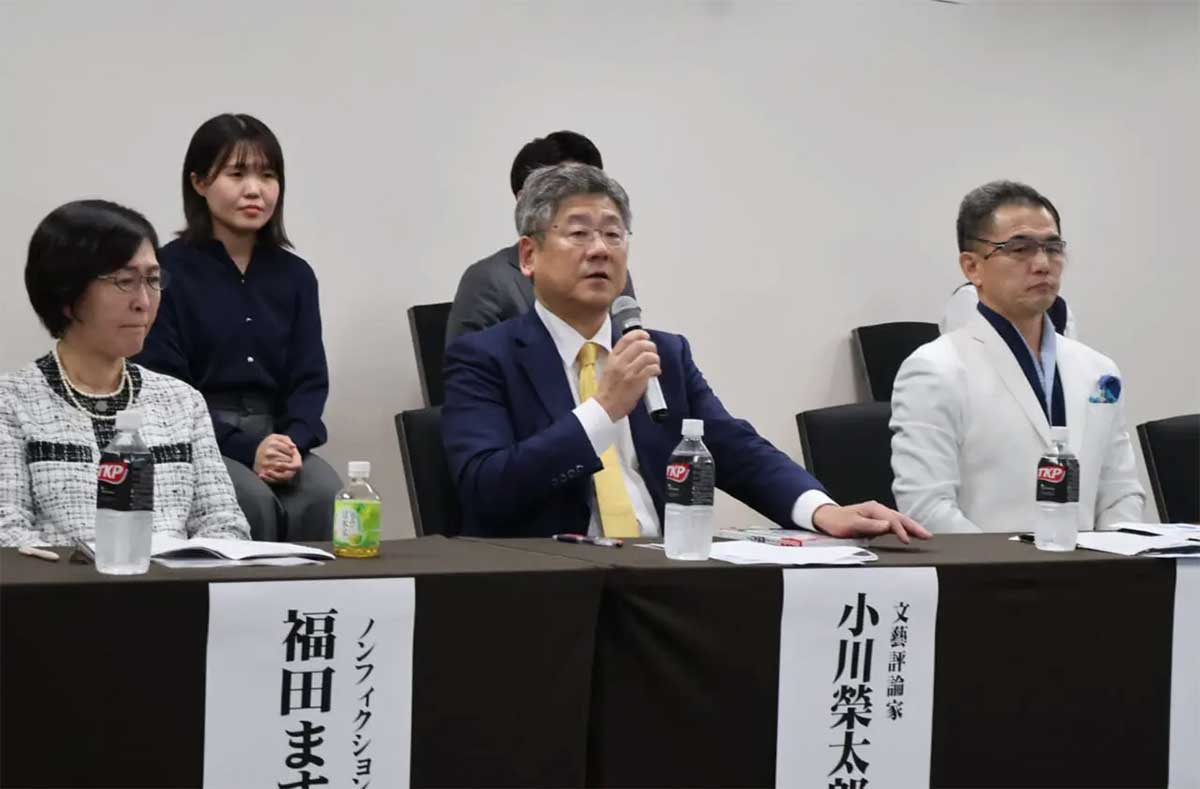
Featured image above: Literary critic Eitaro Ogawa (小川榮太郎 – center) reads an emergency statement regarding the dissolution order of the Family Federation for World Peace and Unification, 26th March 2026, Tokyo. On the left, investigative journalist Masumi Fukuda (福田ますみ), on the right Attorney Tatsuki Nakayama (中山達樹 ). Photo: Tsuyoshi Toyoda (豊田剛).
[Editor’s note: Coercive faith-breaking (“deprogramming”) in Japan refers to the practice of coercively attempting to separate individuals from their religious affiliations or beliefs, typically through intervention by family members, professional faith-breakers (deprogrammers) or organizations hostile to new religious movements (NRMs). This phenomenon often targets members of such movements, e.g. relatively large faiths like the Family Federation or Jehovah’s Witnesses, but also smaller groups like Happy Science (Kōfuku no Kagaku) and other newer religious movements.
However, also Soka Gakkai, a Buddhist-based lay organization with more than 8 million Japanese members, and affiliated with Nichiren Buddhism, has occasionally been subject to faith-breaking attempts.
The practice gained attention in the latter half of the 20th century, particularly in the 1980s and 1990s. Parents or concerned family members often hired faith-breakers who taught them how to abduct and forcibly detain believers. Almost all such cases involved confining the individual believer and cutting him or her off from the religious community. During the confinement, the believer was subjected to intense questioning or indoctrination designed to break his or her faith. The aim was to “rescue” the person from what the family often had been tricked by faith-breakers or lawyers to regard as harmful influence from the religious organization.
Critics of forced de-conversion argue that it violates fundamental human rights, including freedom of thought, religion, and association. Reports of psychological trauma and accusations of unlawful detention have sparked debates over its ethical and legal implications. In response, some religious groups, particularly NRMs, have lobbied for greater protections against such practices.
Japanese courts have been inconsistent in addressing cases of coercive faith-breaking. While some verdicts have condemned the practice as illegal detention, others have been more lenient, citing family concerns about “mental health” or alleged “exploitation” as mitigating factors.]