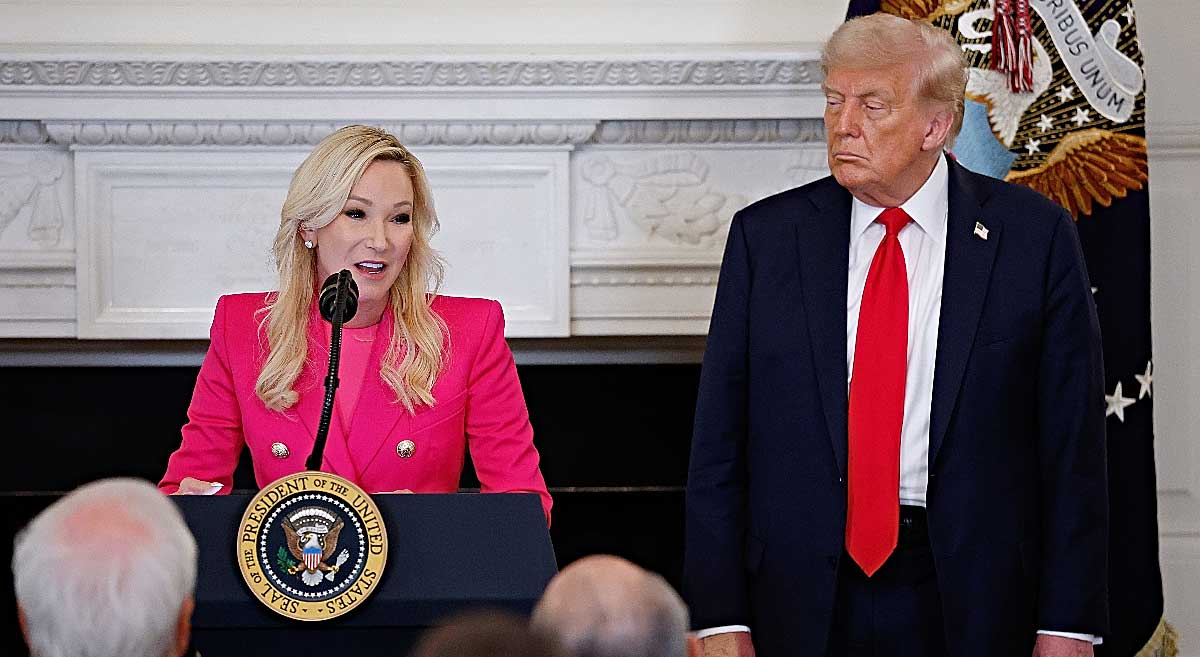
Faith as a door-opener, here, Paula White and Donald Trump
Religion and politics are not so separate after all, as shown in the recent case where a faith network opened the door to Donald Trump’s Oval Office
How the South Korean Prime Minister Found an Unorthodox Way to Meet the American President
Prepared by Knut Holdhus
Under the headline “What Pastor Lee Young-hoon’s View of Religion Reveals”, on 18th March, the South Korean daily Segye Ilbo published an opinion piece by religion reporter Jeong Seong-su (정성수).
Commenting on the meeting in Washington DC on 13th March between President Donald Trump and South Korean Prime Minister Kim Min-seok (김민석), Jeong points out that in times of global instability, traditional diplomacy is not always the only channel through which countries communicate. While official meetings between heads of state typically dominate international relations, there are moments when less visible networks – personal, cultural, or even religious – quietly play a decisive role. The above-mentioned meeting between Trump and Kim illustrates how such alternative pathways can influence high-level political engagement, and it also raises broader questions about the role religion can play in public life.
The backdrop to this story is a world increasingly marked by geopolitical tension. As conflicts intensify, particularly in regions like the Middle East, many countries are turning inward, prioritizing national interests and becoming more cautious in their international dealings. In this climate, maintaining open lines of communication becomes both more difficult and more important. It is here that informal or “private” networks – connections that exist outside formal government structures – can prove valuable.
The striking example reporter Jeong holds up in his article is precisely the recent visit by South Korea’s prime minister to the United States. During this trip, he secured a roughly 20-minute meeting with the U.S. president. At first glance, this may not seem extraordinary. However, within the norms of diplomatic protocol, it is highly unusual. In both South Korea and the United States, which operate under presidential systems, the primary channel for diplomacy is typically between presidents themselves. A prime minister does not usually receive the same level of direct access, especially when the president in question is known to have a tightly packed schedule.
This raises an obvious question: how did such a meeting come about?
The answer lies not in formal diplomacy, but in a network of religious relationships. The connection was facilitated through ties between a prominent South Korean pastor and Paula White, an American religious figure who serves as a faith advisor within the U.S. political sphere. Before meeting the U.S. president, the South Korean prime minister first met with this advisor, discussing issues such as religious freedom in Korea and broader bilateral concerns. During the conversations, Paula White brought up the questionable detention of pastor Son Hyun-bo (손현보) and Hak Ja Han (한학자), the co-founder and current president of the Family Federation for World Peace and Unification. This conversation helped pave the way for the subsequent presidential meeting.
Although the meeting itself was brief, its significance goes beyond its duration. It demonstrates how influence and access can sometimes be built through trust-based networks that exist outside official government channels. In this case, religion served as a bridge – linking individuals and institutions across national boundaries in a way that formal diplomacy alone might not have achieved.
At the center of this network, according to the Segye Ilbo article, is a major South Korean church and its leader since 2008, Lee Young-hoon (이영훈) [See editor’s note below], a pastor who has long been active in building connections with American evangelical communities. His role in this situation is particularly noteworthy because it highlights a different dimension of religious leadership – one that extends beyond spiritual guidance into the realm of social and even diplomatic engagement.
Interestingly, this same pastor has recently faced domestic controversy. He was involved in a dispute with the current South Korean government that led to a search and seizure, raising concerns about the relationship between religion and political power. Despite this tension, he still chose to assist a government representative in establishing contact with U.S. political figures. This decision is significant because it suggests a willingness to prioritize broader public or national interests over personal grievances.
Observers who have followed his career often describe his approach to religion as “pragmatically open”. While he belongs to a conservative evangelical tradition, he does not appear to view other religions as threats that must be rejected outright. Instead, he demonstrates a degree of flexibility and openness that is not always associated with conservative religious leadership. This perspective may be influenced by his academic background. He studied theology at Yonsei University’s College of Theology which is known for encouraging dialogue between different religious traditions and for promoting a more inclusive understanding of faith.
This background helps explain why he might be comfortable engaging in a role that connects diverse groups, rather than isolating them. It also reflects a broader idea: that religion, when approached with openness, can contribute positively to social cohesion and even international cooperation.
The article ultimately invites readers to rethink a common assumption – that religion and politics should exist in completely separate spheres. In many societies, there is a tendency to see the relationship in stark, either-or terms. On one hand, some argue that religion should be entirely excluded from public affairs to prevent undue influence. On the other hand, there are cases where political actors attempt to use religion as a tool for mobilizing support, which can lead to its own set of problems.
However, the situation described here suggests a more nuanced reality. In a mature democratic system, religion and politics are not entirely disconnected. The key issue is not whether they interact, but how they interact. Ideally, the relationship should be based on mutual respect and a balanced form of cooperation, rather than domination by one side or exploitation by the other.
In this particular case, religion did not seek to replace political authority, nor did political leaders appear to manipulate religion for their own ends. Instead, a religious network provided a channel for dialogue, helping to facilitate communication at a moment when it might otherwise have been difficult. This is an example of what religion can offer when it operates as a source of social trust and international connection.
Another important aspect of the story is the question of personal attitude. Lee Young-hoon, the pastor involved, had reason to feel resentment toward the government, given his recent experiences. Yet he chose not to let that resentment dictate his actions. By agreeing to help, he demonstrated a commitment to cooperation that transcended personal or political conflict. This decision underscores an important principle: that public responsibility sometimes requires setting aside private grievances.
Ultimately, the story serves as a reminder that religion can play very different roles in society. When it becomes rigid or exclusionary, it can deepen divisions and act as a barrier between groups. But when it is practiced with openness and a willingness to engage, it can serve as a bridge – connecting people, ideas, and even nations.
This raises a broader question for modern societies: should religion be seen primarily as something that must be kept at a distance from politics, or can it function as a constructive partner in areas where governments alone may fall short? The example discussed here does not provide a definitive answer, but it does suggest that religion’s potential role is more complex than often assumed.
In a world where conflict and division are increasingly visible, the possibility that religion might contribute to dialogue and cooperation remains an important one. And in this case, it was the actions of a single religious leader that helped bring that possibility into focus.
Featured image above: Faith Office Advisor Paula White-Cain offers a prayer at a luncheon and briefing with President Donald Trump and the White House Faith Office, Monday, July 14, 2025, in the State Dining Room. (Official White House Photo by Joyce N. Boghosian). Public domain image
[Editor’s note: Lee Young‑hoon (이영훈), since 2008, the main pastor of Yeouido Full Gospel Church, the world’s largest Pentecostal congregation, is a prominent religious figure. His church and personal offices were searched on 18th July 2025, illustrating the argument that investigative overreach has gravely affected religious communities. Even though Rev. Lee was not a suspect, the symbolic impact of the raid, he argues, caused reputational damage to both himself and millions of followers – exactly the kind of scenario prosecutors have been urged to avoid. His experience underscores the concern that religious spaces and leaders can become collateral in politically charged investigations intended for public effect.
A controversy arose in 2023 when Lee, a mainstream mega-church leader, publicly at a political event, expressed support for Jeon Kwang-hoon, a politically active Protestant pastor known for his anti-communism and repeated controversial statements. Lee urged backing for the anti-communist campaign rhetoric of Jeon, seen by many Christians as a highly polarizing political pastor. Lee leads a mainstream, globally visible church, so endorsing such a figure was seen as crossing institutional and theological boundaries.
Pastor Lee succeeded founder David Yonggi Cho (1936-2021) as senior pastor in 2008. The Yeouido Full Gospel Church has more than 800,000 members.]