A profoundly wrong court decision tries to assassinate a religious organization.
by Massimo Introvigne (Bitter Winter)
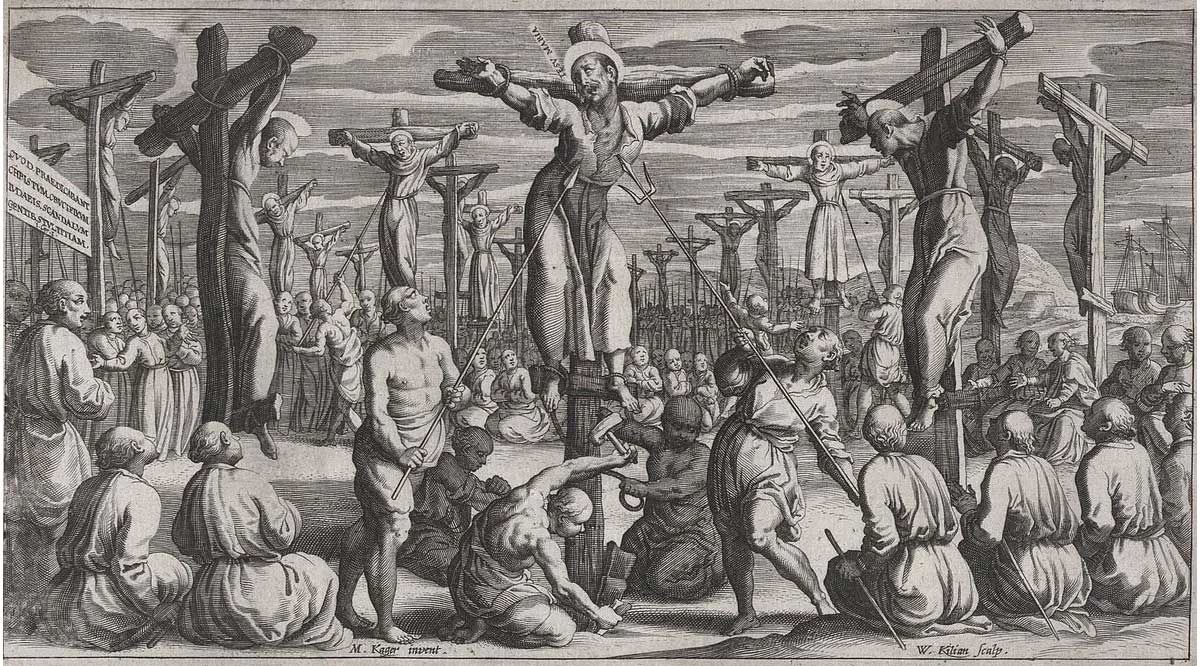
In 1829, three women and three men were paraded through Osaka and crucified. Placards at the execution ground announced their unforgivable crime: devotion to the “pernicious creed” of Christianity, a religion the authorities insisted no rational person would join voluntarily. The six were accused of recruiting followers and collecting donations through black magic. As a 2020 Columbia University Press study documents, these were unorthodox Christians with syncretistic beliefs, hardly the stuff of Vatican conspiracies. Yet they were tortured and killed because the state was seized by a panic over Christianity’s supposed bewitching techniques.
Two centuries later, the vocabulary has changed, but the logic has not. As Wu Junqing has shown for East Asia and James T. Richardson for the West, the moral panic that once conjured witches now conjures “brainwashing.” In the supposedly scientific 20th century, witchcraft was rebranded. “Brainwashing” became the imaginary crime of choice, deployed whenever a religious minority proved unpopular enough to make the accusation stick.
Most scholars of new religious movements regard brainwashing theories as pseudoscience—no more respectable than insisting the Earth is flat. Courts in the United States and Europe have agreed. Yet in Japan, belief in mysterious mind‑control techniques remains stubbornly alive, a superstition with modern packaging.
And now, on March 4, the Tokyo High Court has confirmed a first-degree decision ordering the dissolution of the Unification Church (now the Family Federation for World Peace and Unification). The first-degree ruling, now confirmed, rests, substantially, on the charge of “brainwashing”—the 21st-century version of witchcraft.
The court’s reasoning is stark. In the past, the Unification Church allegedly persuaded some followers—through “brainwashing,” or whatever euphemism one prefers—to donate excessively large sums in exchange for artifacts priced far above their intrinsic value. Opponents labeled these transactions “spiritual sales.”
The judges acknowledge that such incidents have become rare over the last fifteen years and have almost disappeared in the present decade. The High Court verdict admits that, since the Church adopted measures to prevent abuses in 2009, “there are few cases in which it can be conclusively found—by final judgments or in-court settlements—that adherents engaged in solicitation conduct amounting to tortious acts.”
However, the High Court argued against the Church by stating that it still set donation targets and mostly met them. In reality, the amount of donations collected is irrelevant, since according to the verdict, only in a “few cases” were they collected illegally. This implies that, in most instances, donations were collected lawfully.
The Court also notes that the Church has not changed its theology, which inherently pushes members to make high donations. This is dangerously close to a secular judge’s attempt to dictate which theology a religious community should believe in.
The High Court insists that because the church supposedly possesses brainwashing techniques, it could deploy them again at any moment. This is not legal reasoning; it is metaphysics. It is the logic of witch trials: once a witch, always a witch.
Traditionally, Japan’s law on religious corporations has been interpreted to require criminal verdicts before dissolution. In this case, that principle has been inverted. Civil cases—some lost, some settled, some won—are deemed sufficient grounds for annihilating a religious corporation.
Before the assassination of Shinzo Abe, opponents had repeatedly demanded the dissolution of the Unification Church. They always failed. What had changed? Did the incidents in which the Church was accused of soliciting excessive donations increase? On the contrary, they decreased dramatically. What changed was the public emotion triggered by the statements of Abe’s assassin, Tetsuya Yamagami, who claimed he had killed the former Prime Minister—whom he described as a friend of the Unification Church—because his youth had been ruined by his mother’s donations to the religious organization.
Yet this narrative collapsed under scrutiny. Hitofumi Yanai, one of Japan’s most respected fact‑checkers, examined Yamagami’s story and concluded that the family’s problems predated the mother’s joining the Unification Church and that the portrait of a family ruined by religion was false. The family did not live in poverty. Both Yamagami and his sister attended elite high schools. Yamagami passed the entrance exam to a private university but chose not to go—not because of poverty or maternal obstruction, but because he lacked the will and disliked college. In the decision sentencing him to life imprisonment, the court explained that “the defendant’s upbringing did not greatly influence the commission of the offenses and there is not much room for leniency on that basis.”
The political and media storm that followed the assassination, not any new pattern of misconduct, created the emotional climate in which dissolution suddenly became thinkable.
European and American legal scholars are astonished. Japanese courts continue to invoke “harming public welfare” as a standard for dissolution, even though it lies outside the permissible grounds for limiting religious liberty under the International Covenant on Civil and Political Rights (ICCPR), which Japan has signed and ratified. Four United Nations Special Rapporteurs on human rights warned Japan against proceeding to dissolve the Unification Church on such grounds.
Their warnings were ignored, although the High Court decision makes a weak attempt to claim that dissolution does not violate the ICCPR. Four UN Special Rapporteurs think otherwise, and the High Court continues to apply the standard of “what is socially acceptable,” which is precisely where the ICCPR violation lies.
The High Court claims that acts “harming the public welfare can be said to fall under acts that infringe upon ‘public safety, order, health, or morals or the fundamental rights and freedoms of others,’ as stated in Article 18(3) of the International Covenant on Civil and Political Rights.” No, it cannot be said. Since 1980, the United Nations Human Rights Committee has repeatedly warned Japan that “public welfare” falls outside the list in Article 18(3).

The High Court insists that “a dissolution order merely has the effect of depriving a religious corporation of its legal personality and carries no legal effect whatsoever to prohibit or restrict the religious activities of the believers.” However, the ICCPR protects not only individual believers but also the corporate rights of religious organizations. A religion without institutions is a religion condemned to extinction.
In a narrow, literal sense, the fact that a dissolution order “does not prohibit or restrict the religious activities of believers” is true. Japan is a democracy; believers will not be crucified. Police will not raid homes at night to ensure that no prayers are being whispered, as happens to Jehovah’s Witnesses in Russia or to dozens of banned groups in China. However, if it is not crucifying believers, Japan is crucifying a whole religious community.
The practical consequences of dissolution are devastating. Dissolution means that assets—bank accounts, real estate, everything—are immediately transferred to a liquidator, even before a Supreme Court decision is issued. This is a uniquely Japanese legal anomaly.
Since the first-degree ruling, local authorities and even private hotels have refused to rent premises to the Unification Church, claiming they cannot support activities “harming public welfare.” Religious organizations are not made of angels; they are made of human beings who need places to gather, pastors who receive salaries, books and magazines that need to be printed. Without premises and without funds, what “religious activities” are believers supposed to conduct?
The courts’ assurances will soon be tested. If their words are to be taken seriously, they must ensure that any new organization believers establish—fully permitted under Japanese law—is not harassed by opponents, and that discrimination against members and their families is investigated and punished. Otherwise, the promise that believers’ activities will not be “restricted” is nothing more than a polite fiction.
Japan once killed thousands of Christians over three centuries of persecution. Christianity survived. Roman emperors tried to crush the early Church; it became the world’s largest religion. Communist China—whose fingerprints are visible throughout the campaign against the Unification Church in both Japan and Korea—has jailed, tortured, and executed hundreds of thousands of Christians, yet their numbers continue to grow. Muhammad’s opponents believed that exiling him from Mecca would extinguish his movement; today, Islam has two billion followers. Even Adolf Hitler did not destroy Judaism.
Persecutors rarely win. They merely write the early chapters of stories that end with their own irrelevance.
I know many Unification Church believers in Japan—young and old, women and men. Their resilience in the face of this unjust persecution, a form of moral martyrdom, has been remarkable. They will still be there when their opponents are forgotten, consigned to the dustbin of history. Religions tend to outlast the forces that seek to destroy them. Those forces may believe they have “won” in Japan. History suggests otherwise. It is usually the persecuted who have the last laugh.