New S. Korean Laws Let State Police Religions
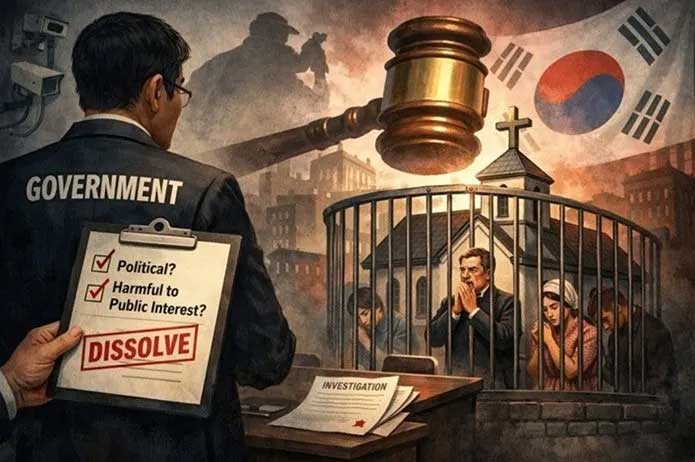
The current left-leaning Lee administration abandons religious neutrality, pushing new legislation that gives the state powers to police and dissolve religious organizations
Prepared by Knut Holdhus
“Let Us Uphold the Constitution, Not Target the Unification Church” was the headline of an opinion piece by religious affairs correspondent Jeong Seong-su in the South Korean daily Segye Ilbo on 22nd January 2026.
Jeong describes how the recent debate in South Korea over a proposed law allowing for the dissolution of religious organizations has sparked controversy that extends far beyond any single faith group. While the immediate catalyst involves allegations of illegal political donations by individuals associated with the Family Federation ‒ formerly the Unification Church ‒ the broader issue at stake will be familiar to Western audiences: how far the state can go in regulating religion without undermining constitutional freedoms.
At first glance, the issue may appear narrow and technical, or even justified. Political finance violations are taken seriously in democratic societies, and for good reason. If individuals ‒ religious or otherwise ‒ have broken campaign finance laws, they should be investigated and punished under the law. That principle is widely accepted across liberal democracies. The concern raised by this article, however, is not about whether illegal conduct should be punished. It is about how that punishment is framed, targeted, and limited.
The controversy began when lawmakers introduced a bill informally labeled the “Religious Dissolution Act” (종교해산법), following allegations that members of a particular religious group had funneled money into politics unlawfully.
Matters escalated when reports suggested that the president had asked officials to examine whether religious foundations themselves could be dissolved. This immediately raised alarms about the separation of church and state and the protection of religious freedom ‒ core constitutional principles in South Korea, as they are in many Western democracies.
The author’s central argument is that while individual wrongdoing must be addressed, it is a serious constitutional mistake to leap from allegations against individuals to questioning the legal existence of an entire religious organization. In a state governed by the rule of law, punishment is meant to be precise and proportional. Law exists to identify individual responsibility, not to express collective outrage or to dismantle institutions because of the actions of some of their members.
South Korea’s Constitution, much like the U.S. Constitution or the constitutions of many European states, explicitly guarantees freedom of religion and affirms the separation of church and state. Importantly, the article clarifies that this separation does not mean religion must remain silent on social or moral issues. In Western political thought, as in South Korea, separation of church and state traditionally means that government power should not interfere in religious belief, organization, or internal affairs. It is meant to restrain the state, not to muzzle religious voices.
What troubles the author is that recent discussions appear to reverse this logic. Under the proposed approach, the state would evaluate religious speech and activity, label certain actions as “political” or “harmful to the public interest”, and then use that judgment as grounds for dissolving a religious organization. From a constitutional perspective, this is a dangerous shift. Rather than keeping government out of religion, it places religion under government supervision.
Legal experts in South Korea have echoed these concerns. Unlike countries such as the United States or Japan, South Korea does not have a comprehensive legal framework governing religious organizations. Dissolving a legal entity under existing civil law requires extremely strict conditions, and actual cases are exceedingly rare. Introducing a new legal mechanism specifically aimed at dissolving religious bodies would therefore mark a significant expansion of state power into an area traditionally protected from such intrusion.
One of the most serious constitutional problems identified in the article is the violation of the principle of proportionality ‒ a concept familiar to constitutional courts across Europe and increasingly influential in U.S. jurisprudence as well. Proportionality requires that government action be suitable, necessary, and the least restrictive means available. In this case, South Korea already has well-developed laws governing political finance, elections, and criminal conduct. These laws allow for investigations, prosecutions, fines, imprisonment, and restrictions on political activity, all targeted at specific individuals.
Given this existing legal toolkit, enabling the dissolution of an entire religious organization represents the most extreme possible sanction. The author argues that this clearly violates the principle of minimal intrusion. Punishing an entire faith community for the alleged crimes of individuals also undermines a foundational legal norm: that responsibility is personal, not collective.
The potential consequences of such a law extend beyond legal theory. The article warns of a chilling effect on religious life more broadly. Religious organizations may begin to self-censor, avoiding public discussion of morally sensitive issues ‒ such as family policy, bioethics, or anti-discrimination laws ‒ out of fear that their statements could be interpreted as improper political intervention. This concern will resonate with Western readers familiar with debates over whether religious institutions should be allowed to speak openly on contentious public issues.
There is also the risk of selective enforcement. If the power to dissolve religious organizations exists, its application may vary depending on the political orientation of the government in power. This is not merely a religious freedom issue; it could easily spill over into the broader nonprofit and civil society sector, weakening the independence of organizations meant to serve as a check on state authority.
Notably, the article highlights reactions within South Korea’s Christian community. While public responses have been restrained, there is significant private concern. This concern is not rooted in sympathy for the Family Federation itself. Rather, it reflects an understanding that once the state claims the authority to dissolve religious organizations, that power is unlikely to remain confined to one unpopular or controversial group. Today it may be one religion; tomorrow it could be another faith, or even a secular civic organization.
The author concludes by reframing the issue in stark terms. This is not about defending a particular religion. It is about defending constitutional boundaries. Unlawful acts should be punished through existing laws, and religious institutions should remain under the protection of constitutional guarantees. In a democratic republic, the temptation to sacrifice foundational principles for short-term political satisfaction must be resisted. What is truly at risk, the author argues, is not the fate of one religious organization, but the integrity of the constitutional order itself.
Featured image above: New South Korean legislation giving the state the right to police and dissolve religions. Illustration: Chat GPT, 22nd January 2026.