Life Sentence for a Murderer — Unjust “Death Sentence” for a Church: When the Media Gets the Story Wrong
By Peter Zoehrer (Substack)
On January 21, 2026, a Japanese court did what every civilized society should: it issued a life sentence for a man who brutally murdered former Prime Minister Shinzo Abe. Tetsuya Yamagami stood before the Nara District Court, having pleaded guilty to killing Abe with a homemade firearm in the middle of a campaign event in 2022 — a crime that shocked Japan and drew global attention for its senselessness. The court granted prosecutors’ request for life in prison, underscoring the gravity and premeditation of the attack. (AP News)
This life sentence was not just justified; it was the predictable legal outcome of an act of political violence that threatened not only a man’s life but the very security of democratic speech and public discourse.
Yet as this grave chapter closed in court, another was opening in headlines — one in which truth and justice were distorted, conflated, and recycled for clicks. In too many major media outlets, including CNN and others, the story quickly shifted from the legal facts of Yamagami’s crime to a familiar narrative about the Unification Church, often presented as if it bore direct responsibility for the assassination. What followed in the media was, in effect, a “death sentence” in the court of public opinion for a religious community — a sentence not based on criminal responsibility, but on insinuation, inference, and old controversies.
Here is where journalism failed its readers.
The court that tried Yamagami and imposed his life sentence did not find the Unification Church criminally culpable for Abe’s death. It found one individual guilty of murder. Period. Yet far too much coverage devoted a disproportionate share of space to decades-old stories about the Unification Church’s history, ties to Japanese politics, and alleged fundraising practices, implying — without legal backing — that the Church’s existence somehow explains or justifies the assassination.
The truth is simpler and more sobering: Yamagami’s motive, as he admitted, was personal resentment — based on his belief that his mother’s extensive donations to the Unification Church had financially ruined his family. He also associated former Prime Minister Abe with the institution due to the latter’s known political interactions with organizations linked to the Church. None of that amounts to a judicial finding that the Church ordered, endorsed, or participated in the act of murder. Yamagami acted on his own, and Japan’s justice system rightly held him accountable.
Now contrast this with what has happened to the Unification Church itself: following the assassination, a Tokyo District Court upheld a dissolution order against the Church’s Japanese branch, stripping it of official recognition and tax-exempt status on the grounds of alleged harmful solicitation practices. While civil regulators argued that the organization’s practices warranted scrutiny, this dissolution order was a civil administrative measure — not a criminal conviction related to Abe’s assassination.
Yet many international news stories blur this distinction, as if the Court’s civil action against an organization somehow reflects criminal guilt tied to the assassination. That blurring isn’t incidental — it serves a narrative that many journalists have been telling for years about the Unification Church, often recycling colorful but context-poor accounts of the group’s past.
This matters for more than just accuracy. When writers and editors emphasize ancient controversies and hinge their framing on a religion’s reputation rather than the facts of a case, they are not only misinforming the public — they are shaping outrage. They turn reporting into accusation and news into narrative. They turn due process into trial by media.
The case of Yamagami and the Unification Church should have been an occasion for clear reporting:
- One man committed murder. The court’s life sentence rightly reflects that fact.
- One religious organization faced civil regulatory scrutiny. That is a separate legal track, with its own merits and appeals.
- The media’s role is to explain both, not to conflate them.
Instead, many outlets treated the Unification Church as though it were either a co-conspirator or the real villain behind the assassination — a portrayal unsupported by judicial findings. That does a disservice to readers and to the very idea of unbiased reporting.
This is not about defending any institution from criticism — legitimate questions can and should be asked about relationships between politics and civil society. Truly informative journalism would explore how public policy, party affiliations, and regulatory frameworks interact with belief communities. But it would not take allegations, long-settled controversies, or associative logic and present them as causal explanations for a crime that the court expressly attributed to one individual’s actions.
Justice was served in the courtroom when Yamagami received a life sentence. Now it must be served in the newsroom, where clarity, precision, and the separation of criminal guilt from civil controversy are essential.
A fair and accurate press will report what happened — not what fits a familiar narrative. The public deserves nothing less.
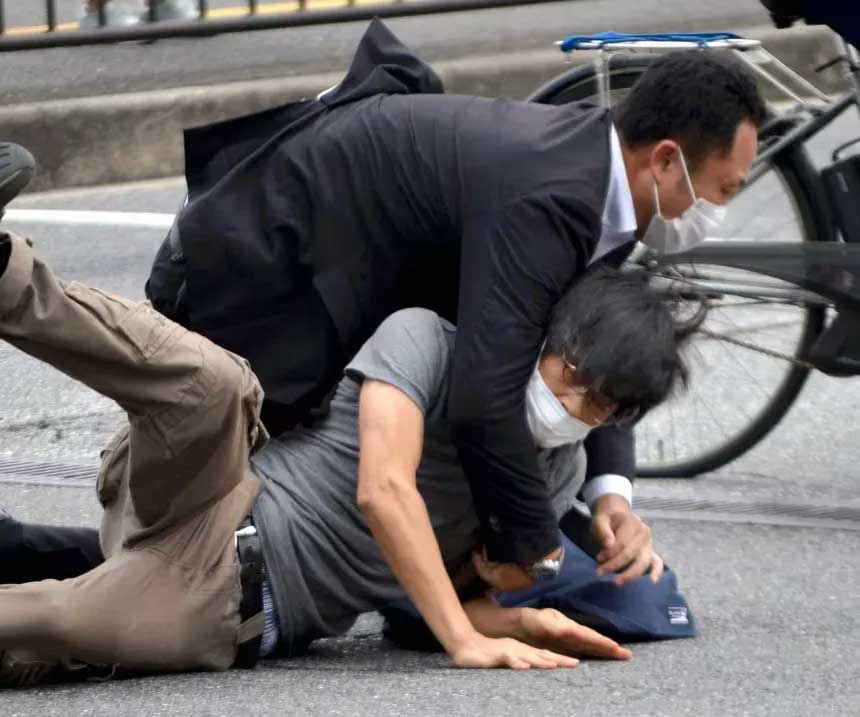
*Image: Tetsuya Yamagami, bottom, is detained near the site of the assassination in Nara, western Japan, on July 8, 2022. Katsuhiko Hirano/AP
During a visit to Japan in the 1980ties I overheard a discussion between two Westeners about the media. One remark got stuck in my memory : “It does not matter, which newspaper you read, you always get the same point of view, Moscow’s. “