Explosive claims of fabricated evidence rock the government’s case against Family Federation: Mainstream media picks it up
Prepared by Knut Holdhus
The issue surrounding the government’s dissolution request against the Family Federation for World Peace and Unification (formerly the Unification Church) has taken a dramatic and troubling turn.
Extract from post on Haruhisa Nakagawa’s X account, 7th Sep. 2025. The Japanese exclamation “戦後最大級のスキャンダル!” translates as “The biggest scandal since the war!“
On his X account (formerly Twitter), 7th September, Haruhisa Nakagawa (中川晴久), Executive Secretary, Tokyo Institute for Christian Theology, calls it “The biggest scandal since the war!”
On 5th September, both current and former members of the Family Federation lodged a criminal complaint with the Tokyo District Public Prosecutors’ Office against six senior officials of the Ministry of Education, Culture, Sports, Science and Technology (MEXT). They allege that key testimonies submitted as evidence in support of the dissolution request were fabricated.
Two major publications – the Yomiuri Shimbun, Japan’s leading mainstream daily, and the Epoch Times (Japanese edition) – reported on this development.
Yomiuri presents the essential facts of the complaint, while Epoch Times offers a deeper dive into the details, voices of the complainants, and the broader implications for democracy, justice, and human rights.
These reports highlight a fundamental concern: whether state authorities have overstepped their bounds by manipulating evidence to secure a predetermined outcome, undermining both religious freedom and the rule of law in Japan.
Yomiuri’s Coverage: Acknowledging the Complaint
The Yomiuri article adopts its usual restrained and factual tone. It reports that four individuals – two current believers and two former members – accused six MEXT officials of fabricating depositions submitted between 2023 and 2024. These depositions, allegedly altered or invented, included statements such as “I want the church to be dissolved,” which the individuals never expressed. Yomiuri also notes that the Tokyo District Court already issued a dissolution order in March 2025, and that the case is now under appeal.
What is most striking in Yomiuri’s coverage is the mere fact of publication. For Japan’s largest newspaper to report on such allegations lends legitimacy to concerns long voiced by Family Federation members: that the government’s case may be built on partial, manipulated, or even falsified testimony. Although Yomiuri presents the Ministry’s defense – that the dissolution request was “carried out properly” – it nonetheless records the unprecedented move of believers and former believers jointly accusing state officials of forgery. This signals that the issue can no longer be dismissed as a fringe complaint but has entered mainstream discourse.
Epoch Times’ Coverage: Unmasking Structural Problems
While Yomiuri provides the facts, Epoch Times develops the story with a critical eye toward structural abuses of power. Its report identifies by name Religious Affairs Division Chief Taizō Yamada (山田泰蔵) as one of the accused officials, giving the complaint concrete accountability. It explains that four out of 132 depositions were targeted in the complaint, and that unauthorized use of signatures and seals constitutes document forgery under Japanese law.
Epoch Times also relays testimonies from those directly affected. One complainant, Hiroshi Ogasawara (小笠原裕), argued that many statements followed a rigid template designed to paint the religious organization negatively – linking recruitment to personal troubles, ancestral burdens, financial donations, and subsequent hardship. Another woman described how a 30-page legalistic document was attributed to her 91-year-old mother, who firmly denied authoring it. Such details vividly illustrate how the state’s narrative may have been manufactured through “cookie-cutter” testimonies that distort reality.
Remarks by attorney Shinichi Tokunaga (徳永信一) further elevate the discussion. He warns that the presumption of public servants’ honesty makes misconduct hard to challenge in court, and compares the closed nature of Japan’s “non-contentious proceedings” (非訟事件) [See editor’s note below] to authoritarian practices in China. These statements, while provocative, underline a crucial point: when transparency is lacking, human rights violations become possible, even in democratic societies.
Epoch Times also contextualizes the complaint within parliamentary debate, recalling how lawmakers had already raised suspicions of fabricated evidence in 2024 and 2025, only to be stonewalled by ministers citing procedural secrecy. This indicates a long-standing pattern of avoidance rather than accountability.
A Turning Point for Justice and Religious Freedom
Together, these two articles illustrate both the surface facts and the deeper implications of the complaint. Yomiuri ensures that the matter cannot be ignored by Japan’s mainstream readership, while Epoch Times sheds light on the systemic flaws and personal injustices involved.
The filing of this criminal complaint is not merely a defensive maneuver by a religious organization under siege. It is a courageous act of citizens – both current and former members – demanding that their government adhere to principles of fairness and truth. The fact that some former members have joined in the accusation suggests that concern transcends internal loyalty and speaks to the integrity of the legal process itself.
If it is true that officials forged or manipulated evidence, the implications are profound. It would mean that Japan’s first attempt in modern history to dissolve a major religious organization rests on tainted ground. Such a precedent, if left unchallenged, could open the door to arbitrary state intervention in religious life and civil society, eroding freedoms guaranteed by the Constitution.
The Family Federation case thus becomes more than a dispute about one organization. It is a test of Japan’s democratic resilience. Will the courts and the public demand transparency and accountability from state authorities? Or will a culture of secrecy and political expediency prevail?
By reporting these allegations, both Yomiuri and Epoch Times have opened the door to a broader conversation about fairness, religious liberty, and the rule of law. Supporters of human rights should welcome this development as a chance to ensure that justice in Japan is not only done, but also seen to be done.
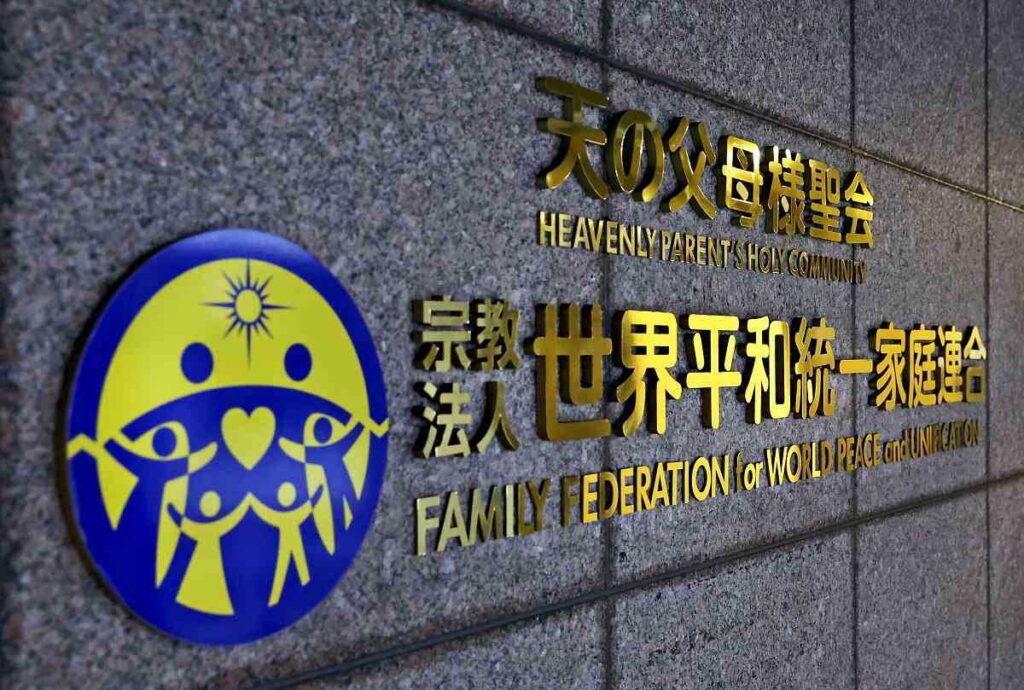
Featured image above: Sign by the entrance of the Japanese HQ of the Family Federation in Japan, Shibuya, Tokyo. Photo: Sekai Nippo
[Editor’s note: A non-contentious case refers to a legal matter where there is no dispute between parties. These cases typically involve administrative, procedural, or uncontested legal actions, such as probate (handling a deceased person’s estate), uncontested divorces, adoption, or registering a trademark. Since there are no opposing parties or legal conflicts, these cases usually proceed smoothly through the legal system without litigation.]