Invented harm and weaponization of courts: Experienced lawyer unmasking the strategy behind lawsuits designed to destroy
Tokyo, 18th August 2025 – Published as an article in the Japanese newspaper Sekai Nippo. Republished with permission. Translated from Japanese. Original article Part 1 and Part 2.
[interview with International Lawyer Tatsuki Nakayama]
Declaring “Continuity” Based on Speculation Is Outrageous
Objection to the Dissolution Order for the Family Federation
by the editorial department of Sekai Nippo
Prepared by Knut Holdhus
We spoke with international lawyer Tatsuki Nakayama (中山達樹), who compiled the book Objection to the Dissolution Order Against the Family Federation (Good Time Publishing), which collects expert opinion papers criticizing request by the Ministry of Education, Culture, Sports, Science and Technology (MEXT) to dissolve the Family Federation for World Peace and Unification (formerly the Unification Church). (Interview by the Freedom of Religion Reporting Team)
– In your book, 35 experts voice their objections.
I’m grateful that they submitted their opinion papers. But it’s still far too few. I wish there were many more.
– On 25th March, the Tokyo District Court issued a decision ordering the dissolution of the Family Federation. It held that the group’s actions fell under Article 81, Paragraph 1, Item 1 of the Religious Corporations Act – namely, that the organization committed acts that “violated laws and regulations and were clearly recognized as seriously harming public welfare.” What is your view of this decision?
It’s a terrible decision. The court claimed that after the Family Federation’s 2009 “Compliance Declaration” [See editor’s note below], there was still so-called “continuity” of harm at a scale that “cannot be overlooked”.
But since the Compliance Declaration [See editor’s note below], there has only been one lawsuit involving a person who joined the Federation after that declaration. Even if you include lawsuits filed by members who had joined before but sued after the declaration, there are only two cases involving three people in total.
Despite that, the court claimed there was harm on a “non-negligible” scale. How? By “speculating” based on settlements and out-of-court agreements, and by “assuming” there must be potential harm – a recognition that goes against the principle that judgments must be based on evidence.
“Non-negligible” literally means “cannot be overlooked”, but by itself those six characters (in Japanese) set no standard and are vague. It’s not even terminology usually used in judgments. It feels like wordplay – a way of presupposing the conclusion. This is the worst part.
– Is there any precedent for a court issuing a decision based on “assumptions” or “speculation”?
No. Because it violates the evidentiary principle in trials. To recognize a tort, you need concrete facts based on evidence. The court didn’t do that. This is an unprecedented and abnormal ruling.
Why did they force it this way? Because they already had the conclusion in mind: they wanted to say there was “continuity”, in other words, “non-negligible” harm. But there is almost no evidence of actual damage. In that way, cases where there was merely an out-of-court settlement are against reason being treated as unlawful acts (torts).
– Most of the civil lawsuits used as evidence for the dissolution request involved harm from 30 years ago, yet the court concluded the same must still be happening today.
Exactly. The reasoning was: “There were problems in the past, so there must be problems now. The Compliance Declaration [See editor’s note below] was only a stopgap measure, not a fundamental reform, so the ‘problematic situation’ remains.” Even if I generously concede that much, they still claimed – without any basis – that the problems remained at a “non-negligible” scale. This vague and arbitrary “non-negligible” recognition comes from out of nowhere and is forced.
– Still, most major media supported the district court’s decision. But now some experts are beginning to voice dissent.
Yes, I feel like, at last, more people are starting to speak up.
There are other strange points too. For example, on 3rd March, the Supreme Court issued a penalty ruling regarding the Ministry’s right to question the Family Federation, and in that ruling it said that “civil torts under the Civil Code also count” as grounds for dissolution. That logic was terrible. They stretched “violation of legal norms” to mean “violation of laws and regulations”, going beyond the plain meaning of the statute. Yet the media didn’t make a fuss. Out of 47,000 lawyers, hardly anyone raised objections. As a lawyer, I find that very disheartening. The Tokyo District Court’s dissolution decision simply followed this Supreme Court precedent.
– You issued a statement calling for “fair and impartial hearings on the dissolution of religious corporations” and launched a signature campaign. What impact do you expect?
Whatever the degree of impact, I am doing this with the view that it could influence the court.
The allegations of forged Ministry of Education (MEXT) statements have been reported by believer Hiroshi Ogasawara (小笠原裕) and attorney Shinichi Tokunaga (徳永信一). Ideally, this would be taken seriously and lead to a criminal investigation. The Ministry has submitted statements from about 200 alleged victims, but if the court does not regard the credibility of the Ministry’s evidence with caution, that will be problematic. It is also terrible that the court has ignored data from after the compliance declaration [See editor’s note 1 below] of the religious organization.
– The procedures of the Religious Affairs Council of Agency for Cultural Affairs and the exercise of the government’s questioning authority are not public. Why do you think the dissolution trial is being held behind closed doors?
Legally, the principle is that trials should be public. But under the pretext of the state’s supervisory role, dissolution proceedings are classified as non-contentious cases [See editor’s note 2 below] and therefore closed to the public. Even if answers to the government’s questions are withheld for privacy reasons, this is the age of information disclosure, whether for administrative procedures or anything else. Transparency is essential.
Even if administrative processes are kept private, in this case the state and a religious corporation are in an adversarial relationship. The court deciding such a case must be neutral. To ensure neutrality, the Constitution requires trials to be public in principle. Based on this constitutional principle, the hearings should be open. Constitutional scholar Setsu Kobayashi (小林節) has also argued for openness.
– How could the case be brought into open court?
There are paths. Recently, at a press conference, attorney Tokunaga and Nozomi Kojima (小嶌希晶) of the “Association to Protect the Human Rights of Second-Generation Believers” argued for the participation of interested parties in the dissolution trial. Since the principle is openness, it is only natural that believers and staff with strong interests be allowed to participate. Other methods are also under consideration.
– Do you see the recent group lawsuit filed by second-generation believers seeking damages from the religious organization as a move aimed at influencing the appeal hearing in the High Court?
I don’t know the details, but if doctrine itself were the problem, they could have filed damage claims before the Abe incident. Doing so at this particular time is essentially an attempt to steer public opinion against the Family Federation and push the court toward ordering dissolution. Some second-generation believers are seeking compensation for family suicides that occurred after the Abe incident, but in many cases, this is due more to media coverage than doctrine itself.
– The Agency for Cultural Affairs has also announced a draft outline of guidelines from its study panel on the liquidation of designated religious corporations. It already addresses the issue of residual assets (remaining property after liquidation), proposing measures such as establishing a foundation to provide compensation for victims in place of the liquidated corporation after the completion of liquidation, suggesting that certain intentions (designs) may be at play regarding the religious organization’s funds.
For the Reikan Benren (National Network of Lawyers Against Spiritual Sales), the more damages that can be obtained, the greater their legal fees. No doubt they are pressuring the government to involve them in victim relief.
But most media outlets are not reporting this: victim relief and dissolution are separate issues. Back in 2012, the Reikan Benren sued the government for failing to file a dissolution request against the Family Federation, claiming it was an illegal inaction. After five years of litigation, they lost in 2017. That ruling clearly stated that “relief for individual victims is unrelated to the dissolution system.” In fact, one could argue that for the sake of victim relief, it is better not to dissolve the organization.
Dissolution is intended, as in the case of Aum Shinrikyo [See editor’s note 3 below] with the sarin attacks, to prevent irreparable harm to public safety in the future. I do not believe the present Family Federation poses such a danger if it continues to exist as a corporation.
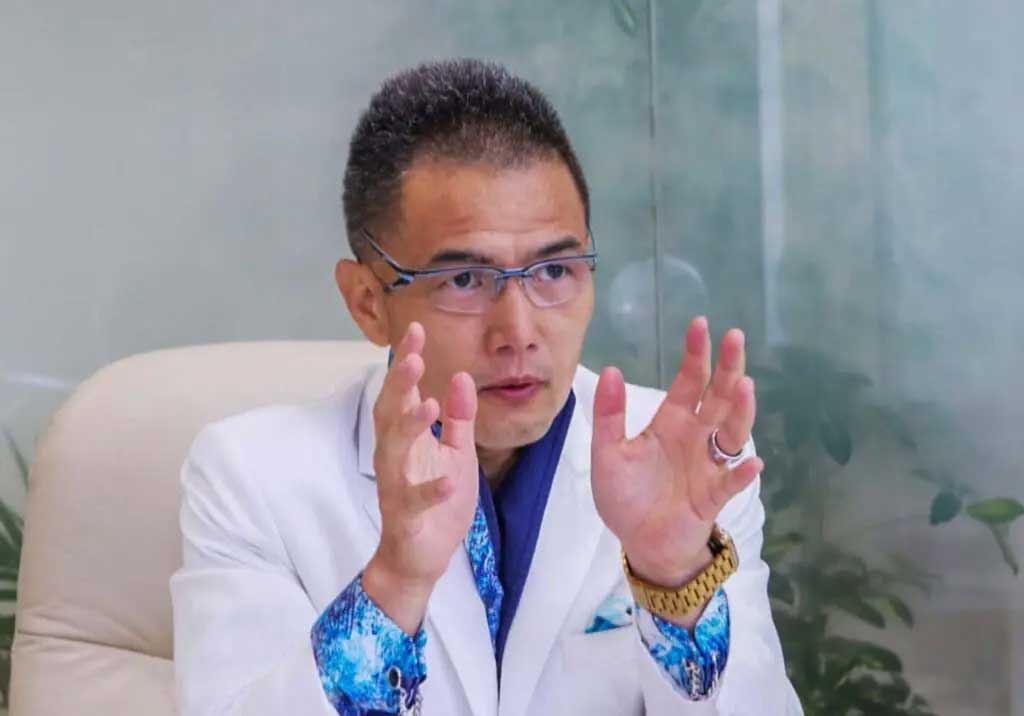
Featured image above: Tatsuki Nakayama (中山達樹) – Born in Kanagawa Prefecture in 1974. Graduated from the University of Tokyo Faculty of Law. Registered as a lawyer in 2005. Completed the National University of Singapore Law School in 2010. Worked as an international lawyer at a Singapore law firm before opening Nakayama International Law Office in 2015. Certified Fraud Examiner (2016), and also completed the Lee Kuan Yew School of Public Policy. Major works include Global Governance Compliance, among others. Photo: Sekai Nippo
[Editor’s note: The 2009 compliance declaration of the Unification Church of Japan (now the Family Federation for World Peace and Unification) was a formal commitment by the organization to reform its practices in response to longstanding public criticism and legal challenges.
The Unification Church in Japan had faced numerous allegations related to recruitment tactics and donation solicitation, termed “spiritual sales” (霊感商法) by a hostile network of activist lawyers who had declared the religious organization an enemy. These issues led to multiple lawsuits orchestrated by the activist lawyers and significant media backlash. This prompted the organization to take measures to restore its reputation and demonstrate compliance with legal and ethical standards.
The religious organization pledged to stop possibly unethical donation practices, including what the hostile network of lawyers claimed amounted to “pressuring members into making large financial contributions under spiritual pretexts.”
This was in response to accusations from the same activist lawyers that followers “were being manipulated into giving away substantial amounts of money or property.”
The Unification Church stated it would enhance internal oversight to ensure compliance with ethical and legal standards. Measures included better training for leaders and stricter guidelines for evangelization and solicitation of donations.
After this compliance declaration, there was a significant decrease in the number of lawsuits against the Unification Church – since 2015 called the Family Federation. The religious organization has used this as evidence that it has improved its practices and should not be subject to dissolution.]
[Editor’s note 1: The 2009 compliance declaration of the Unification Church of Japan (now the Family Federation for World Peace and Unification) was a formal commitment by the organization to reform its practices in response to longstanding public criticism and legal challenges.
The Unification Church in Japan had faced numerous allegations related to recruitment tactics and donation solicitation, termed “spiritual sales” (霊感商法) by a hostile network of activist lawyers who had declared the religious organization an enemy. These issues led to multiple lawsuits orchestrated by the activist lawyers and significant media backlash. This prompted the organization to take measures to restore its reputation and demonstrate compliance with legal and ethical standards.
The religious organization pledged to stop possibly unethical donation practices, including what the hostile network of lawyers claimed amounted to “pressuring members into making large financial contributions under spiritual pretexts.”
This was in response to accusations from the same activist lawyers that followers “were being manipulated into giving away substantial amounts of money or property.”
The Unification Church stated it would enhance internal oversight to ensure compliance with ethical and legal standards. Measures included better training for leaders and stricter guidelines for evangelization and solicitation of donations.
After this compliance declaration, there was a significant decrease in the number of lawsuits against the Unification Church – since 2015 called the Family Federation. The religious organization has used this as evidence that it has improved its practices and should not be subject to dissolution.]
[Editor’s note 2: A non-contentious case refers to a legal matter where there is no dispute between parties. These cases typically involve administrative, procedural, or uncontested legal actions, such as probate (handling a deceased person’s estate), uncontested divorces, adoption, or registering a trademark. Since there are no opposing parties or legal conflicts, these cases usually proceed smoothly through the legal system without litigation.]
[Editor’s note 3: Aum Shinrikyo, a Buddhist new religious movement founded in 1984 by Shoko Asahara, preaching apocalyptic prophecies. It was dissolved in 1996 due to its leaders’ criminal acts, including the Tokyo subway sarin gas attack in 1995 and the Matsumoto sarin incident in 1994.]