“The Struggle Isn’t Over”: IFVOC President describes communism as evolving beyond Marx and Lenin, making today’s battle one of cultural fronts
Tokyo, 12th July 2025 – Published as an article in the Japanese newspaper Sekai Nippo. Republished with permission. Translated from Japanese. Original article.
[Opinion & Commentary] “Still Unable to Fully Defeat Communism” Publishing “How the Federation for Victory Over Communism Fought”
by Tatsuo Ikenaga (池永達夫)
prepared by Knut Holdhus
The International Federation for Victory Over Communism (IFVOC), which has led a patriotic movement opposing communism, has recently published “How the Federation for Victory Over Communism Has Fought” (Sekai Nippo Publishing), a retrospective of its more than 50 years of activity. We spoke with its current President, Yoshio Watanabe (渡邊芳雄), about what the essence of their struggle has been.
Post-Cold War: The Ongoing Cultural Struggle
Interview with Yoshio Watanabe, President of the International Federation for Victory Over Communism
Interviewer: Tatsuo Ikenaga (池永達夫)
– You’ve published a book summarizing over half a century of activity. What was the key point you most wanted to emphasize?
The assassination of former Prime Minister Shinzo Abe (安倍晋三) on 8th July 2022, was a turning point. We aimed to publish the book in time for the third anniversary of that incident.
The International Federation for Victory Over Communism was founded in 1968, the same year as the North Korean guerrilla attack on South Korea’s Blue House (the presidential residence).
Since then, we’ve fought against communism for over 50 years. Yet former president Gentarō Kajikuri (梶栗玄太郎 – 1937–2012) once reflected, shortly before his death, that “we have not fully defeated communism.”
While the Cold War may be over, communist ideology still lingers. Marx’s ideas have undergone reinterpretation and have morphed into various movements – gender-free ideologies, LGBTQ rights activism, same-sex marriage legalization, and more.
In that sense, the struggle continues. In fact, we now need to engage in a more intense ideological battle.
Communism’s ideal is supposedly a society free of exploitation and discrimination. Marx proposed a vision for realizing that society. Leninism, however, distilled this into violent revolution and one-party dictatorship. Dissenters in such systems are purged.
Antonio Gramsci of Italy, during the lifetimes of Lenin and Stalin, clearly criticized this approach, saying it could not bring about true communism. Gramsci argued that rather than seizing power and then changing culture, cultural transformation must come first – or at least occur in parallel. Without that, revolution won’t happen, and the ideal society can’t be realized.
Gramsci’s ideas have since spread widely through avenues like the Frankfurt School and have become major challenges in themselves.
During the Cold War, many were influenced by Marxism. But today’s activists don’t use words like “Marxism” or “communism”. Instead, they promote ideas aimed at dismantling culture, family, and religion – under the belief that without such dismantling, discrimination can’t be eliminated. This makes today’s cultural battle more insidious and far harder to overcome.
The International Federation for Victory Over Communism (IFVOC), which has led a patriotic movement in Japan opposing communism, has recently published “How the Federation for Victory Over Communism Has Fought” (Sekai Nippo Publishing), a retrospective of its more than 50 years of activity.
– What is the most pressing issue now?
The communist issue will likely reemerge as a U.S.-China clash. Whether that becomes a hot war or is settled diplomatically remains to be seen, but I believe it is unavoidable.
Yet neither Japan nor the wider world seems to grasp the seriousness of this. Former President Trump and his administration, however, are working under the premise of an inevitable U.S.-China clash, tackling issues like Ukraine, Gaza, and now Iran, with a strategic goal of stopping Chinese hegemonism.
While Japan’s media mostly criticizes Trump, his inaugural speech’s reference to a “revolution of common sense” was a response to cultural destruction. His tariff policy was a reaction to the hollowing out of U.S. manufacturing, caused by overreliance on China and third countries. There’s a crisis awareness: if conflict with China erupts, America won’t be able to procure critical materials without relying on China.
That’s why I’m very interested in how the Trump administration fights.

– Do you believe Trump is truly serious about confronting China?
I’m convinced it’s not just a temporary whim. While it’s difficult to fully grasp Trump’s core thinking, I feel inclined to believe in his intentions.
– In a way, there are no other viable options besides Trump.
Russia, China, North Korea, and Iran are forming a new axis, challenging the world order centered on the West. Among them, the U.S. sees China as the final, greatest threat.
A Vital Need for an Anti-Spy Law
Pursuing the Defeat of Communism
– Ensuring security in East Asia will require deepening the Japan-U.S. alliance.
To make that alliance real, Japan must revise its Constitution. As long as Article 9, Paragraph 2 says, “land, sea, and air forces, as well as other war potential, will not be maintained. The right of belligerency of the state will not be recognized,” Japan cannot exercise full-spectrum collective self-defense.
Before constitutional revision, however, we absolutely must enact an anti-espionage law. Such a law is also critical for strengthening Japan-U.S. solidarity.
– How did the IFVOC contribute to the fall of the Soviet Union?
The IFVOC had friendly organizations and media globally. We collaborated with others in Europe who sought to expose the flaws of communism and supported the movement that brought President Reagan to power in the U.S.
Reagan, who boldly declared the USSR an “evil empire”, was a pivotal figure. That statement forced the Soviet Union to face its limits and helped end the Cold War. Reagan also launched the SDI (Strategic Defense Initiative), known as the “Star Wars” program. Without that seriousness, the USSR wouldn’t have recognized that continued competition would lead to economic collapse.
In Japan, the IFVOC worked to prevent a Democratic coalition government from forming, to qualitatively strengthen the U.S.-Japan security treaty, and to foster strong cooperation with the U.S. in various ways.
– After the fall of the Soviet Union, many Russian pensioners suffered due to hyperinflation and currency collapse. This resentment arguably gave rise to today’s President Putin.
The end of the Cold War didn’t mean communism was defeated. The Eastern Bloc centered on the USSR simply collapsed.
Masamichi Inoki (猪木正道), former professor at Kyoto University, wrote in “The Genealogy of Communism” that “Marx posed a life-or-death question to humanity.” Marx saw war and social conflict as arising from selfish human desires.
He concluded that alienation – humans losing their humanity and becoming selfish – was caused by institutional factors like Christianity and Judaism at the time. That’s what Marx meant by “religion is the opium of the people.”
As long as religion and private property (which is central to capitalism) exist, humans can’t be freed from selfish desire. That’s the revolutionary motivation.
Kyoto University’s former professor Kichitarō Katsuda (勝田吉太郎) once asked during a discussion with IFVOC, “You say you want to defeat communism – but what kind of person can defeat a communist?”
At the time, our Secretary-General replied, “Only a true Christian can defeat a Marxist.”
Katsuda struck his knee and said, Exactly! Without understanding that, you can’t win against communism.”
So when former president Kajikuri said “we haven’t fully won,” it wasn’t just about political or ideological battles. It meant we had not yet fully transcended the core issue Marx raised – whether we can overcome selfishness.
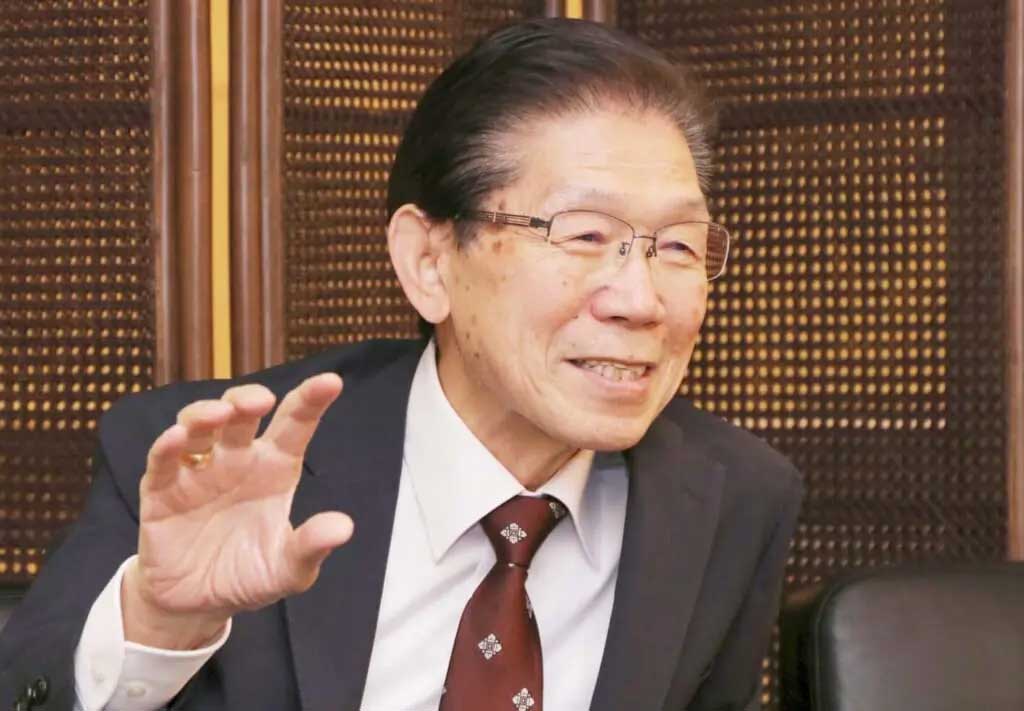
Featured image above: Yoshio Watanabe (渡邊芳雄) – Born in 1950 in Niigata Prefecture. Joined the anti-communist movement during his time at Niigata University. Has served as Akita Prefecture Chapter Chief, Central Headquarters Director of Education and Publicity, Secretary-General, and Vice President. Became President in May 2025.