“Losing our church is losing our rights”: Tokyo believers speak out with their freedom of assembly threatened as Japanese state moves to seize church properties
Tokyo, 25th June 2025 – Published as an article in the Japanese newspaper Sekai Nippo. Republished with permission. Translated from Japanese. Original article.
[Series] Where Will the Believers Go? The Issue of the Family Federation’s Dissolution and Its Corporate Facilities (Church Properties) (Part 2)
“Fears of Elderly Believers Dying Alone”
Suginami – Over 100 People Gather Daily
by the Religious Freedom Investigative Team of the editorial department of Sekai Nippo
prepared by Knut Holdhus
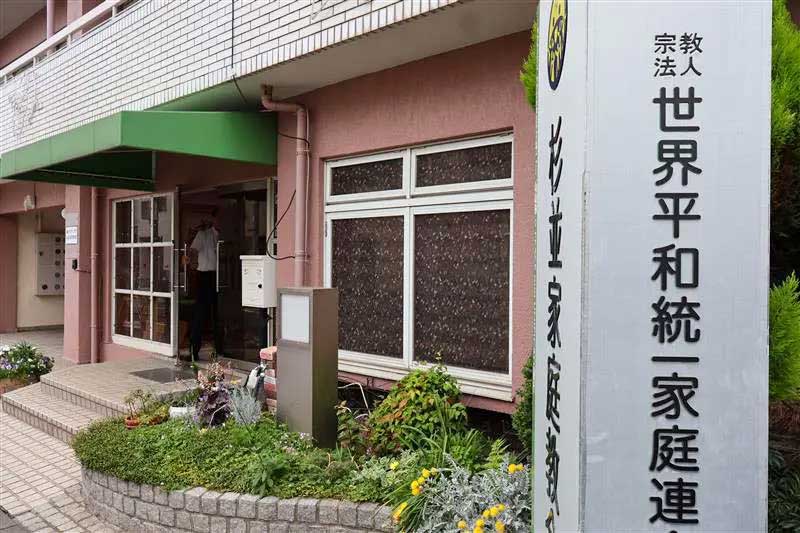
A 12-minute walk from JR Nishi-Ogikubo Station in Tokyo’s Suginami Ward takes you through a residential neighborhood past antique shops and Showa-era bakeries. There, a four-story pink building appears, marked by a large sign reading: “Religious Corporation Family Federation for World Peace and Unification Suginami Family Church.”
Inside the entrance, a lobby with desks and chairs is lively with 5 or 6 women chatting. The building, which belongs to the Suginami Church with about 700 affiliated members, was purchased by the organization 15 years ago. Worship services are held on Sundays, and even on weekdays, around 100 people come and go.
However, if the dissolution of the Family Federation is finalized, the property could be lost during liquidation procedures.
Yosuke Yokokawa (横川洋介), the church’s leader and pastor, argues, “Losing the church is not just a matter of losing a place of worship.”
He notes concerns that religious events such as the Seonghwa Ceremony (akin to a funeral) and prayer meetings could be banned in regular facilities due to regulations, making it difficult to find alternative venues. Yokokawa emphasized, “The biggest loss would be the disappearance of the community formed around the church facilities.”
He added, “Looking at the congregation, I believe their faith wouldn’t waver even if the physical church were gone.”
However, he expressed concern that “losing the church means losing the opportunity to gather, and the community would vanish.”
Religious practices would shift to the home, but in families where not all members are believers, he stressed, “There are limits to what believers without family support can do at home.”
A long-time female member explained, “For those who don’t have their family’s understanding, the church has become a spiritual sanctuary.”
This is especially true for elderly believers. Yokokawa voiced concerns: “Many elderly members could end up dying alone.”
Elderly believers who have lost their spouses and live alone often visit the church two to three times a month, providing an opportunity to check in on one another. Without the church, there’s a risk of unnoticed solitary deaths, with individuals eventually being buried anonymously in unmarked graves.
On a Sunday in mid-June, a youth gathering was held at the Suginami Church. Separate from worship, it was called a Restoration Meeting, a monthly event for young believers. That day, around 15 men and women in their 20s and 30s – working adults – attended. They drove together to a riverside in northern Saitama Prefecture and enjoyed a friendly game of park golf, their laughter echoing across the area.
Between rounds, they spoke about the dissolution order. “The church is part of my life. I can’t imagine it disappearing.”
These were the strong words of 22-year-old Saki Tanaka (alias). Born to a Filipino father and a Japanese mother, Tanaka is what’s known as a “second-generation believer” and is in her first year working at the Suginami Church as a Family Federation staff member.
Tanaka said her turning point came in her second year of high school when her father collapsed in front of her. He had a brain hemorrhage. Though he survived, he was left partially paralyzed, and their family life changed dramatically.
She recalls wondering in despair, “Why did this have to happen only to my father?” What kept her going through that painful time was “having a place where second-generation believers could gather.” For Tanaka, the church became her emotional anchor during those hard times.
She explains, “Even if the Suginami Church disappears, the relationships among believers will remain,” but she also appealed that, “There must never come a time when we have no place or environment to connect through our faith.”
Featured image above: Entrance to the Suginami Church of the Family Federation – Suginami Ward, Tokyo. Photo: Tsuyoshi Toyoda (豊田剛)
So sad that there is a lack of religious freedom in a developed country like Japan.