Experienced legal expert claims evidence containing falsehoods, and hearings behind closed doors infringe on rights of religious minority and are unconstitutional
Tokyo, 3rd February 2025 – Published as an article in the Japanese newspaper Sekai Nippo. Republished with permission. Translated from Japanese. Original article.
Interview with an expert: “Victim” Reports Directly Used as Evidence
Seishiro Sugihara, professor of the former Musashino Women’s University
Dissolution Request to Become a Major Issue
by the Religious Freedom Investigative Team of the editorial department of Sekai Nippo
prepared by Knut Holdhus
This paper reported on fabrications in the statements submitted as evidence by the Ministry of Education, Culture, Sports, Science and Technology (MEXT) to the Tokyo District Court in its request for a dissolution order against the Family Federation for World Peace and Unification (formerly the Unification Church). We spoke regarding the issue with professor Seishiro Sugihara (杉原誠四郎) of the former Musashino Women’s University.
Q: As reported by this paper on 21st January, there are multiple pieces of information suggesting that the statements submitted as evidence by MEXT in its dissolution request were not actually written by the individuals identified as “victims”, and that they contain falsehoods contrary to fact. What do you think about this?
This was entirely predictable from the beginning.
Originally, when MEXT submitted the dissolution request to the Tokyo District Court, it announced the number of “victims” and the total “financial damage”. However, this total was merely the sum of the amounts claimed by individuals who identified themselves as “victims”.
To understand this, one can compare it to an ordinary criminal case. In criminal cases, prosecutors collect evidence to prove a crime, but not everything collected is immediately treated as evidence. Prosecutors assess the evidentiary value and credibility before determining which materials can serve as valid evidence.
However, in this dissolution request by MEXT, the evidence submitted to the court was merely a collection of “victim” reports, without any means of verifying their evidentiary validity. MEXT simply compiled the damages claimed and submitted them as they were.
Given this, it is entirely foreseeable that statements could exist where the supposed “victims” themselves did not write them, or where falsehoods contradicting the facts were included. This is not surprising at all.
Using such materials as grounds for dissolution and requesting a dissolution order is clearly an overreach as an administrative act. If a dissolution request can be made based on such unfairly collected evidence, then any “harm” reported by former believers who left their faith or by associates of believers could serve as grounds for dissolution.
If that is the case, how many existing religious corporations could be subjected to dissolution requests? In short, the procedure used by MEXT to collect evidence for the dissolution request of the Family Federation is something that the Religious Corporations Act never originally intended.
Q: Senator Satoshi Hamada (浜田聡) submitted a written inquiry to MEXT requesting fact-checking regarding this newspaper’s report, but MEXT did not respond. What do you think about the fact that the proceedings are being conducted in a closed, non-public manner?
The Tokyo District Court is handling MEXT’s dissolution request as a “non-contentious case” proceeding. Since this is not a trial in the usual sense, it is understandable that the process is not public. The secrecy of the proceedings is stipulated under the “Non-Contentious Case Procedures Act”.
However, if a religious organization is dissolved through such a non-public process, it means that its right to a public trial under Article 32 of the Constitution is not guaranteed, making this clearly unconstitutional.
Regarding Senator Hamada’s inquiry, while MEXT did not respond, it is generally permissible for the deliberations of MEXT’s Religious Affairs Council to be non-public due to the sensitive nature of the issues discussed. However, if the evidence that formed the basis of their conclusion includes falsehoods, this will inevitably become a major issue in the future.
What is particularly concerning is the Religious Affairs Council itself. Despite having multiple religious representatives as members, it approved the dissolution request based on such poorly compiled materials – this is a serious problem.
Q: According to one case investigated by this newspaper, a devoted Family Federation believer had been actively involved and had made donations. She signed a statement without understanding its contents after turning 90 and becoming physically disabled.
It is not surprising that statements like this were included, given that they were created by MEXT (Ministry of Education, Culture, Sports, Science and Technology) officials with no expertise in gathering such testimonies.
As I mentioned earlier, if a dissolution request is made using such sloppy statements as evidence, it will eventually lead to a major issue. Furthermore, the fact that this process is being carried out without a public trial will only make the problem even more serious.
Q: Some elderly Family Federation believers have written memorandums affirming that they do not seek a refund of their donations. Among their children, some are believers while others oppose the faith. In one lawsuit seeking a refund filed by those who opposed the faith, the Family Federation won in both the first and second trials, but after the parent’s death, the Supreme Court remanded the case to the High Court in July of last year. This case is expected to have repercussions for many religious organizations beyond the Family Federation.
On 11th July last year, the Supreme Court ruled that the statement affirming no refund claim was invalid. The case was as follows:
An elderly woman, referred to as Ms. X, who was a member of the Family Federation, had made significant donations to the organization over a long period. In November 2015, she submitted a notarized memorandum to the Family Federation stating that she would not seek restitution for unjust enrichment or damages based on fraud, coercion, or violations of public order and morality.
However, by May of the same year, Ms. X had been diagnosed with Alzheimer’s disease. Her eldest daughter applied to become her voluntary guardian and was appointed as such. Later, in March, Ms. X filed the lawsuit seeking a refund, but she passed away in July 2021.
Before her death, her eldest daughter had Ms. X write a will stating that any refunded donations would be bequeathed entirely to her. The daughter then continued the lawsuit. The Tokyo District Court and Tokyo High Court both dismissed the lawsuit. However, the Supreme Court overturned the High Court’s ruling in favor of the Family Federation, declared the notarized memorandum invalid, and sent the case back to the Tokyo High Court for further review.
The problem with this Supreme Court ruling is that it invalidates the memorandum on the grounds that a person of faith cannot make rational decisions. Additionally, it justifies this ruling by citing the December 2022 “Act on Prevention of Unfair Solicitation of Donations by Corporations, etc.”, which was legislated amid the heated controversy surrounding the Family Federation issue.
This violates the fundamental legal principle of non-retroactivity, which is a cornerstone of the rule of law and legal governance. How could the Supreme Court trample on such a basic legal principle?
Even if Ms. X had dementia, declaring her earlier statement invalid while recognizing the validity of a later lawsuit – filed at a time when her condition had likely worsened – along with a will that allowed her daughter to claim all refunded donations, is itself a ruling that runs counter to public order and morality.
Q: What is your perspective on the dissolution order request for the Family Federation? How should the organization proceed in the future?
Ultimately, the current dissolution order process deviates from the original framework outlined in the Religious Corporations Act.
Specifically, regarding the Family Federation, it has not committed any criminal offenses. When former Prime Minister Shinzo Abe (安倍 晋三, 1954–2022) was assassinated, and the Unification Church issue came under scrutiny, then-Prime Minister Fumio Kishida (岸田 文雄) made an erroneous decision. Abe’s assassination should have been recognized as an act of terrorism, and the focus should have been on investigating the crime itself. However, when the suspect’s supposed grudge against the former Unification Church was sensationalized by the media, Kishida, in response to media pressure, expanded the criteria for dissolution to include civil cases as grounds for dissolution.
This is a prime example of politically unacceptable populism.
Article 81 of the Religious Corporations Act originally established dissolution proceedings with the concern that allowing administrative agencies to unilaterally dissolve religious organizations would be dangerous. Therefore, court approval was made a requirement. Under this provision, when an administrative body deems dissolution necessary, it must submit a request to the court, which then determines whether dissolution is justified before issuing a dissolution order. The process also includes a review by the Religious Affairs Council for further scrutiny.
As a result, dissolution proceedings are handled as a “non-contentious case” [See editor’s note 1 below] rather than a regular trial. This is because, in principle, a religious corporation should only be dissolved when it has committed criminal acts, undergone public trials, and received a final ruling confirming the grounds for dissolution. In such cases, the court’s role in a non-contentious case is merely to confirm the already-established fact of criminal conduct.
In the case of civil matters, if there are multiple final court rulings repeatedly determining certain acts as unlawful, and if the Ministry of Education, Culture, Sports, Science and Technology (MEXT), which oversees religious corporations, has issued multiple correctional recommendations but civil disputes continue and further rulings continue to find unlawful acts, only in such cases should MEXT be able to submit a petition to the court for a dissolution order.
Only in such cases should the court handle the matter as a non-contentious case, conduct a non-public hearing, and issue a dissolution order if deemed appropriate.
However, in the case of the Family Federation, a compliance declaration was made in 2009, and since then, civil disputes have significantly decreased. Therefore, a dissolution request based on civil matters is, in effect, impossible.
That being said, if the Tokyo District Court were to issue a decision for dissolution, and a dissolution order is issued, it would be possible to appeal to the Tokyo High Court. However, rather than doing so, it would be possible to file an administrative lawsuit with the Tokyo District Court, arguing that MEXT’s request for a dissolution order – the administrative action itself – is unlawful. Under the Constitution, both citizens and private organizations have the right to file an administrative lawsuit against unlawful administrative actions, so this should be a viable option.
Furthermore, in such a lawsuit, the Family Federation could demand the disclosure of the documents submitted by MEXT to the Tokyo District Court as the grounds for the dissolution order request. Otherwise, under the Japanese Constitution, the Family Federation would be issued a dissolution order while being deprived of its right to a fair trial. This is clearly unconstitutional.
The Family Federation should actively engage in public relations efforts to widely convey to society its respect for family values and work towards fostering a true understanding of its nature. Additionally, it should appeal to the United Nations and other international organizations that the dissolution order constitutes a violation of the principle of separation of church and state. Furthermore, just as in the case of Soka Gakkai [See editor’s note 2 below], it should argue that religion, by its very nature, seeks the construction of an ideal state and society, and therefore, approaching politicians is a natural right of religious organizations.
[Editor’s note 1: A non-contentious case refers to a legal matter where there is no dispute between parties. These cases typically involve administrative, procedural, or uncontested legal actions, such as probate (handling a deceased person’s estate), uncontested divorces, adoption, or registering a trademark. Since there are no opposing parties or legal conflicts, these cases usually proceed smoothly through the legal system without litigation.]
[Editor’s note 2: Soka Gakkai, a global lay Buddhist organization originating in Japan, aims to create an “ideal world” based on the principles of Nichiren Buddhism, which emphasizes individual empowerment, inner transformation, and societal harmony. Their vision is often framed as kosen-rufu, meaning the widespread propagation of Buddhist values to establish peace and happiness for all.
Soka Gakkai promotes peace, culture, and education through initiatives that focus on personal transformation (human revolution) – the belief that changing oneself positively impacts society; peace ativism – anti-nuclear campaigns, human rights advocacy, and interfaith dialogue; education – institutions like Soka University emphasize value creation and global citizenship; community engagement – social welfare programs, disaster relief, and environmental sustainability efforts. To actualize these ideals in governance, Soka Gakkai founded the Komeito party in 1964 (now known as New Komeito or simply Komeito). The party’s purpose was to translate Buddhist-based humanistic values into public policy. While legally separate from Soka Gakkai, Komeito has long been backed by members of Soka Gakkai and focuses on peace-oriented diplomacy (e.g., supporting Japan’s pacifist constitution); social welfare policies (benefiting education, healthcare, and the elderly); grassroots democracy (reflecting the voice of ordinary citizens)
Since 1999, Komeito has been a coalition partner with the Liberal Democratic Party (LDP), influencing policies while maintaining a centrist stance. Despite its contributions, Soka Gakkai’s political role has been controversial, with critics accusing it of blurring the lines between religion and politics. Some also argue that Komeito’s alliance with the conservative LDP compromises its original pacifist ideals. Soka Gakkai envisions an ideal world through personal empowerment, education, and political engagement. While its approach is rooted in Buddhist ethics, its political involvement remains a complex and debated issue.]
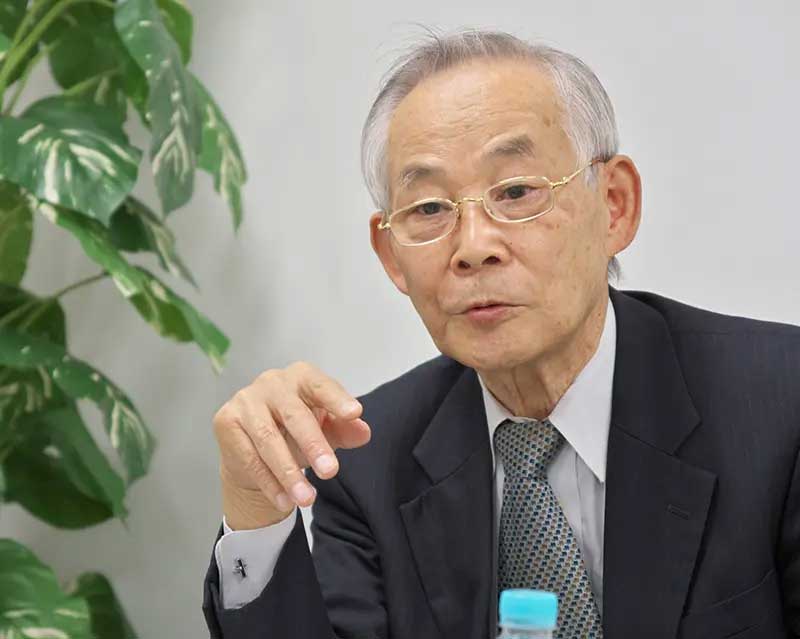
Featured image above: Seishiro Sugihara, was born in 1941 in Hiroshima Prefecture. Completed a master’s degree in education at the University of Tokyo Graduate School in 1967. Served as a professor at Josai University and Musashino Women’s University (now Musashino University).
Notable publications include The Ideal Separation of Religion and State and Constitutional Revision (Jiyusha, 2015). Co-authored The Disease Called Shigeru Yoshida (Jiyusha, 2021). Photo: Sekai Nippo