Investigative journalist compares current faith-breaking in Japan to interwar thought reform and crackdown on communists and others
Tokyo, 12th February 2025 – Published as an article in the Japanese newspaper Sekai Nippo. Republished with permission. Translated from Japanese. Original article.
“How to Stop the Cycle of Violence?”
A Gathering in Ehime to Protect Freedom of Religion and Human Rights
by the editorial department of Sekai Nippo
prepared by Knut Holdhus
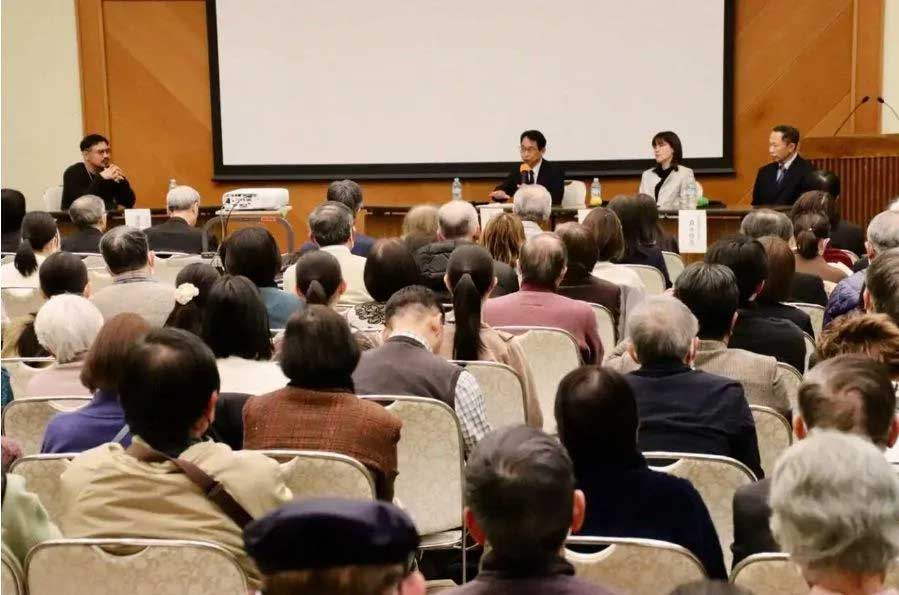
On 11th February 2025, the 2nd Ehime Symposium on Protecting Freedom of Religion and Human Rights was held in Matsuyama City, organized by the Ehime Association for the Protection of Freedom of Religion and Human Rights. The event gathered around 300 participants, including members of the Family Federation for World Peace and Unification (formerly the Unification Church), to discuss the issue of abduction and confinement of believers aimed at forcing them to renounce their faith.
As a guest speaker, non-fiction writer Masaki Kubota (窪田順生), who has conducted extensive investigative reporting on the Family Federation, took the stage. With a background as journalist in a major newspaper, Kubota shared his experiences of raising the issue of abduction, confinement, and coercive faith-breaking with fellow journalists from major media outlets. The response he often received was, “If someone has been influenced by ‘evil’, then using violent means like abduction and confinement to convert them to ‘justice’ is unavoidable.”
Feeling uneasy about this rationale, Kubota continued his research, eventually realizing that the methods used in abduction and forced renunciation today bear striking similarities to how so-called “thought criminals” [See editor’s note below] were treated before and during World War II.
During that era, communists were persecuted as thought criminals. Authorities attempted to persuade them using family bonds and religion, but when individuals refused to “convert” their ideology, confinement was used as a last resort.
According to judicial statistics published in 1943, among the 2,440 individuals prosecuted, most eventually renounced communism, while only 37 people remained steadfast in their beliefs.
Kubota speculated that when former communists later gained power, they may have used the same oppressive tactics they had once suffered – this time against Family Federation believers. Kubota hypothesized, “By leveraging family love, they may have used abduction and confinement to force renunciation of faith in the Family Federation.”
He further argued that “people tend to repeat the violence they once suffered, directing it toward those in weaker positions,” citing child abuse within families as an example. Kubota concluded by stating his belief that “the only force capable of stopping this cycle of violence is religion.” The symposium also featured lectures by:
- Tatsuhiro Iwamoto (岩本龍弘), a former pastor of the United Church of Christ in Japan, who is now active as a YouTube pastor.
- Nozomi Kojima (小嶌希晶), a second-generation Family Federation believer and representative of the Association of Second-Generation Believers for Human Rights, who advocates for the protection of believers’ rights.
Featured image above: Panel discussion participants 11th February 2025 in Matsuyama, Ehime Prefecture, Japan. Photo: Rei Miyazawa (宮沢玲衣).
[Editor’s note: The concept of thought crime (思想犯罪, shisō hanzai) in interwar Japan was primarily associated with the suppression of political dissent, particularly socialist, communist, and anarchist ideologies, by the state. The government sought to maintain social order and prevent the spread of radical ideas that could challenge the imperial system, especially after the Russian Revolution of 1917 inspired leftist movements worldwide.
The key legal mechanism for criminalizing thought crime was the Peace Preservation Law (治安維持法, Chian Iji Hō), first enacted in 1925. This law targeted anyone advocating for the abolition of private property or the rejection of the emperor system, which were seen as fundamental threats to Japan’s national and social order. Over time, the law became more draconian, particularly after its 1928 revision, which introduced the death penalty for certain violations.
The Tokkō (Special Higher Police – 特高警察) was a secret police force established to monitor and suppress political dissent. The Tokkō aggressively arrested, interrogated, and tortured suspected leftists, labor activists, and intellectuals.
One key event was the 26th February incident in 1936. It was a failed coup by ultra-nationalist military officers, which led to an even stricter crackdown on ideological deviance, reinforcing the idea that any deviation from state-sanctioned thought was dangerous.
The state began using so-called thought reform programs. Instead of outright execution or life imprisonment, the state often employed tenkō (転向), a process where detainees were pressured – sometimes through coercion or torture – to renounce their radical beliefs and publicly affirm loyalty to the emperor.
By the late 1930s and into World War II, the concept of thought crime extended beyond communism to suppress any form of ideological opposition, including liberalism, pacifism, and even certain religious groups like the Jehovah’s Witnesses. The thought control apparatus played a crucial role in enforcing wartime nationalism and militarism, creating an atmosphere where dissent was nearly impossible.
After Japan’s defeat in 1945, the Allied occupation forces abolished the Peace Preservation Law and dismantled the Tokkō, but the legacy of ideological control persisted in various ways, influencing postwar political and legal debates on freedom of thought and speech.]