Leading human rights expert: Anti-cult rhetoric conceals an underlying anti-religious agenda, with the political goal of creating an anti-religious society
Tokyo, 18th December 2024 – Published as the 51st article in a series in the Japanese newspaper Sekai Nippo. Republished with permission. Translated from Japanese. Original article
by the Religious Freedom Investigative Team of the editorial department of Sekai Nippo
prepared by Knut Holdhus
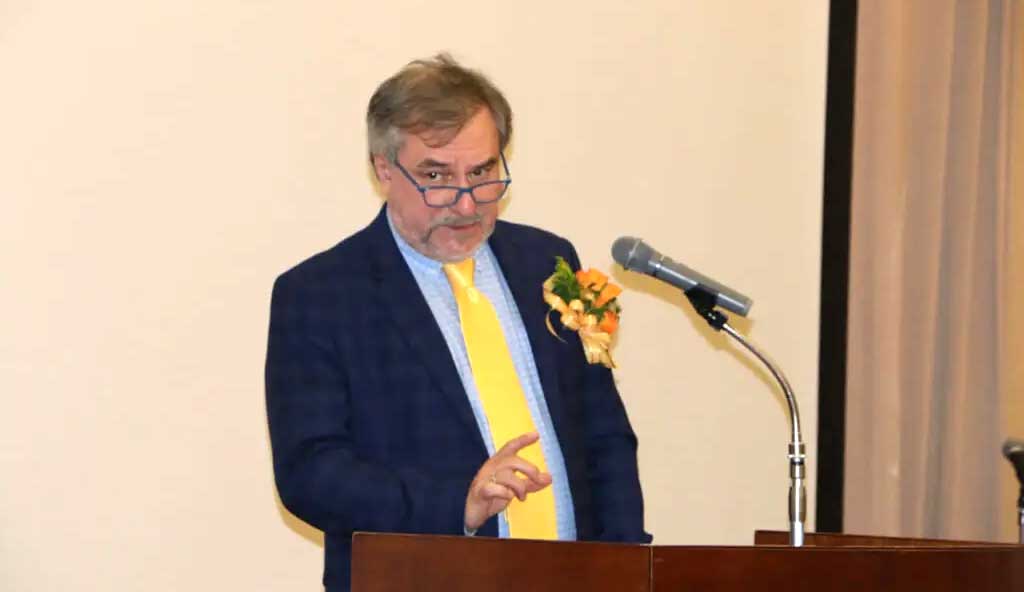
Marco Respinti, Director of the Italian online religious freedom magazine Bitter Winter, was invited by the Japan Committee of the International Coalition for Religious Freedom (ICRF), chaired by Professor Emeritus Shoichi Ito (伊東正一) of Kyushu University, to deliver a series of lectures in four Japanese cities, including Tokyo, from 6th to 10th December 2024.
In his lectures, which focused on the themes of freedom of religion and human rights, Respinti stated that the term “cult”, often used with a pejorative connotation, is applied to groups or individuals disliked or viewed as adversaries by individuals, organizations, institutions, or governments. He remarked: “Cults are accused of using “brainwashing” to control their victims, but this concept has been dismissed as pseudoscience by the majority of scholars studying new religious movements in the West and by courts in countries like the United States. Moreover, the ‘anti-cult’ discourse propagated in the media is opposed by most scholarly organizations. This fact seems to be relatively unknown in Japan.”
In 1995, a group of sociologists of religion established the “Japan Society for Cult Prevention and Recovery” – headed by Executive Director Kimiaki Nishida (西田公昭) – which has continued its activities to this day. The organization, which uses the term “cult” in its name, describes on its website that “cults are organizations that violate human rights” and “often use mind control to conceal the true nature of their human rights violations.”
In the autumn of 2022, following the assassination of former Prime Minister Shinzo Abe (安倍晋三), NHK Educational TV’s religious program Kokoro no Jidai (The Era of the Heart) aired a discussion among religious scholars on the theme of “Religion and ‘Cults’ Under Scrutiny”. Participants included Kenji Kawashima (川島堅二), a professor at Tohoku Gakuin University and an advisor to the Japan Society for Cult Prevention and Recovery, and Yoshihide Sakurai (櫻井義秀), a professor at Hokkaido University Graduate School.
Susumu Shimazono (島薗進), Professor Emeritus at the University of Tokyo, who also participated in the discussion, stated, “(the term ‘cult’) is somewhat unsuitable as an academic term.”
However, the discussion proceeded on the premise that the Family Federation for World Peace and Unification (formerly known as the Unification Church) was a “cult”. Scholars present also used the term “mind control”, which is often associated with “cult” in public discourse.
Lawyers involved in activities against the Family Federation frequently use the term “mind control” as well. However, J. Gordon Melton, a prominent researcher of new religious movements in the United States, stated in an interview with Sekai Nippo about 30 years ago, “Scholars who claim that new religious movements brainwash their followers are using the media to spread the terms ‘brainwashing’ and ‘mind control’, but this is merely a political argument designed to attack new religious movements.”
In the United States, an organization called the Cult Awareness Network (CAN) operated under the premise that followers of new religious movements were victims of brainwashing or mind control, abducting young people and forcibly deprogramming them. However, the organization lost a lawsuit, was ordered to pay massive damages, and went bankrupt and dissolved in the late 1990s.
In Western countries, terms such as “cult” and “mind control” have long been abandoned due to their role in stigmatizing religious groups and their followers, and in some cases leading to severe human rights violations such as forced deprogramming. However, these terms are still widely used in Japan – not only by the media but also by prominent scholars of religion. Respinti highlighted this distinct aspect of Japan.
He also noted that “anti-cult” activists claim they are not opposing freedom of religion but are merely against “cults”. However, he cautioned, “This quickly becomes generalized.” This is because the concept of “cult” is vague, raising the question of who determines the line between a “legitimate religion” and a “cult”. Inevitably, the target of the term becomes arbitrarily decided by those using it.
Respinti stated, “The majority of these lawyers (engaged in anti-cult activities) are socialists or communists. Their real target was a specific new religious movement in Japan that had been successful in anti-communist activities, namely the Family Federation for World Peace and Unification (formerly the Unification Church).”
If these individuals are materialists, it suggests that anti-cult rhetoric conceals an underlying anti-religious agenda, with the political goal of creating an anti-religious society.
Click here to read more on Religious Persecution
Featured image above: Marco Respinti speaking at a conference in Japan in December 2024. Photo: ICRF Japan