In a report from an international conference on minority religions, Tokyo paper sums up key issues at stake in a situation with horrendous persecution in Japan
Tokyo, 15th June 2024 – Published as an article in the Japanese newspaper Sekai Nippo. Republished with permission. Translated from Japanese. Original article
Calls to make the Japanese dissolution request an international issue
Family Federation and others concerned about the situation in Japan at a religious symposium in Bordeaux, France
by the Religious and Political Reporting Team of the editorial department of Sekai Nippo
prepared by Knut Holdhus
The 2024 CESNUR Conference, an international symposium on minority religions was held in Bordeaux, western France. The focus was on the issue in Japan where the religious corporation the Family Federation for World Peace and Unification (formerly the Unification Church) faces a dissolution order.
The media created a sensation by criticizing the religious organization following the shocking gun attack on former Prime Minister Shinzo Abe two years ago. That led the government to plan the dissolution of the religious corporation, an act that severely restricts the religious freedom of all members of the organization, who have nothing to do with the incident. The symposium raised awareness that “the Japanese government’s attack on the Family Federation represents a serious crisis for religious freedom in the democratic world.”
The symposium, co-hosted by the Center for Studies on New Religions (CESNUR), Université Bordeaux Montaigne – CLIMAS (Cultures and literature of the Anglophone World), and International Society for the Study of New Religions (ISSNR), is being held from the 12th to the 15th June 2024. The theme is ““The Contribution of Minority Religions to Society”. Discussions were being held in 23 sessions on the social situations of minority religions around the world.
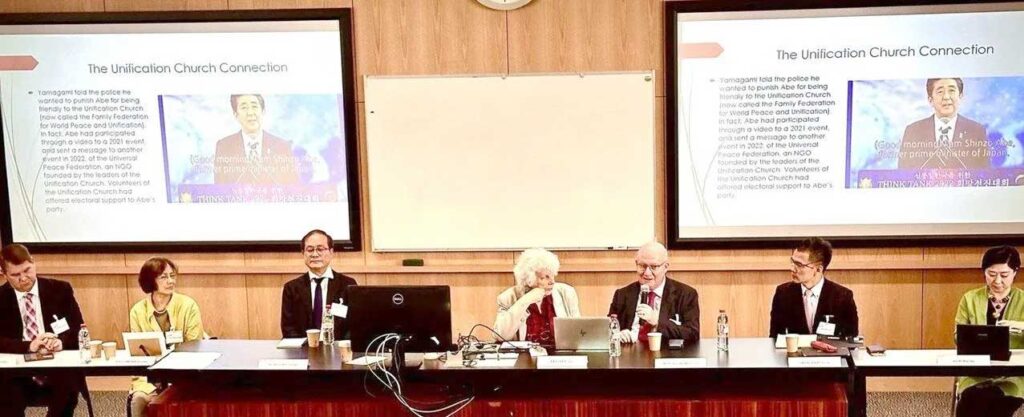
On 13th June, the 8th session titled “The Unification Church and Japan: What Is Exactly Happening?” addressed the issue surrounding the Family Federation in Japan, with the B200 lecture hall at the University of Bordeaux Montaigne nearly full.
Researchers showed interest in the circumstances surrounding the government in “no time at all” using its majority power to request the dissolution of a religious corporation for reasons other than violation of the criminal law. This is the first time this has happened in Japan under its postwar constitution, a country where democracy has taken root, and which has become an advanced nation. This development could potentially affect many other minority religions and their followers. The session was moderated by British sociologist of religion Eileen Barker.
As an introduction, co-founder of CESNUR and Italian sociologist of religion Massimo Introvigne gave an overview of the circumstances leading to the government’s request for a dissolution order against the Family Federation. His presentation was titled “The Post-Abe Assassination Crisis: An Outline“. He discussed the incident caused by Tetsuya Yamagami, the defendant who harbored resentment against the religious organization due to his mother’s large donations as a believer.
Introvigne stated that after the incident, “a parade began of defectors who had become apostates.” They criticized the religious organization in the media. The Italian scholar indicated that the statements of those defectors are one-sided and sometimes not factual. He also expressed concern about the situation surrounding minority religions in Japan, mentioning abusive criticism against the Jehovah’s Witnesses. Introvigne stated, “The way forward is to internationalize the issue and bring it to international conferences. I believe what we are doing today contributes to that.”
During the session, there was time to hear voices from officials from the religious organization. They expressed concerns about the threat to religious freedom posed by the request for a dissolution order against the Family Federation in Japan. Testimonies were given by Attorney Tatsuki Nakayama; Deputy Director of the Legal Affairs Bureau of the Family Federation‘s Japan Headquarters Norishige Kondo; and Suzuko Hirschmann, who lives in Vienna and whose older sister was forced to de-convert through abduction and confinement.
Tatsuki Nakayama spoke on the topic “Why the Family Federation in Japan Should Not Be Dissolved.” He said that the conditions for dissolution under Article 81 of the Religious Corporations Act stipulate that an act must be “clearly” recognized as violating the law and “significantly” harming the public welfare, and that this should be interpreted strictly. He argued that the Family Federation does not meet these criteria and noted that past prime ministers, governments, and courts have said no to dissolving the organization. He mentioned that Prime Minister Fumio Kishida overnight changed his parliamentary response, stating that “torts under civil law” could qualify as grounds for dissolution.
Nakayama furthermore emphasized that
- 1) The Family Federation has been recognized as a religious corporation for 60 years as of July and has not been involved in any crime during this time.
- 2) They lost some civil lawsuits for the return of donation, but
- 3) behind those lawsuits are apostates who have been forcibly de-converted.
Norishige Kondo speaking in Tokyo 10th Sep. 2023. Photo: Screenshot from live transmission by Japanese Victims’ Association against Religious Kidnapping and Forced Conversion
Norishige Kondo reported that after the Abe incident, media reports criticizing the organization escalated, resulting in threats and harassment against organization facilities and believers. He also criticized Prime Minister Kishida’s declaration on August 31, 2022, to sever ties with the Family Federation, stating,
“Since most Family Federation believers work in general companies, if Liberal Democratic Party members follow Kishida’s instructions, they would have to investigate the beliefs of everyone they contact, and if they are identified as Family Federation believers, sever ties, which is unconstitutional.”
In addition, Kondo addressed the civil lawsuits regarding donations, pointing out that
- 1) there is no research in Japan indicating that the testimonies of apostates are unreliable;
- 2) there is no custom in Japan of making large donations to religions;
- 3) since Japanese people, including legal professionals, generally do not believe in God, judges think that no one would make large donations unless threatened with stories of suffering in hell; and
4) judges in Japan fear being criticized by the media for helping a “cult”.
The dissolution of the religious corporation means that all believers lose their place to worship and engage in religious activities. The fact that a session was devoted to this issue at an international conference overseas shows the growing interest. During the question-and-answer session, many questions were asked from the audience about the so-called second-generation religious issue, abduction and confinement, and other topics.
Click here to read more on Religious Persecution
Featured image above: The panel during session 8 at the 2024 CESNUR conference in Bordeaux, France. Photo: FOREF