By Juraj Lajda
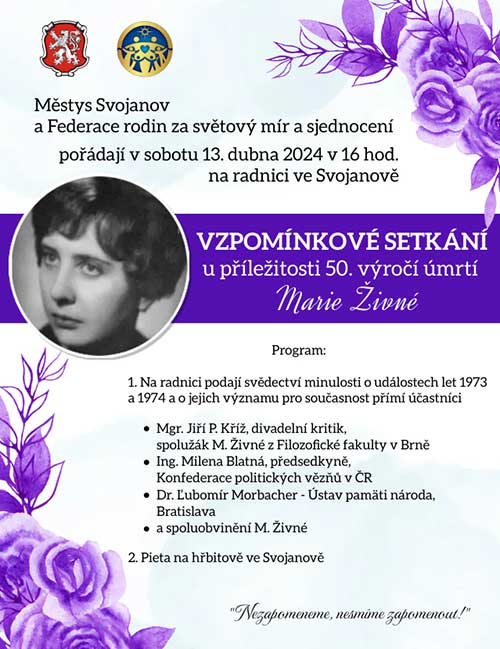
On April 13, 2024, we commemorated the 50th anniversary of the passing of Marie Živná, a martyr in the former Czechoslovakia.
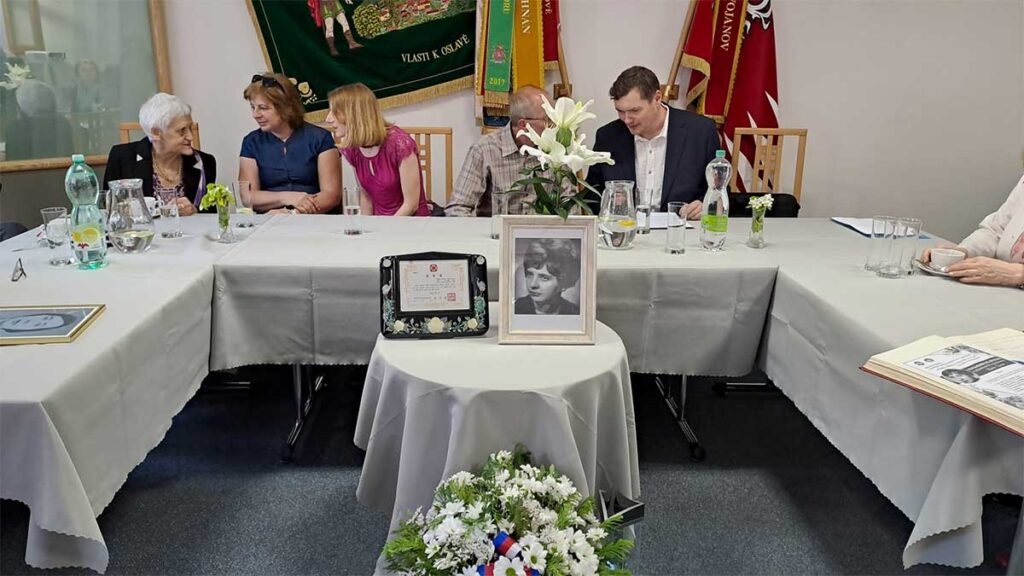
To mark the occasion, the Czech chapter of the Family Federation, together with the administration of the Czech village of Svojanov, where Marie was born, organized a memorial meeting in the Town Hall in which distinguished guests and village residents participated.
From an early age, Marie Živná was shaped by the environment in which she grew up. Her father was a castellan in a medieval castle, where she watched him paint pictures on winter evenings. It was her love of history and art that led her to study art history at the Faculty of Philosophy in Brno. She was just about to graduate, and she had also written her diploma thesis, in which she researched a set of Gothic churches in the Svojanov region. In the end, however, everything turned out differently.
In 1972 she became one of the first Czechoslovak members of the Unification Church. The newly forming movement, standing outside the official structures, immediately provoked a reaction from the regime. A group of believers were arrested in Bratislava, and a trial took place in which 18 young people were found guilty of subverting the republic and sentenced to unconditional sentences of one to five years. The nineteenth, Marie Živná, did not live to see the trial.
The mayor of Svojanov emphasized in his opening speech that during the time of communism, people could not freely practice their religion.
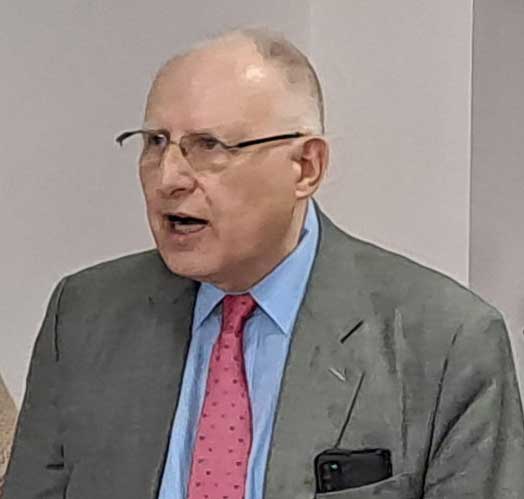
The theatre critic Jiří P. Kříž, who met Marie during joint activities at the Society of Philosophy Listeners, said: “Marie Živná’s heroism is not a showy standing on the barricade. She was a pure girl from Svojanov who managed to resist and not give in until the end, about which nobody knows anything to this day”.
The next speaker was Milena Blatná, the president of the Confederation of Political Prisoners in the Czech Republic. She described the atmosphere of the 1950s and 1970s under the communist regime. Marie lost her life for her ideals, and no one causing this tragedy was punished, Mrs. Blatná said.
Juraj Lajda, the MC of the event, who spent 3 years and 2 months in prison, recalled: “In 1990, I visited Marie’s parents in Svojanov, together with Dr. [Andrew] Wilson, an American professor. The father of Marie showed us a telegram that had come from Bratislava: ‘Your daughter has died; come and get her things immediately.’” Dr. Lajda, who himself spent three years and two months in prison, declared with emotion that Marie should not be forgotten. “She is a role model; she represents noble values and character,” he added. Then he gave a short presentation describing the history of the Unification Movement.
Afterward, a short video was shown in which Alžbeta Danišková, leader of the Unification Movement at that time and the main person in the trial, spoke about Marie Živná. Alžbeta spent four years and four months in prison.
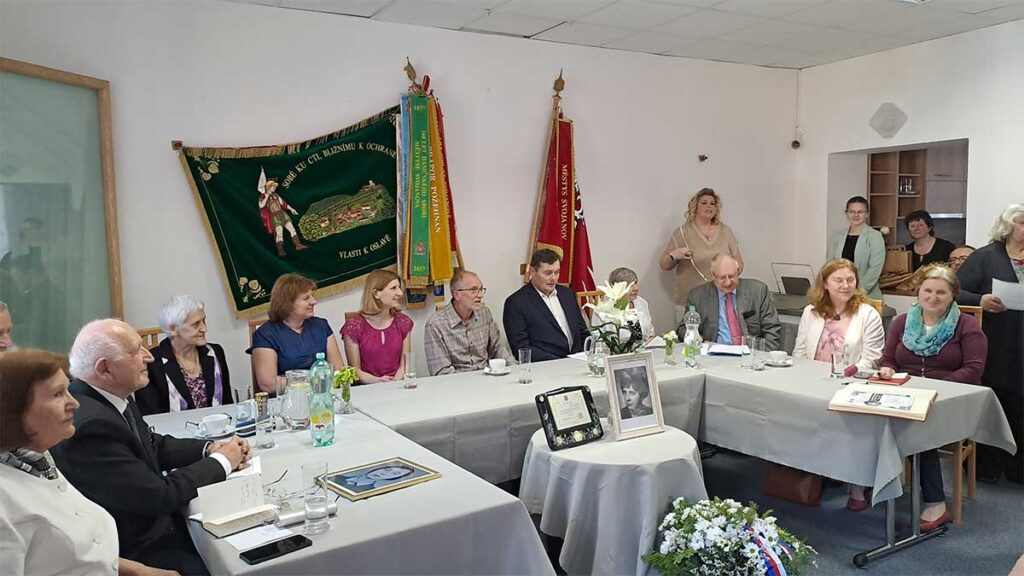
Another speaker was Anton Uhnák, who spent three years and eight months in prison. He recalled that in 1968 there was the Prague Spring movement, but Soviet tanks interrupted the reform process. At that time, Reverend Moon was founding the international organization Victory over Communism.
We need young people who are willing to sacrifice their lives for God. We need to find the logic of love, the speaker concluded.
Dorota Šimeková, the next speaker, spent three years and eight months in prison. She said that the crown is humility and freedom means freedom of the soul.
Mária Uhnáková spent three years and two months in prison. For her, Marie Živná was a deep person.
When she prayed for hours and thought of Marie Živná, images of flowers always came to her. Marie left with a glow like the princess of Svojanov, she said.
Then Mária recited her own poem dedicated to Marie Živná with a touching deep inner feeling.
In the next part, Marcela Gregůrkova, a medical doctor who joined the Family Federation after the fall of communism in 1990, said that many young people at that time were searching for the meaning of life and for God. After the fall of communism, it was possible to speak about God freely. But this was not possible for those who lived before that time. Marie Živná lost her life because of her faith.
Finally, Suzana Strkulová, the acting president of the Family Federation in the Czech Republic, said that she had not experienced hard communism. Everybody has the ideal to have a good family, to have children and to be happy. Marie Živná was never allowed to do that, and that made her sacrifice all the greater.
In the next part, others in the audience had the chance to speak. Many expressed that they had known Marie since childhood and described her as the best person. One woman recalled going to school with her. She remembered Marie as a great girl.
František Beneš, who helped Marie Živná photograph churches for her thesis, also recalled the moments after her death.
“When the terrible telegram came, I was in the factory. It was a shock in the whole village. It was word of mouth: Maruška had died in prison. One person commented: ‘What did she want? Society gave her a degree, and she joined the anti-state group.’ My blood started boiling. I shouted at him, ‘You approve of this?’ I got a call from the manager. ‘You, Franta, watch your mouth. I have a report against you for insulting the party.’ That was the time,” Mr. Beneš said.
Then the participants went to the local cemetery where Marie is buried. Here they laid wreaths, sang, and prayed.
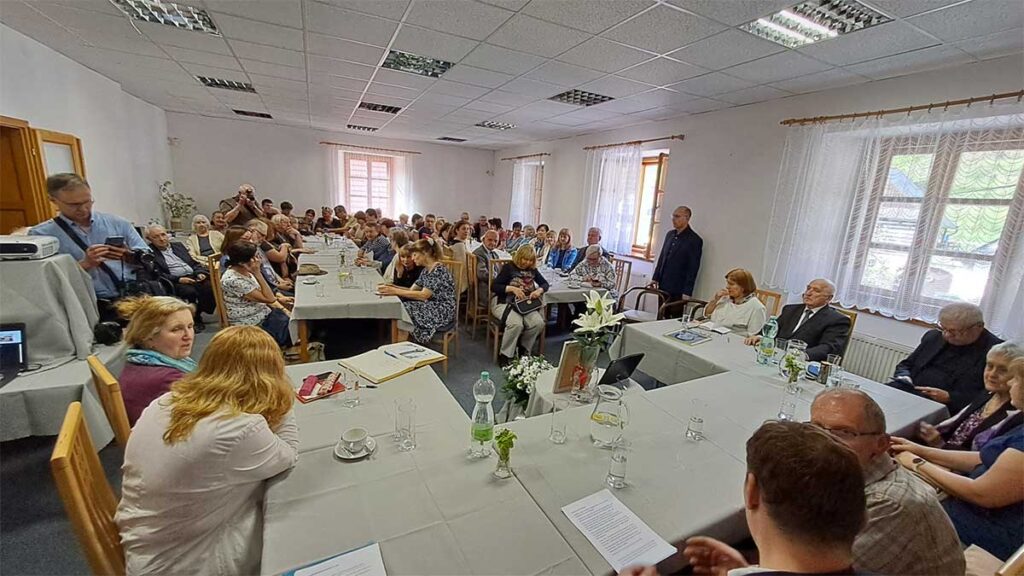
The memorial meeting was attended by over 90 people, mostly local residents who for many years had not been able to talk about this case.
Those who attended the meeting expressed their appreciation, because it allowed them to learn more about the circumstances of Marie Živná’s life and death. Guests also came from Slovakia and Austria.
Marie Živná’s brother also attended the meeting with his wife and daughter.
The next day there was a coverage of the event by the biggest Internet news server, written by a regional journal who attended the event.
Suhyon Kim: A 360,000 couples
Last Saturday, April 13, 2024, the 50th anniversary of the martyrdom of Maria Živná was commemorated at the town hall of Svojanov, a small town in the Moravian region of the Czech Republic, where Maria was born and where her grave is located. By 4 p.m., the hall was packed with people, completely filled. Maria’s brother, her only living blood relative, was present, as well as the mayor and citizens of Svojanov town, the president of the Czech Federation of Political Prisoners, a theatre critic and alumnus of Maria’s university philosophy faculty, Maria’s former colleagues, and friends and acquaintances from Svojanov. Many of them gave eulogies reminiscing about Maria. Maria’s former colleague and fellow prisoner, UPF Czech Republic President Juraj Lajda, gave a brief presentation about Maria and introduced a video tribute by the first national leader of the Unification Church in Czechoslovakia, Elizabeth …………., who was seriously injured in a car accident and as a result of inadequate medical care and imprisonment ended up partially paralyzed in a wheelchair. The president of the Czech Family Federation also gave a tribute and testified that she was following in Maria’s footsteps in attending True Parents and continues to do so nowadays.
I was very honoured to be able to attend the above ceremony. Before I could just read about Maria and see her photographs, but to be in her hometown and meet real people who had known her, and who still remember and miss her was overwhelming. The woman sitting next to me was a friend of Maria’s sister; she recalled how they used to go to the castle where Maria lived. The three women in front of me introduced themselves as classmates of Maria’s elementary school and high school, one introduced herself as Maria’s friend. They recalled that on weekends, they would go up to the castle where Maria’s family lived, and the parents would talk and the kids (Maria and her friend) would play together. And then there was another person saying he was Maria’s friend, had tears in her eyes as called Maria by her nickname (Marushka). Another person said that Maria was really nice and smart. Mrs. Maria Uhnák, who was also imprisoned along with Maria, recited her own beautiful and poignant short poem about her dear friend Maria touching hearts of all those listening. The warmth of everyone’s love for Maria was palpable, and the fact that so many people were there to pay respect her made me feel that the town of Svojanov really does remember and honours Maria deeply.
When visiting the cemetery, I felt that Svojanov was a sunny, warm and beautiful place. I could feel Maria‘s smiling face. I deeply realized that by giving her life in attendance to Heavenly Parent and True Parents Maria expressed the heart of Hyojeong which fits very much for nowadays when we should attend True Mother, the only-begotten daughter, on earth. I thanked Maria for taking this precious path. Together we prayed that Maria helps True Mother.
Jack Corley: Tribute to Marie Živná
On Saturday, April 13, I had the privilege to be invited to a special ceremony honoring the life and martyrdom of Czech Unificationist Marie Živná. She was just 24 years old when she died in prison 50 years ago, apparently as the result of being tortured for her faith. I felt honored to remember such a precious young woman, who was profoundly loved by True Parents for her sacrifice.
What was also moving was that the anniversary of Marie’s death was commemorated not only by Unificationists from the Czech Republic and Slovakia, some of whom also had been imprisoned in the early 1970s, but also by people from her hometown, the Czech village of Svojanov. Approximately two-thirds of the standing-room-only audience in Svojanov’s town hall were people who had known Marie or her family, including her younger brother and the village mayor.
Later, in a beautiful cemetery overlooking Svojanov, the mayor, followed by other local leaders and the Unificationists who had suffered imprisonment, laid wreaths and candles on her family gravesite. It was a beautiful, sunny spring day, and one could feel Heaven’s joy shining down upon this beloved daughter of God and True Parents.