Theory of Heavenly Unified Korea
Hello! I am Sung-bae Jin, head of Unification Thought Institute. The reason why I emphasize that I’m the director of UTI is that Unification Thought is one ideological and official institution in our internal group. The ideological system of Director Sang Hun Lee, who served as the first director of UTI, has become the foundation of our ideology. So, Godism derives from Unification Thought, and when we speak of Headwing Thought, we are talking about Unification Thought. Headwing Thought is Unification Thought. “The End of Communism,” the idea of anticommunism and the critique of Kim Il-sung’s Juche ideology, these three are the works taught by our first director, Sang Hun Lee, who is a historical and providential person. Director Sang Hun Lee is the one who laid a great foundation by asking True Parents directly about every concept, letter, and sentence, and obtaining permission to organize each concept.
The first president of the association, Rev. Hyo Won Eu organized Christian theology, Unification Thought, and Headwing Thought within the standardized framework of True Parents’ words. Upon this basic framework, we have entered the realm of True Mother’s new era of providence, and an historical goal of ours was set: a Heavenly Unified Korea and Heavenly Unified World. Realizing that there is a need for realistic theories and ideological elements that can be approached more closely by applying these ideas to the real world, True Mother also spoke of the ideological system called True Parents Thought. Also, the International Headquarters, led by General Secretary Yoon Young-ho, saw the need for a Theory of Heavenly Unified Korea as a theoretical basis for achieving Heavenly Unified Korea. In a place where UPF’s activities around the world are heading toward the historical goal of a Heavenly Unified Korea and a Heavenly Unified World, if we talk about hardware as necessary activities, we must have the necessary software and content too. That’s why I felt the necessity of the Theory of Heavenly Unified Korea, Theory of the Heavenly Unified World, and True Parents Thought, so I already reported to International Headquarters just recently. The theoretical guidebook, Theory of Heavenly Unified Korea and True Parents Thought toward a Heavenly Unified World, followed by a summary of Dr. Sang Hun Lee’s three works, Unification Thought, The End of Communism, and Criticism of Juche Thought to be published aiming at the World Summit planned for Feb. 11, 2022.
It’s a bit regrettable that it was first published in English, but since it is a theoretical guidebook for world leaders who will come to work for the Heavenly Unified World in the future, I am grateful to Heaven for preparing this according to the guidelines of the World Headquarters, and for shoring up the foundation that has been taught according to True Mother’s special guidelines. I am grateful to True Parents for leading this, and I cannot help but be grateful for being able to work along the guidelines of International Headquarters. The Korean version will come out in three volumes one month later. With the theories and basics taught by our leaders, there have been many individual studies and papers by various professors on the principle of co-existence, co-prosperity, and co-righteousness. In fact, the concept of co-existence is used as a concept of symbiosis or sharing in general, but the wording is confusing. The words in English “Interdependence, Mutual Prosperity, Universally Shared Values” cannot represent the original meaning of co-existence, co-prosperity, and co-righteousness. This is because of the limitations of English. For example, we cannot translate the concept of “Shimjeong”,so we have to translate it as “heart”, but it has a somewhat different meaning from Shimjeong. For that reason, there is no English word for “Gongsaeng.” “Interdependence” can’t catch the right meaning. “Gongyeong” is translated as “Mutual Prosperity”, but in this concept of interdependence meaning “Let’s live together”, God is missing. So, in the English version, we are using the original basic concepts such as co-existence, co-prosperity, and co-righteousness together with two concepts. We tried to translate it while making use of one English expression that is easy to understand by ordinary secular people and one of the most basic conceptual principles of Godism.
Now that I am standing in front of young people, I feel at ease as if I was standing at a university pulpit, and I feel more intimacy, different from the Peace Forums I have addressed so far. We have held ten Peace Forum sessions now, and this is the 11th lecture. In fact, I thought and prepared one continuous lecture, and I prepared an introduction according to it, but International Headquarters asked me to give a comprehensive lecture suitable for students, so I changed the preparation for the lecture. So, I thought about what to explain in my lecture. What I am going to convey now might be quite shocking for you. I will deliver unfamiliar, new, and strange content that you can’t hear on a regular YouTube channel. Materialism, humanism, Godism—these worldviews and ideological foundations are totally different, so it will be a completely new and unfamiliar concept to the concepts you are comfortable with. That’s why I am concerned that you may be challenged with what I will be teaching here because it is a work that can be judged difficult, and it is a work that takes a new view of the world, so I understand if many doubts arise. I hope you will not be deceived by my words. I will deceive you from now—but in a good way, in the direction of Godism. I will tell you a story that breaks the frame of your common humanistic thoughts. I don’t know if I’ll be able to deceive you. However, if you are deceived in a good way, I think that it is better to even be deceived ten times, a hundred times, a thousand times. Since the forum was held to talk about fundamental things like ontology, I hope that it can be used as an opportunity to reverse the framework of your thinking and your entire worldview.
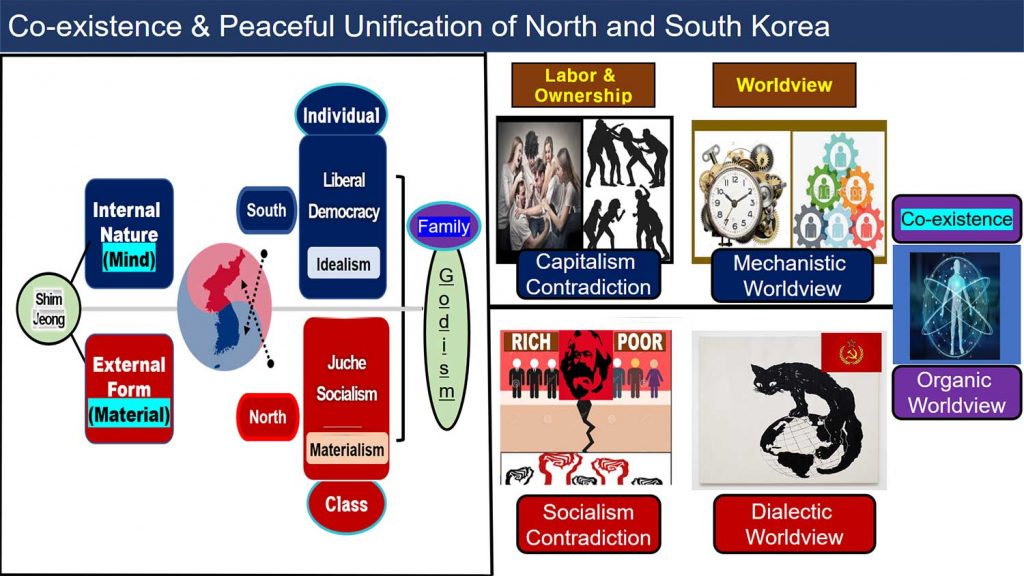
The 38th parallel we are facing is the DMZ. The confrontational nature of this can only be seen as a military and diplomatic confrontation line split through the Korean War, or through static talks such as the 1945 Potsdam Conference. As we know in principle, this standoff between North and South Korea is a providential and historical confrontation; this is the ultimate confrontation line between good and evil and between God and Satan; it is the conflict between the systems of religion and anti-religion, philosophy, and values of spiritualism and idealism. It cannot but be emphasized that this is the line of confrontation between values and historically, the point of final showdown of good and evil.
In the reality of division between North and South Korea, the only irreconciled, divided Korea has to be last to remain. In some ways, this is an unfortunate history, but in a way, this is a historical event, and what this unification of the Korean peninsula means is civilizational history, providential history, and from the viewpoint of values, it is the event of the last line of confrontation between the providential God and Satan between good and evil, and the resolution of this line of confrontation on the Korean peninsula is to resolve history, and it is based on a much deeper value that goes beyond the simple military and political unification of the two Koreas. In the sense of resolving the history of civilization and creating a new foundation for all providential history and all histories, the confrontation on the Korean peninsula is no simple political confrontation.
(Slide 2)
The only thing that can solve this problem is the principle of co-existence, co-prosperity, and co-righteousness which instructor Koh Yu-mi spoke of a while ago.
(Slide 3)
Before that, this is a principle you know well. The principle is to unify through the give-and-take action of the dual characteristics of Sung-sang and Hyung-sang. However, it is only possible to say that the physical manifestation of these mental substances act in genuine give-and-receive action only when based on heart (Shimjeong). It is an eternal and unchanging truth that mind and body, mind and matter unite based on Shimjeong. It is literally the principle. What if this fundamental principle were not merely a theoretical principle, but were viewed as the most ultimate solution, principle and law for resolving the reality of the two Koreas? It’s a serious matter. Considering that this is not just defined as a principle, but a key and a core that can handle all real problems of the two Koreas, this is a principle that has meaning not only as a principle or a theoretical value, but that it is the all-round key to a realistic solution. If you look at it from the viewpoint of unification, the standpoint of solving various problems such as the issues of history, the problem of North and South Korea, the problem of peace, and the problem of conflict within the South—it all hinges on the unification of the image based on the heart. The bliss, joy, and happiness we will feel there once we realize that this point of view stands certain, proven, and historically confirmed are indescribable beyond words.
Originally, it is not simply a theoretical principle, but a direct principle of the Korean peninsula. The philosophies of the South—liberal democracy and capitalism based on idealism, and Juche socialism and nationalism of the North founded on material values—both were adapted from outside. When we see the conflict between socialism and capitalism, and the conflict between liberal democracy and socialism, we see a confrontation of values, a confrontation between humans, and basically a confrontation between philosophy and the view on God.
The same is true when looking at history. North Korea sees all these experiences of our people through the prism of class. Is there a history of struggle between workers and capitalists in the history of Korea? No, there isn’t. Through the 931 invasions by the Sui Dynasty, Tang Dynasty, Japan, and many others, can you explain the enduring spirit of the Korean people based on class struggle? No, you can’t. That is just a distorted history based on a false, contrived thought. When we see that the history of Korea is an ultimate point of confrontation between the values of good and evil, this Godism, ideology of Shimjeong, and the factual event of Shimjeong, I think that this is bound to emerge as the more essential issue.
Where did the concept of Hyojeong that we’re hearing these days come from? Did you or some philosophers, scientists, linguists discover it? True Parents were the one to use the word Shimjeong for the first time. Before True Parents used the concept of heart (Shimjeong), the life of True Parents must have existed, right? Let’s define that life as an event of Shimjeong. Then who coined the word Hyojeong? It’s not from any philosophy, not in the dictionary. It is True Mother’s proprietary patent, uniting the traditional vertical value of “Hyo”(filial piety) and the horizontal value of Korea’s ethical values and affection; there is no Korean linguist who thought that the vertical spirit of Korea, called Hyo (filial piety), and the horizontal spirit of Korea, called Jeong, were tied together. But True Mother always said Hyojeong. Before the word “Hyojeong” was spoken, True Mother’s life must have been there. There must have been True Mother’s substantial incident of Hyojeong. Through such a life, the concept of Hyojeong emerged, and through the life of True Parents, the word Shimjeong emerged in its full meaning. Therefore, it can be assumed that there was the substantial embodiment in the life of True Parents before the concept of Hyojeong.
From the concepts of co-existence and co-righteousness (Interdependence and Universally Shared Values), let’s look at all problems on the Korean peninsula through the conception of True Parents’ Shimjeong and that True Parents’ life, history, and event of Shimjeong are the only things that can reunite our divided nation. Various issues on the Korean peninsula are raised in the concept of co-righteousness. North Korea is guiding the Party and the people under the concept of the Parent-Leader, along with the theory that he bestows eternal life. As such, it has become a national religion with a god and a belief. We cannot simply evaluate North Korean society academically in terms of the value of social democracy. North Korea is a deified, monarchical society, a world of Juche ideology ruled by a false god. In Korea, the gods of religion and the Christian view of God in various religions such as Christianity and Buddhism are representative. Here, the view of God, the source of all ideas and values, is the root of the confrontation between North and South. Who is the main subject of the Korean peninsula in terms of the question of God? For this we must look to co-righteousness (Universal Values).
Second, there is the human problem. Class emancipation and worker liberation became issues for humans through the proletarian revolution and the awakening of consciousness. How about the bourgeoisie? The French Revolution was a bourgeois revolution. In the liberal democracy created by this bourgeois revolution, the value of human dignity and human rights was the basis of freedom, demanding freedom or death. Did that freedom embody human liberation? Are we who live under this capitalism or social democracy able to enjoy what we call freedom in principle? This freedom has become indulgence, and ends up depriving the freedom of others. In the reality of Korea, undergoing indescribable chaos and conflict, what do you seek in human liberation? It is said that the problem of the Korean peninsula cannot be resolved without the great liberation of Hyojeong Thought.
The cultural Marxism that Dr. Koh lectured on shows up as the new face of Marxism that has arisen in the heart of capitalism since the 19th and 20th centuries. Now capitalist society is being overcome by this Marxism. Their catchphrase is that all the structures of consciousness that capitalism has coopted—politics, economy, law, philosophy, religion, education—all these patterns of consciousness are fictional structures. Because it is a false structure for exploiting workers with capitalism, in the end, through the Cultural Revolution, we want to reverse the culture of workers and the marginalized labor culture. In other words, let’s overturn capitalism through a cultural movement by implementing Marx anew in a successful capitalist society. Singer Ahn Chi-hwan (who performed on stage before my lecture) is a representative singer in an important movement. Following the Candlelight Revolution, these songs represent youth as a demo song, but evolved into a cultural movement to overturn the existing capitalist values. Even though it is pure art, the art is being used.
What is the pinnacle of cultural Marxism? It’s a gender issue. Marcuse, a Freudian, overturns the big frame of family and religion because the ascendancy of capitalism is exploited by the religious establishment and the nuclear family to exploit the people and labor. What has emerged here is the Eros civilization based on Freud’s sexual psychology. Homosexuality is possible because this Eros uses human desires at will. So cultural Marxism undermines traditional families through these new game rules. Does capitalism have an answer to that? Capitalism has grown ever more corrupt and hedonistic. Hedonism has taken over capitalism. In a society like ours, how significant is the advent of the Absolute Sex and True Family Movement? This is because the only theory that can coexist with North and South Korea is the Theory of Heavenly Unified Korea, connected with co-righteousness.
The same goes for co-prosperity (Mutual Prosperity). How many peace talks have been held? How many times have we agreed on denuclearization? What is denuclearization anyway? For the United States it means the denuclearization of North Korea. For North Korea denuclearization means for the nuclear submarines to leave from the Korean peninsula and the withdrawal of U.S. forces. Peace in North Korea means that there is peace when it is supervised by Mr. Kim Il-sung. In that scenario, what peace can there be? North Korea’s concepts of peace and denuclearization are different from ours. It’s not the peace we think it is. The peace of the Moon Jae-in government in South Korea is a peace relativism where we maintain an acceptably war-free state. The only true peace in the extreme situation we face is True Parents’ peace essentialism. There is nothing that can bring about peace on the Korean peninsula other than peace essentialism.
Gorbachev sent 25 people to assassinate Rev. Sun Myung Moon. According to the CIA report, the guerrillas were fortuitously apprehended at a turnpike rest stop, and Gorbachev’s plan to kill Rev. Sun Myung Moon was thwarted. Later, after the collapse of the Soviet Union, Gorbachev somehow managed to visit True Parents’ mansion in Hannam-dong in South Korea. The two leaders embraced, and Cain and Abel were so happy and moved that they shed tears centered on God. What is peace? There can be no peace without God as the foundation. Peace essentialism cannot be realized without True Parents’ factual event of Shimjeong, tears, and movements to save the world. The linchpin was the event where True Parents exhorted Kim Il-sung to abandon Juche thought.
Is this the 30th year? The International Association of Academicians for Peace is preparing for the World Summit in February with world-class scholars presenting on the topic of the visit to North Korea and second Moon-Kim summit. At the historic event, President Kim Il-sung mentioned a gathering of pastors, claiming that there are many pastors in the North. When I went to the Juche Ideology Tower, I saw their names written on it. President Kim Il-sung said that only two people ever talked to him about God. The first was the famous Rev. Milligan from USA who preached about God and the second was Rev. Moon. Moreover, he urged him to let go of Juche thought and follow God the Lord.
This issue of peace essentialism is important. Keywords here are Juche nationalism, ethnic nationalism, federal reunification, absorption unification, and inter-Korean unification measures. We need to present new alternatives to these unification measures. We have to prepare for such things as open nationalism, the theory of perpetual peace, and the inter-Korean general election. It’s a real challenge! Sung-sang and Hyung-sang are not just theoretical, but provide a clue to solving the problems of peace, denuclearization, nationalism, and the anti-unification directly, centering on heart (Shimjeong).
At a large seminar of 20 Million Separated Families Association last week, two former Vice Ministers of Unification, Ahn Chan-il and I, altogether four people held a symposium. I made a presentation on the Theory of Heavenly Unified Korea and nationalism as it is. I received enthusiastic applause. This is the only way to go.
I will meet Candidate Yoon Seok-Yeol on Feb. 26th. Somehow an opportunity has arisen. I’m not meeting him because I planned it, but it just happened. I will discuss our program for five minutes. I’m originally from North Korea; I am a 1.5 generation North Korean refugee. During the campaign, isn’t now the time they risk losing votes from the provinces? Yet we have to tell our story, and we have to assert our legitimacy.
Our 300 professors and 100 faculty members at Sun Moon University will all vote for Yun Seok-yeol! I don’t know if it’s a lie or not, but that’s how we’ve been advised. For example, let’s talk fundamentally, rather than a mere political act of choosing a certain candidate or not. We need to talk about fundamental issues. Presently some forms of leadership hinge on patriarchal tyrannical leadership or confrontational leadership. Only when approached through confrontational leadership, people in their 20s and 30s will open the door. Change cannot come with the fuddy-duddy theory at this stage in the game. Generational conflict is a big problem. What kind of problems can we solve if we’re stymied by such a barrier? That is why, through this co-prosperity (Mutual Prosperity), it is the same for various political and social problems, and coexistence.
There are two premises for co-existence, co-prosperity, and co-righteousness (Interdependence, Mutual Prosperity, Universally Shared Values). We can solve this problem when the questions of what is God and what is a nation are addressed.
What is God? Let’s investigate who God is through myths. I’ve been giving lectures on myth for seven years at Sun Moon University. No matter how much I read the Sisyphus myth or Roman mythology, I can’t get enough of it. There are many stories, yet I can’t fully understand their meaning. However, the myth of Sisyphus can be solved by taking our Unification Thought perspective and interpreting through Divine Principle. So, everyone, don’t be fooled because it’s my theory; it may be different from what you think, so please listen and if it’s reasonable, you may perhaps agree with it. Sisyphus is the existentialist philosophy of Camus. Sisyphus was only at fault for being smart. He was punished for the crime of discovering that Zeus was having an affair and divulging it, and for the theft of the god Hermes and the crime of going around talking about the gods’ corruption. This stone was rolled down, he raised it again to the top of the mountain forever and it rolled down. The fate of this life, the existentialism of Camus, sees this as symbolic of the miserable life of humans. This becomes an important philosophical theme in existentialism.
Turning to the legend of Prometheus, Zeus warned him not to do it, but he took pity on humans, loved them, and gave the fire of the gods to the people on this earth. As his punishment, Prometheus had to go to Mt. Ararat and have his liver pecked by an eagle, and at night the liver grew back. He was punished by the eagle perpetually pecking his liver on the mountaintop. The liver has the ability to regenerate. What’s wrong with loving humans? Such humanism is eternally punished in mythology. It is because he violated the order of the world of the gods.
Next is the legend of the goddess Athena and the mortal Arachne. Athena disguised herself as a grandmother and asked Arachne to weave. Since Arachne said she is better at weaving than she, Athena turned Arachne into a spider for challenging the gods. So who is bad? From the point of view of humanism, the gods are bad characters. Such are the moral lessons in mythology. You are all familiar with the story of Pandora’s Box. It closely parallels the fall of Eve. Zeus warned her not to open it, but she opened the precious box, and sin spread to all mankind. Just as God admonishes us not to eat the forbidden fruit, the fall of Eve became the eternal crime of mankind because she ate a fruit out of curiosity. Likewise the myth of Sisyphus conveys the story of Pandora’s Box. No one expected violating a seemingly trivial order would result in such severe punishment.
Here Principle and Eros are related. Eros represents desire. Even in Divine Principle, human beings have desires, and it is stated in the Divine Principle introduction that the purpose of our life is to ultimately enjoy happiness by fulfilling our desire. This Eros, which stands for desire, indicates such a possibility. It is expressed as youth because it is potential. Desire is to rise; Eros has wings to ascend to heaven. To be young and have wings. If you look at Western paintings, Venus the goddess of beauty and Eros are always together. Desire and beauty are in an inseparable functional relationship. Eros’ lover is Psyche or the soul, implying ethics. This is important. Our desires related to universal laws. It is the law of conscience, it is soul, it is spirit, it is pure. This is one source from which desire rises. But what about human desires? If you indulge in physical lust it will suck you into death.
The legend is simple. It is a distinction between the world of the gods, the world of eternal immortality of the gods, and the world of human beings who cannot but die. If you do this you will die, if you do that you will live, if you do this you will perish forever, if you do that you will live forever. Therefore, the ultimate source of human desire lies in eternity. The passionate human desires are to buy a car, to buy a house, to be rich, to marry a pretty wife—while the essence of the lofty human desire is eternity. Giving birth is to reproduce one’s own genes; an individual dies, but the genes remain forever. Richard Dawkins said the principles of the gene are selfish. The scholar talked about the god we created in biology. Genes are not selfish—they are unselfish and altruistic. We have to get biology back on track. We know many cases where a dog ran into a fire or a flood and struggled to save its master who was about to die. What is the relationship between dog genes and human genes? They are not related to each other. But how does the selfish gene explain the loyalty of a dog to save its owner despite the differences in species? How can biology tell a lie that we invented God? These are all Darwin’s descendants. Darwin’s idea of struggle mistook the biological origin of species as accidental evolution. This is the logic of survival of the fittest, which violates Mendel’s laws. In the end, the essence of ultimate human desire rises with Psyche as a lover. The only way to attain the eternal world is to form a family and the Four Great Realms of Heart, according to Divine Principle.
What do Christians have to say about this? Christian philosophers came up with the dialectic. The Christian God is the Absolute Spirit, pure spirit, and spiritual existence of Hegel. Because this spirit moves on its own, it becomes creation, history, and returns to the mind in the dialectical evolution of the Spirit. This is the philosophical interpretation of the Christian view of God. Hegelian leftists such as Marx, Strauss and Engels, speak of the materialist dialectic, holding that if the mind moves on its own, matter also moves on its own. Matter itself moves, there is no god, and so matter itself can become God. This Marxist dialectical materialism even proposes a materialist theology. Have you ever heard of a materialist view of God? Have you heard of militant materialism? Materialism is the reversal of Christian thought. Toynbee once said: “We are all the illegitimate children of the original Christian faith.” Marxism, the anti-transition opposing Hegel, is the so-called Hegelian Left, the Young Hegelian School, the reverse of Christianity, that tries to remake the Christian heaven into a communist world by using and applying the framework drawn by Christianity. If God can be material, from that point Nietzsche proclaimed, “God is dead.”
A spiritual god, a Christian god, a weak, self-sufficient god is not needed in this world. If God exists, I find him in my passion, my human desires, and the acidity of life. Why in history, that easy-going god in the sky far away, that god is dead. If God does not exist, as Marx said, does not God exist in reality and in the world? God is dead! They are making such outrageous claims! Time magazine posted the headline, “Is God Dead?” When you contemplate Christian orthodoxy, it seems that what Marx said is correct: there is no way to avoid the challenge of Nietzsche. Since modern society is becoming an atheistic society, we move from orthodoxy to neo-orthodoxy. There are the Presbyterian Church of Christ and the Presbyterian Church of Jesus Christ, and the Christian Presbyterian Church espouses neo-orthodoxy. In orthodox theology, Catholics see God as a transcendent God, and in neo-orthodox theology, Jesus is God, according to a dialectic that defines Jesus himself as God. Catholicism has affirmed the transcendent God for two thousand years. Neo-orthodoxy does not talk about that kind of God, and now Christian theologians have come out with a theology of God’s death. Dr. Rubinstein is the first president of Bridgeport University. He was invited from Harvard University Theological Seminary. Dr. Rubinstein is a theologian of the death of God. Modern theologians take God’s death for granted. By so interpreting the story of Jesus and the event of the Word, they decided, “Let’s define Jesus, who intervened in history through this event of the Word, as God.” This is what the dialectic has led to.
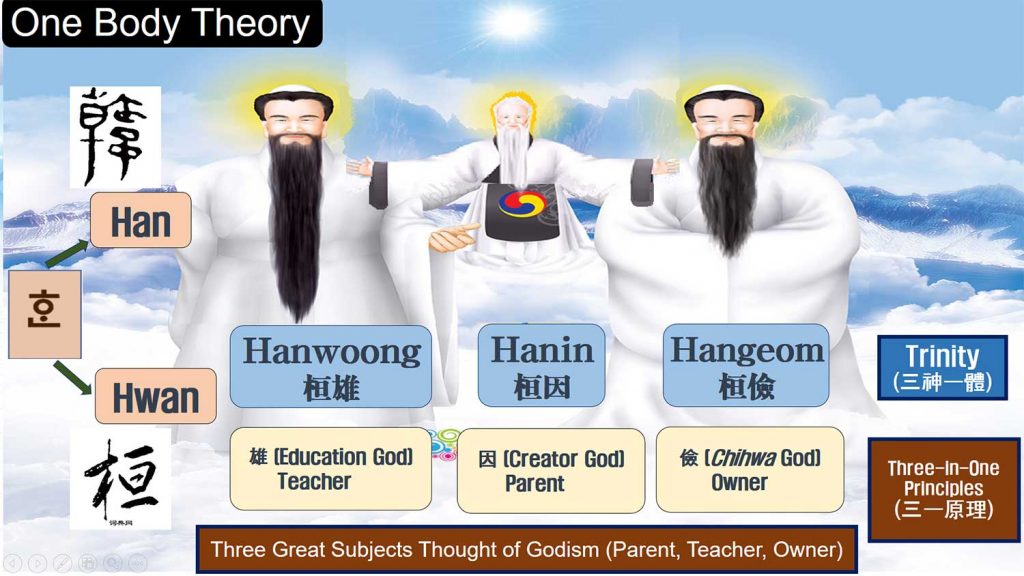
It’s interesting to talk about the Korean traditional God within this framework. If you look at the views of God in Korea, we find the element “Han”. The Korean people, as “Han people,” are bright. Hwan and Han are interchangeable, because of the Chinese characters. At first, there was Hwanin, the god of creation and growing up as a parent. Hwanin’s son Hwanung longs to become a human, so he begs permission from his father to come down to earth. Hwanung is the God who descends to earth. I interpret the idea of “Han” as the essence of love and heart. Through the essence of love and heart, he is the first God of creation, paralleling the God of Judaism, Yahweh. How natural it is that he descends from heaven to earth! This is naturalism. To whom does he get married? With an animal—the bear Ungnyeo who becomes a woman. That is why he is the God of Heaven and Earth. Heaven and earth joined to give birth to Dangun. Dangun is the master who rules and guides the people through wise politics.
In fact the Korean God exemplifies the three-in-one principle of the Trinity. No pattern of conflict is seen in this dialectic of spirit and matter, as conveyed in the dialectic of the Korean legend. It abides by the law of similarity and give-and-receive action. God may be said to transcend and inbound. The image of God is just as in Genesis 1:26: “God said, ‘Let us make man in our image, in our likeness’.” In this passage, the image of God is Adam and Eve. God would be revealed in visible form through the perfect couple, Adam and Eve. This story conveys that Adam and Eve were created as the True Parents of mankind. This is the model of the True Parents event. This is none other than a factual event of Shimjeong.
Plato narrated his interesting ”Allegory of the Cave,” revealing very deep points in cognitive philosophy, the true reality, and the transcendental world. This story is famous and widely studied even today. At Hyojeong Academy, I systematized the study of Godism in physics and biology. We are systematizing True Parents’ studies in quantum physics, biology, and philosophy. Some of the world’s leading scholars are engaged with us. No one has yet received the Nobel Prize, but a Nobel Prize nominee contributed a book he wrote. There is so much more to share on a wide variety of topics!
Let’s discuss the conclusion. Do I exist because I think? In some languages there is no “I”. Am I the cause of my own existence? A goose is surprised to see her own reflection in a mirror and fights it. In fact, without a mirror, I don’t even know what I look like. I am myself because of other people. That’s the principle of Ta-ah—“Other-and-I.” I am who I am because of my conscience. Conscience is the parent, teacher, and master. These are the three main pillars of Three Great Subjects Thought, in contrast to Kim Il-sung’s Juche thought, where Supreme Leader is the parent, teacher, and master. God commands the conscience through our heart. God, the source of the heart and subject of the conscience, is the Subject of subjects, Parent among parents, Teacher among teachers, and Owner among owners.
Second, I am the one who came from my wife. I am who I am by virtue of my neighbor. Here’s where I advise you not to be deceived. Whose are the genitals? Is a genital for yourself? No. Are the genitals mine? They are not. Just by looking at their appearance, you can see that you are an altruistic being, and I am who I am thanks to my wife. It’s me for sake of a child. It’s me for the sake of neighbors. This “second other” is my neighbor. Co-righteousness is a three-in-one principle, the basis for the common existence of God and neighbor, and it exemplifies the “other-and-I” culture of Korea. The original ideal culture called the “us” culture is different from Western, Christian, or Buddhist culture.
It’s an amazing miracle that all religions have come to Korea borne fruit here. All the world religions and civilizations come here and blossom because of the culture we have. The world’s five largest churches are in Korea. Despite 931 invasions, we persist in protecting the soul of the nation and the sentiment of our country. Koreans often fight, and if a neighbor buys land, they feel envious. However, when faced with a national crisis, the mainstay of our culture is Korea’s han. This is True Mother’s han, based on the wellspring of heart called the “Essence of Original Being,” the Triune God principle, where three entities become one. Religions and cultures of all kinds find fertile soil here. My grandfather and my co-workers call my wife “our wife.” You can’t translate it into English as “our wife”; the Korean expression doesn’t have that meaning. Still, the core being called “our wife” is from the “Essence of Original Being”, as well as from the idea of Hyojeong, “Other-and-I-ism,” and co-righteousness. Co-existence and co-prosperity are what God, me and my neighbor do together. It’s the same pattern. It is the co-existence of three beings when compared in ethical form. From the point of view of politics and ownership, we can define co-prosperity and co-existence. I’m not a person from me, it’s that I’m a person who comes from Heavenly Parent and neighbors. Yet this neighborhood concept is open to interpretation.
I’ll conclude with a final hint. A typical type of what we call a neighbor is the nation. I’m giving you a hint. It is God, the nation, and me. Plato said that if there are just five people, a nation can be formed. Our 43 couples constitute a form of a state and heaven. The 430 families are a movement for a clean country, not to evangelize. You won’t have your motherland or country. The most basic type of state is the 43 couples community, the basic principle of the form of heaven. It’s is God’s country and my country. This nation resembles Heavenly Parent the most. How do you view the historical God? Without a nation, we cannot see God. Just as Jacob met Esau and saw God in the face of his enemy Esau, God does not appear to Jacob alone. As God’s face was revealed through Esau, the pattern that most resembles God is the nation. Does it make sense? It is said that God, me, the nation, and our neighbors are the starting points of co-existence, co-prosperity, and co-righteousness (Interdependence, Mutual Prosperity, Universal Values). How great is this word? I will close today’s lecture by saying that the only way to solve the problem of reunification of the Republic of Korea and the problem of world peace is that there is Shimjeong and the factual event of Shimjeong in the essence of the Word. Thank you.