A testimony given during the leaders’ assembly 2015
By David Hanna, PhD
(David is currently the director of the Blessed Family and Education Department in Europe.)
I do not seek to hold my family up as any kind of example, but will share some points from our experience as parents that hopefully others may find useful. Circumstances and opportunities vary greatly from family to family, and it is not possible much of the time to say for sure what exactly in the nurturing process contributes to perceived success or failure. Because of this, and because of the unseen dimensions of our spiritual life, we know that making comparisons can be very unwise – all I can say is that somehow, by God’s grace, our children have found a path by which they can receive the Blessing and be voluntarily part of this extraordinary Kingdom-building process centered on True Parents. As parents we are very grateful for that.
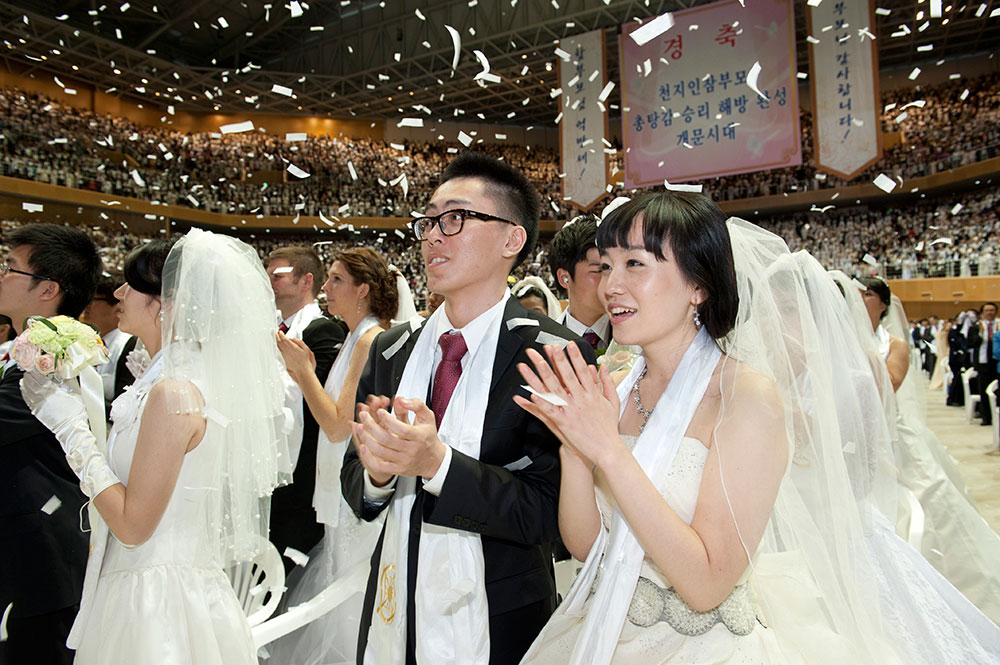
First, a short introduction to our family: we have six children, and by February 12th the five oldest will all be blessed. Their mother is Korean, their father English, and we have made our family home in London, UK, for the last twenty years. We count as an 1800 couple but took part in the Blessing ceremony in Madison Square Garden on 1 July, 1982. Our eldest daughter is now living in Berlin, and has given us our first grandchild. She worked for three years after university in the European Second Generation Department office in Frankfurt. Our second daughter passed away in 2010, aged 25. She was very confident in her faith and open with her friends about her connection to the Movement, determined to use her abilities as a singer and performer to bring a positive message to others. She could receive the Blessing for ascended second generation in May 2013. Our third daughter is blessed and lives with her husband in The Netherlands. She completed two years of STF and has helped as a staff member on many youth workshops. Our fourth child, our eldest son, has worked now for three years full-time with the European Second Generation Department, his wife teaches religious education at high school and they currently live in our family home. He is making inroads into the area of lecturing. Our fifth child, and fourth daughter, is participating in this 2014 Blessing. She has served as a Sunday School teacher, helping with the crèche, and organizes regular home group meetings for girls of similar age. Our youngest, our second son, is quietly faithful and personally driven to pursue a career in architecture away from home, and is currently preparing for the Blessing.
I sometimes joke that having three girls first was a wise choice, but they certainly helped greatly with the nurturing and raising of the younger ones. As parents, we are grateful that our children have always felt very close to each other, and they continue to provide each other with a lot of support. Since we had adopted a missionary-type life, for much of our early family life we lived in church-owned public properties, and the children all shared bedrooms when growing up (for seven formative years in Ireland our family, eventually eight people, slept in one large room together). We did not have our own family home until twelve years into our marriage, and as my wife and I always held some public mission, finances were tight. These circumstances combined have both advantages and disadvantages when it comes to raising children, but we would say the benefits far outweigh the difficulties. Also, because we held a public mission, we had a lot of invaluable support from other dedicated brothers and sisters who would look after our young children when we were away on church- related business. Our three eldest stayed in a full-time nursery during some years of intense church activity. Living this lifestyle is not as simple as saying, ‘Just trust in God and everything will be all right. We know too well that sacrifices we choose to make, because our life and mission are very serious, often can be real and painful. So here already are several reasons why it is not simple to say ‘this is what you do to raise children’; it has not been a path without tears, and we know families who lived a similar way for whom things have turned out less fortunate.
We are in a different era now, so what practical advice could we possibly pass on? Marriage is a partnership, so all the points I am making here come out of discussions with my wife, and for sure, the love and the quality of the working relationship between husband and wife is crucial. My wife, in particular, always encouraged a very strong routine: from two years old, children would always attend 5 am Pledge (in those days, on Sundays and the first day of each month) and never missed a Sunday Service. This absoluteness extended to school, and it was very rare that any of the children missed even one day. Also, whenever there was an opportunity to send children to a workshop during school holidays, we tried our best to take advantage of that – until they were signing themselves up. They would plead to be allowed to go, even when we were worried about the expense or feared it might interfere with their studies, and it was probably good that we relented. The bonds made with other Blessed Children proved to be very important, and even though we were always willing for them to bring school friends home and develop friendships there, they have all enjoyed and valued most the quality of relationships available with children of other blessed families. When children become familiar with the workshop protocol, they are able to take on a staff role in workshops for younger children, which is what our children often did.
I always feel that the role of other parents – what we call ‘uncles and aunties’ in the British Movement – is underestimated. When adults who are not direct family members reinforce the same values as the parents and are there to engage with one’s children in sensible conversation, it is tremendously helpful and provides a common moral outlook that has a stabilizing effect. I see this as one of the current challenges for our Movement – to further develop this aspect of ‘true community’ through deepening inter-family connections. There are many pressures on families to assume an insular existence, and I think we should actively work to counter these. Like all relationships, to gain benefit from the faith community, one has to invest in and contribute to that community. The fact that my wife and I held a pastor role for many years gave us the natural opportunity as well as the obligation to serve the community. Children pick up on these attitudes and the approach that the parents take, but it is important to include the children in the process. When I was young, I remember resenting my parents’ involvement in local ‘public’ affairs – but that was largely because, by the nature of the work, I was excluded and it would mean I saw less of them. We have tried to naturally involve the children in our work and make our house a place that is always open to visitors.
My wife would always insist that children make some act of devotion before breakfast or even a cup of tea in the morning – and would insist that the children’s friends who were staying over would do the same: a bow to True Parents, a prayer and some reading. We encouraged tithing, which can be started at any age, as soon as children earn a little money or when they receive a gift, even by offering first to Heaven (on a plate for ‘True Parents’) from a box of chocolates. I think this is common in our Korean tradition, but I do not see it done so often in Western families. So having a ‘family altar’ is important (we never had space for a separate prayer room in our family home, but this would be preferred). We have to pass on our faith and conviction by example, and it is often these small acts that provide the basis for habits that in later life children can choose to adopt or not. My guess is they will themselves be doing many of these things for their own children, when that time comes. Even so, it remains a concern of ours that, left to themselves, our adult children may not have adopted these habits to the extent that they carry on the tradition in respect of their own devotional life but there again, maybe they will be more serious about it than we have been. I know these suggestions focus on quite basic practices, but often our problem is we do not do the basic things.
I want to add something to the comment about workshops. I realised that for some time we had not run seven-day Divine Principle workshops in the UK, so in 2006 I made a move to revive these, organizing first a workshop for HARP-age children (12-16 years old), even though some adults tried to dissuade me saying it would not work – children would not be able to sit and listen to lectures that long. In fact, they have proven to be very popular with this age group. We have tried to keep these going every year, and I recommend that our children hear the whole Divine Principle (and the seven-day workshop, with twenty-one presentations, is the minimum length to hear something from every chapter) when they are twelve, again around fourteen or fifteen, and again around seventeen or eighteen. It will not be a simple repetition because they are growing and are able to receive it differently each time. It is only through hearing the whole Principle that its power can be experienced – the inner thread of logic becomes clear. In my opinion this is not a mere intellectual exercise – the Principle speaks to our internal ignorance and awakens a person spiritually from within. I remember one of our first seven-day Divine Principle workshops for young people. One boy, who had some behavioural problems on previous shorter, more activity-based, workshops, wrote in his evening reflection on day five, having heard the section on historical parallels: “This is amazing! Why did nobody ever tell me this? Now I know why my parents joined the Movement.” That comment more than anything brought home to me, with an acute pang of judgment, that we absolutely have to educate our children in the Principle (and incidentally, many years on, this same young man is actively involved in Church and UPF programs).
I find it common that parents assume that their children know and understand the Divine Principle, but as a teacher I am very much aware that this is often not the case. So I have tried to encourage our children to take advantage of longer, serious Divine Principle workshops, and to have them appreciate the depth and power of Father’s teaching. I also try to instil in them a recognition of the fact that our Unificationist lifestyle and our traditions have much in common with the practices of other faiths – that what we do and how we live is not strange or peculiar to us but is a very sensible and meaningful progression in a well-established line. They are the current fruit of a long line of faithful people going all the way back to Abel. Over the last two years or more I have been running seven-day workshops where we have tried to maintain a balance of new guests (including Ambassadors for Peace interested to know something of Father’s teaching), established members (first generation, hearing the Divine Principle afresh) and second generation (sixteen years old and over). Our new guests are amazed at the spiritual perception and moral standard of our young people. Our young people see guests meeting the Principle in depth for the first time, and witness the effect that it has on them – an experience that is sadly all too rare for them, but that is extremely beneficial; our old-timers get some spiritual revival and contribute greatly to the discussions.
When I look at my children, I feel they are where they are, and have the qualities they have, in spite of myself. This is, for me, the real miracle of True Parents: out of the impure comes the pure. If the next generation is not purer and more naturally connected to God than the one before, then our faith has little meaning. Having had the experience of teaching Religious Education classes at high school in a secular environment, and having taught many workshops for our blessed children, I could witness the profound difference between these two audiences; it is dramatic, but the purity and potential that is so evident in our blessed children has to be reinforced and further nurtured or it can remain like a bud caught by the frost. I encourage blessed children to ‘make the Principle their own’ and to develop their own philosophy of life based on the extraordinary wisdom and insight that Father’s teaching gives. They have to have thought it out for themselves, in my opinion, or their faith will not survive in the challenging environment they will meet at university or in the workplace. So when I teach a seven-day workshop, I always include a talk to this effect.
As for taking up public missions, where our own children have done this, the desire and decision has always come from themselves. We have supported them in their choice but have not been the instigating factor and have not been persuading them to go that route. I recently started a small debate in a leaders’ meeting over whether there is such a thing as a ‘calling’ for our children today (in other religious traditions it is common for people to feel ‘called by God’ to take up a life in the ministry). People were fairly divided on this one. If it is just a career option then we should definitely make it an attractive one, and then a percentage of our young people will feel that it is what they would like to do. If it is more of a calling, then God is in control and a young person will want to pursue a path within the Movement in terms of public mission even though it might not be as financially rewarding as a non-church career. My own opinion is that we should provide more and better training for careers within the Movement, and make the prospect more attractive, while encouraging people to listen to that inner voice of God that says, ‘I need you to do this, and have raised you with this purpose in mind’. I have heard conversations between my son and his mother where she is encouraging him to take up some further study and embark on a ‘serious’ career, and he is saying that he feels so much for other second generation blessed children that he wants to devote one more year at least to working with our youth programmes. In the realm of the heart, those seemingly different aspirations are not really contradictory. When I see blessed children pursuing a career I always encourage them to aim to be the best students, and to aim to be successful and contribute greatly to their chosen field. And if they choose to work within the Movement, I know that this is not an easy option, and no guarantee that their faith will not be sorely tested, but it is truly the most important work for the sake of Heaven, and our hope is that in this new era our approach will be more ‘professional’ in very way, while retaining the vital connection to our deep spiritual roots.
As parents, we never made cheon seong conditions specifically for our children, with the exception of prayer conditions to support the matching process, and fasting conditions when progress in this area had reached an impasse. However, we always maintain a time of morning devotion which we do jointly when we are together, and my wife in particular has been very regular in her devotional life. When she was carrying a child she would not cease from active public work until the time to give birth; I cannot help but feel that such a spirit must affect the child in the womb. Before he was born, our son was demonstrating at the Berlin wall, and before she was born, our daughter climbed Croagh Patrick, a holy mountain in the west of Ireland. I have to admire such exploits, although they seemed to challenge common sense at the time.
As I look back over our life of raising a family together, now that our youngest child is twenty-two, I would like to think that our efforts to live a public life, inadequate as they may be, have offered some protection and support to our children that would not have been there otherwise. It is hard to know, of course. Parents can love the religious life too much, so their children see only an unattractive fanaticism, and that is something one has to avoid. I remember hearing True Father, when I was a young church member, interrupt his own sermon in Belvedere to ask a most surprising question: “Do you think I like this religious life?” he asked. “No, I don’t. But I do know that at this time in history it is absolutely necessary.” Hearing that was so liberating for me. Whenever did you hear a great religious leader say something like that? I do think this ability to see what one is doing, in the round, is tremendously important and that has influenced the way I relate to my children. We must keep a proper perspective, and we must guard against thinking we know all the answers. My personal motto has been, ‘There is always a deeper wisdom,’ so I try to keep that in mind. That and the wise words of Saint Augustine: ‘Pray as though everything depended on God, and work as though everything depended on you.’