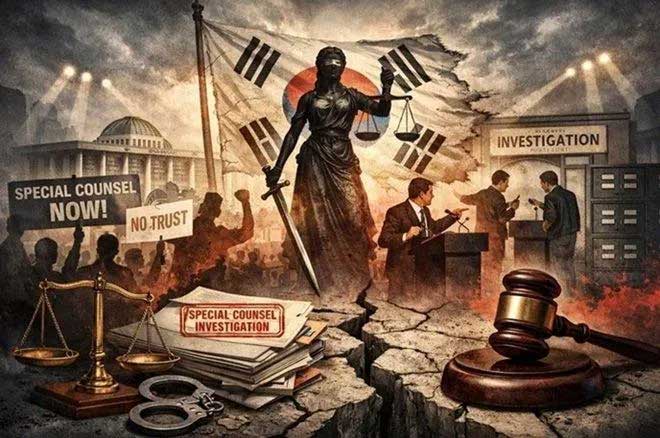
South Korea’s justice system faces a crisis of confidence as special counsel investigations are now becoming common, dominating the country’s politics
The Korea Herald, South Korea’s largest English-language daily, The Korea Herald, published on January 11th an article by Jung Min-kyung (정민경) headlined “Korea wrapped up in ‘special counsel war’ amid justice system mistrust”.
Prepared by Knut Holdhus
According to the report, the country of Korea is currently facing an intense political and legal confrontation that many observers describe as a “special counsel war”. At its core, the dispute reflects a deepening crisis of trust in the country’s justice system and a growing tendency for political parties to weaponize extraordinary legal mechanisms for partisan advantage.
While the term “special counsel” may be familiar to Western readers through U.S. politics, its role and implications in South Korea carry distinct historical, institutional, and political meanings that help explain why the current situation is so contentious.
In South Korea, a special counsel (or special prosecutor) is an independent investigator appointed by the National Assembly to examine cases that are considered too sensitive or politically charged to be handled by ordinary prosecutors. These investigations are typically reserved for exceptional circumstances, such as allegations involving sitting or former presidents, senior government officials, or powerful political networks. The logic behind this system is simple: when the public believes that prosecutors ‒ who traditionally fall under the executive branch ‒ cannot act impartially, an independent counsel is meant to restore credibility and public confidence.
However, what was once an extraordinary legal remedy is now at risk of becoming routine. According to the reporting by The Korea Herald, South Korea’s National Assembly has entered a phase in which rival political parties are proposing multiple, overlapping special counsel investigations at a rapid pace, even as the results of earlier probes are still being announced. This proliferation has led legal experts and political analysts to warn that the system is being distorted into a partisan tool rather than a safeguard of justice.
At the center of the current conflict are South Korea’s two main political camps: the ruling Democratic Party of Korea (DPK) and the main opposition People Power Party (PPP). In recent weeks, both sides have introduced or floated special counsel bills targeting a wide range of alleged misconduct. These proposals come on top of three recently concluded or ongoing special counsel investigations, creating a sense of legislative overload and political escalation.
Particularly striking is the fact that three pending special counsel bills are all related to the Family Federation ‒ formerly called the Unification Church. The Federation, a religious organization with international reach, is currently facing allegations of involvement in unlawful political funding and election interference. According to The Korea Herald, each bill has been drafted by a different political grouping, reflecting not consensus but competition over how far and how aggressively the investigations should go.
The ruling Democratic Party’s proposal is the most expansive. It seeks to investigate not only the Family Federation but also the Shincheonji Church of Jesus [See editor’s note below], a splinter Christian group that has previously been linked to political controversies. The bill targets alleged unlawful campaign donations, improper political influence, and election interference by these religious organizations.
A separate bill from the minor Rebuilding Korea Party narrows its focus to allegations of bribery and illicit donations involving politicians. Meanwhile, a joint proposal by the opposition People Power Party and the New Reform Party goes further by including alleged cover-ups and interference in earlier investigations related to the Family Federation.
Rather than consolidating these proposals or waiting for existing investigations to run their course, the ruling party has moved aggressively to push additional special counsel bills forward. On 8th January, the Democratic Party placed two major bills ‒ one comprehensive special counsel bill and another specifically targeting the Family Federation and Shincheonji [See editor’s note below] ‒ on the agenda of the National Assembly’s Legislation and Judiciary Committee. These bills were immediately referred to the committee’s mediation panel, a procedural step that is usually reserved for contentious legislation.
The Korea Herald points out that under South Korea’s parliamentary rules, a mediation or agenda coordination committee can deliberate on disputed bills for up to 90 days. However, if four of its six members vote in favor, a bill can be fast-tracked and sent directly to a plenary vote. Because the ruling party holds a numerical advantage in the Assembly, critics argue that this mechanism allows it to push through controversial legislation without meaningful bipartisan agreement.
Tensions escalated further when Democratic Party chair Rep. Jung Chung-rae (정청래) publicly suggested the possibility of yet another special counsel investigation ‒ effectively a “third” comprehensive probe ‒ before the second one had even begun. Speaking on a YouTube program on 6th January, Jung argued that if the second investigation proved insufficient, a follow-up “wrap-up” special counsel might be necessary. His remarks reinforced opposition claims that the ruling party is less interested in impartial fact-finding than in maintaining continuous political pressure through successive investigations.
Legal scholars have expressed alarm at this trend. Hwang Do-ssu (황도수), a law professor at Konkuk University, pointed out a fundamental contradiction in the ruling party’s position. Special counsels, he explained, are appointed precisely because the public does not trust existing investigative authorities, particularly prosecutors. Yet the Democratic Party has long claimed that it has successfully reformed the prosecution by stripping it of excessive investigative powers and increasing its independence. If those reforms were effective, Hwang argues, then there should be no need for repeated special counsel investigations.
According to Hwang, this contradiction raises the troubling possibility that special counsels are being used not to compensate for institutional failure, but to engineer investigations that align with political objectives. In his view, such an approach risks turning the justice system into an instrument of populism, where legal processes are shaped by political narratives rather than evidence and due process.
Political commentator Choi Jin (崔湸), head of the Institute of Presidential Leadership in Seoul, echoed these concerns, describing the situation as a symptom of widespread public distrust in South Korea’s core institutions. He noted that skepticism now extends beyond prosecutors to include the judiciary and the police, creating an environment in which extraordinary measures appear increasingly justified to the public ‒ even when they may undermine institutional stability.
As the National Assembly prepares for a plenary session scheduled for 15th January, the confrontation shows no signs of easing. The ruling party is expected to push forward with the special counsel bills regardless of opposition resistance. In response, the People Power Party has threatened to launch a full-scale filibuster to delay or block passage. Despite these efforts, most observers believe the bills will ultimately pass, given the ruling bloc’s numerical advantage.
Perhaps the most significant concern raised by experts is that the original purpose of the special counsel system is being reversed. Traditionally, special counsels were demanded by opposition parties seeking to investigate those in power, based on the belief that ordinary prosecutors could not act independently. Now, in a striking inversion, it is the ruling party itself that is aggressively promoting special counsel investigations.
This shift, critics warn, could set a dangerous precedent. If special counsels become a standard governing tool rather than an exceptional safeguard, South Korea risks normalizing a cycle of perpetual investigations driven by political rivalry. For Western observers, the situation offers a cautionary example of how legal mechanisms designed to protect democracy can, if overused or politicized, contribute to deeper institutional mistrust and prolonged political conflict rather than accountability and reform.
[Editor’s note: Shincheonji, officially known as Shincheonji Church of Jesus, the Temple of the Tabernacle of the Testimony, is a new religious movement founded in South Korea in 1984 by Lee Man-hee, who claims to be the promised pastor mentioned in the Bible’s Book of Revelation. Shincheonji teaches that the Book of Revelation is being fulfilled through its church and that Lee Man-hee has received divine revelation to interpret it.]