Blog of Unification Theological Seminary
Click to listen to this article:

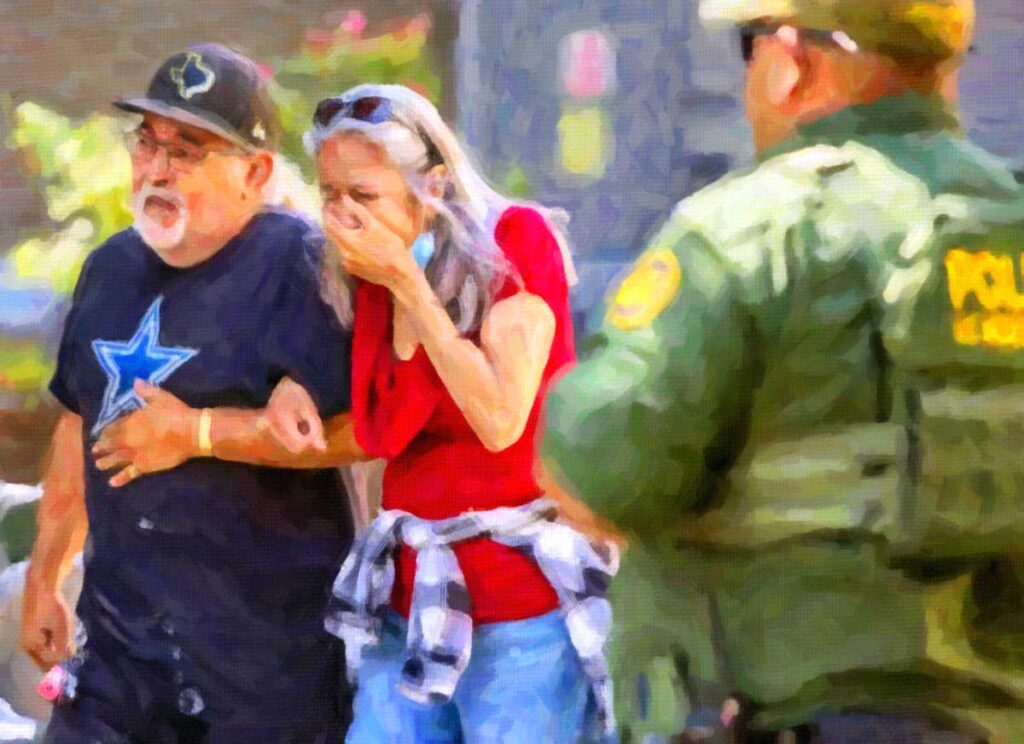
There have been 23 school shootings this year that resulted in injuries or deaths, according to a recent Education Week analysis. There have been 167 such shootings since 2018.
It’s very alarming that such incidents are becoming increasingly prevalent. How are we to understand violence in society and, more importantly, to correct this disturbing trend?
Certainly, an approach must be immediate and include responses by those tasked with public safety — law enforcement, legislators, nonprofit civic action groups, and those in the judicial branch.
But tackling social problems through those venues will not result in the longer term and more comprehensive solutions we need. Such a strategy could be likened to EMTs, paramedics, and emergency room staff treating superficial wounds while ignoring underlying organ or other bodily system damage.
Surely efforts must be made to identify underlying factors that contribute to this troubling social trend weakening our societies. Those factors include, but are not limited to, the perpetration of violence upon the innocent and vulnerable, the venting of frustration and anger through violence, and the inability of people to curb their destructive impulses. Even more deadly are the bullying and dominance of individuals, groups, and larger levels of society based on a perceived division between them and us that is rampant within society.
This article has been informed by the works of scholars I encountered as part of my current graduate degree pursuit at UTS. I present my own views at the conclusion.
One scholar, Wolfhart Pannenberg (1996), notes that currently the religious and spiritual dimension of human beings has been marginalized in the public sphere. He traces this to the thinking behind and actions of the French Revolution, which, among other revolutionary initiatives, included the beheading of those in the monarchy and aristocracy who could not flee the wrath poured upon them, pitted reason against faith, and scapegoated religious institutions (generally the Catholic Church) as sources of repression and injustice, enacting a strict separation of church and state.
In this scenario, the church and religion were seen as the source of problems, not solutions. The separation of church and state in the United States is not as contentious as in many European nations, since the U.S. doesn’t have the antagonistic backstory found in Europe. In the U.S., while religion and government are separated by the Constitution, religion is still considered a potential source of social help and beneficial public service.
While the U.S. is at its core a religious (essentially a Christian) nation (see Himmelfarb, 2004), religion’s presence in the public sphere is noticeably missing. Pannenberg claims that in societies where religion has been reduced in prominence, a profound and debilitating loss of meaning can be found, which he ties to the presence of personal and social violence.
In the last two or three decades, however, it has become evident that secularization (or, as some prefer, progressive modernization) faces severe problems. The thoroughly secularized social order gives rise to feelings of meaninglessness: there is a vacuum in the public square of political and cultural life, and this invites violent outbreaks of dissatisfaction.
Pannenberg points out that the religious sphere holds the lion’s share of responsibility for this situation, at least in the Western world, due to rampant social instability caused by the wars of religion waged in Europe during the 16th, 17th and early 18th centuries. He has wise counsel for the Christian religious world and other faiths regarding their need to indemnify such historically based flaws, practices and attitudes in hopes that such chastisement will compel them to make amends and refrain from repeating such shameful histories. Here are some of his key points:
. . . The lack of tolerance among Christians in the post-Reformation period was directly responsible for the rise of a secularist culture. What Christians should learn from this is the urgency of overcoming their inherited controversies and of restoring some form of unity among themselves.
Those of the religious sphere have significant work to do if they wish to add their narrative to those currently prevalent in the public sphere. That work will certainly be required if the religious sphere hopes to regain the trust of those living in our modern society and must include the demonstration and manifestation of tolerance, love and a marked maturity of spirit.
Another key insight by Pannenberg addresses the current understanding of freedom which has become dominant and widely accepted in Western culture. This is the idea that freedom is divorced from the religious concepts of ethics, morality, responsibility, and the idea of the good, including the need to control the baser instincts of humanity derived from the presence of sin. This divorce of freedom from the good seems to have generated a type of mindset which implies that being free is akin to allowing citizens to do whatever they want, including behaving in a way that religious people refer to as license.
The prevailing idea of freedom in our societies today, of course, is the idea that each person has the right to do as he pleases. Freedom is not connected to any notion of the good as constitutive of freedom itself.
Hans Joas (2014) sees the baser tendency of humanity to grab dominance through power as a root source of violence, what I consider bullying behavior. This behavior can be found at the individual level but is also present in organizations, nations and in the religious, political, economic, and entertainment and media spheres as well.
The practice of self-benefiting dominance seems to be found when any specific characteristic such as race, religion, ethnicity, sexual orientation, possessing a mental or physical disability, political affiliation, eye color, etc., can be used to pit one group or social entity against another — leading to an us vs. them mentality coupled with a sense of superiority being attributed to the us group. The following speaks to this:
American religious economists have sought, interestingly and I believe persuasively, to demonstrate that religiously charged violent conflicts in societies do not come about through the encounter of different religions such as (as the “clash of civilizations” thesis would lead us to expect) but through the particularist state regulation of religious life, regulation that seeks to aid one particular religious community while keeping another under control.
A broader take on bullying behavior has been elucidated by David Martin (2017), which he ties to self-firstness, selfishness, and the tendency towards bullying as an expression of the baser aspect of human nature manifested in multiple social systems.
I want to disrupt a narrative that lays the primary blame for violence on religion and my thesis is astonishingly simple. Violence is written so deeply into human relationships and into the unremitting struggle for power, wealth, honour and dominance, generated by the difference between Us and Them, that we can take it for granted. Religion will be complicit in this struggle because it provides a major and powerful marker of the difference between Us and Them. But so does every form of social solidarity. In recent centuries other forms of solidarity, for example nationalism and secular political ideology, have been as complicit as religion in the struggle for dominance.
J.V. Langmead Casserly (1955) ties the issue of violence to humankind’s baser nature, which he further ties to humanity’s spiritual sickness, an underlying sinfulness:
Original sin certainly does not mean a new kind of sin that has never been sinned before. On the contrary, it refers to the spiritual sickness, the underlying sinfulness, which afflicts man from the very point of his origin, so that man is a sinner even when he is not sinning in any overt or particular fashion. . . . Man is not a sinner because he sins; he sins because he is a sinner.
Pannenberg traces individual violence to the loss of meaning due to the marginalization of the religious and spiritual dimension of human beings. He also linked it to the separation of free will and action from the idea of the good. Joas, Martin and Casserley extended the issue far beyond to the presence of violence perpetrated by individuals, to violence found in a broad swatch of social spheres, levels, and factors, including individuals, organizations, religions, nations, political ideologies, and economic factors.
One doesn’t have to look far to find extremely troubling examples of this broader presence. There are examples of violence perpetrated by religions including the Crusades from 1096-1270, the Inquisitions in France, Portugal and Spain from the 12th to the 18th centuries; the religious wars in Europe of the 16th, 17th and 18th centuries; and the Salem Witch trials, to name just a few.
However, the violence perpetrated by those belonging to the realms of politics, ideology, and even on the interpersonal level are extremely chilling as well. These include the violence inflicted on humankind through the Nazi regime, Stalin, and Mao; the killing fields in Cambodia; the geocide in Rwanda; and the current invasion of Ukraine by Russia. Then there are the shameful practices, both historical and present day, of slavery, human trafficking, the promotion of bigotry and hate of one human being or group over another, drug, sexual, and other bodily abuses, prevalence of gun violence, addictions of all kinds, and pornography.
The issue of violence at all levels and in all social spheres is found in all human societies, is extremely troubling, and must be delt with if humanity is to achieve social peace at any level and in all spheres.
The foundational and underlying contributor to the problem of violence in the public and private sectors is spiritual. By spiritual I refer specifically to the internal dimension of human mind and heart that grapples with and endeavors to understand the supernatural dimension of God and those eternal question of life’s meaning and purpose as well as dealing with the baser natures of human beings grounded in sinfulness. This arena of human life typically comes under the purview of religion, whose professionals apply themselves to counsel discipline, sacrifice, humility, service of others beyond the self, and self-control of humanity’s base natures as well as making available to humanity the great work of salvation for the purpose of eliminating the reality of sin and evil in human life.
If we look to the influence of humanism for a solution to the issue of violence, we will be greatly disappointed as that sphere is too limited in its resources to be very effective against violence. For example, related to the issues of freedom, those who represent the humanistic perspective with its emphasis on human rights can be at a disadvantage in the campaign against violence when the discussion strays into the issues of social responsibility and the public good, the comprehension of consequences, universal morality, ethics and the good. Those who would look to the ideology of Marxism will also be greatly disappointed since it ignores the importance of human rights as well as denying the religiosity and spiritual nature of human beings.
The religious sphere must be embraced and welcomed as a pivotal influence and voice if we are to ever achieve a peaceful world.
The richness of human society is lessened when there is a dearth of opportunities for those belonging to the religious sphere to contribute their hard-won wisdom garnered through the work and service resulting from their labors on behalf of God and for the benefit of humanity. There is a prevalent tendency for society to exclude religion and religiosity from the public cultural sphere, and yet I contend that the optimum platform for the religious to contribute their wisdoms and counsel is within that sphere.
The exclusion of the voice of the religious narrative from that sphere has resulted in a vacuum which humanism, secularism, and Marxism cannot even remotely fill, and society is the poorer because of it. Currently, society is dealing with a volatile and dangerous cocktail of influences that have the potential to ignite uninhibited violence against those perceived to be enemies and persecutors, the them vs. us. This scenario can also be a source for vehement venting of resentment, hatred and anger, just because a person, organization, religion, or nation wants to and can, as though it is a justified behavior, no matter how immoral or base those actions and attitudes may be.

The scholarly quotes I have shared reinforce the connection between violence, the lack of meaning, as well as the flagrant lack of inhibition of humankind’s baser nature and selfishness because our world has pushed aside the voice of those whose job it is to advocate for God, conscience and godliness. Of course, there are those who will seek religion and God despite the roadblocks set up by popular culture, but many more will be diverted by the anti-religion narrative; it’s hard to go against public opinion and what is considered normative at a societal level.
Considering existing anti- or demeaning attitudes towards religion or at least a lack of public appreciation of that sphere, those searching for meaning in their life may attempt to assuage their spiritual uneasiness and hunger through a variety of options and venues, but many will probably give up or avoid such endeavors altogether.
If Pannenberg, Joas, Martin, and Casserley are correct, this social reality can result in a buildup of frustration, distrust, resentment, arrogance, and despair leading to emotional and mental stage agitation in immature or troubled individuals and groups who become obsessed and focused upon their internal state of frustrations, perceived injustices, resulting in their arrogantly asserting what they perceive as rightness at the expense of others.
If this is not dealt with or defused, it is probable that such a mind/heart-set can easily boil over and compel those individuals and larger social groupings to burst through humanistic mental and social constraints (i.e., human rights, including respect of others) and express their agitation, resentment, self-firstness, arrogance, and anger through violent negative and destructive outburst and actions.
What solution is there to the above scenarios? Any solution must also include the reintroduction of the religious narrative into the secularized public sphere. There are, however, many contingencies related to such a recommendation.
I am not against the separation of church and state, which is healthy and necessary to diminish the possibility of the emergence of a state-sponsored religion or church, a scenario the U.S. is fortunate to have avoided. Though the church should be separate from the state, moral, ethical, and God- and religiosity-honoring men and women should be involved in politics, the sphere of government, and all venues of human society.
We need a religious landscape that embodies cultural and religious diversity and pluralism, which is healthy and valuable. As well, any religiously-motivated individual or grouping of individuals that wants to contribute their narrative to the cultural and public sphere, would need to demonstrate spiritual maturity, tolerance, and respect toward other faiths and accept the normalcy of a social environment which encompasses a comprehensive spectrum of spiritual diversity.
In addition, members of religions and organizations must absolutely refrain from a self-glorifying mind and/or heart-set, and from any tendencies to bully or dominate other faiths and believers, even if they believe in the superiority of their message. They would need to refrain from promoting any sense of entitlement and elitism. No bigots are allowed in the sphere of religion or any other social sphere for that matter. The name of the dynamic must be respect for the other’s right to follow their conscience carried out with the heart of love and compassion (refraining from using violence to do so, of course).
If any faith or human being, including the level of groups and social systems, refuses to be ruled by such guidelines, then they should not be a welcomed contributor of their narrative until such time as they can do so (though how this would be accomplished is another matter altogether), or at least clearly called out and exposed for their anti-social attitudes and practices.
Additionally, participants and contributors to the public narrative should not be limited to those belonging to the sphere of religion, but that sphere would open to any who encourage, nourish, uphold, and nurture humanity’s moral and spiritual values and responsibilities. From that perspective, I believe mental health professionals need to be included due to their expertise in dealing with the tendency of human beings towards practicing social violence.
I set a high bar and standard for this yet unattained, reformed, and revitalized public sphere. I do so, however, to facilitate an envisioned response to the current social illness and danger. It is also my hope that quality control measures could be put in place to avoid unintended consequences and/or additional problems cropping up (whatever those may be) and, if they do emerge, they need to be immediately mitigated and dealt with. I think it is better to aim high while we’re at the level of hopes and dreams.
The strong presence of responsible spirituality will not solve all humanities’ problems and curb all violence; that will not happen until the baseness in human nature is conquered and totally eliminated. However, if stronger norms abound in the cultural sphere that favor self-control and moral/ethical considerations and responsibility; that tie the understanding of freedom with the good; that strongly promote a heightened respect and love for the rights and safety of others beyond personal resentment, anger, and hate; the tendency towards selfishly motivated violence will at least be hampered and tempered.
Since we are witnessing an increasingly volatile climate of social violence, I encourage others to contribute creative options and participate in helping responsible citizens develop insightful ways and practices to diminish this escalating social trend.♦
Alice E. H. Fleisher joined the Unification Movement in 1968, is an 1800 couple, and lives with her husband, Gary, in his hometown, where they are part of a three-generation tribe. She received her BA in 1970 in Interdisciplinary Creative Arts from San Francisco State College, a Religious Education Certificate from UTS in 1977 (MRE upgrade in 2017), and an MA in sociology in 2015 from the University of Colorado at Denver. She is currently a Doctor of Ministry candidate at UTS.
References:
Casserley, J.V. Langmead. 1955. The Bent World. New York: Greenwood Press.
Himmelfarb, Gertrude. 2004. The Roads to Modernity: The British, French, and American Enlightenments. New York: Vintage Books.
Joas, Hans. 2014. Faith as an Option: Possible Futures for Christianity. Stanford: Stanford University Press.
Martin, David. 2017. Secularisation, Pentecostalism and Violence: Receptions, Rediscoveries and Rebuttals in the Sociology of Religion. New York: Routledge.
Pannenberg, Wolfhart. 1996. “How to Think about Secularism,” First Things.