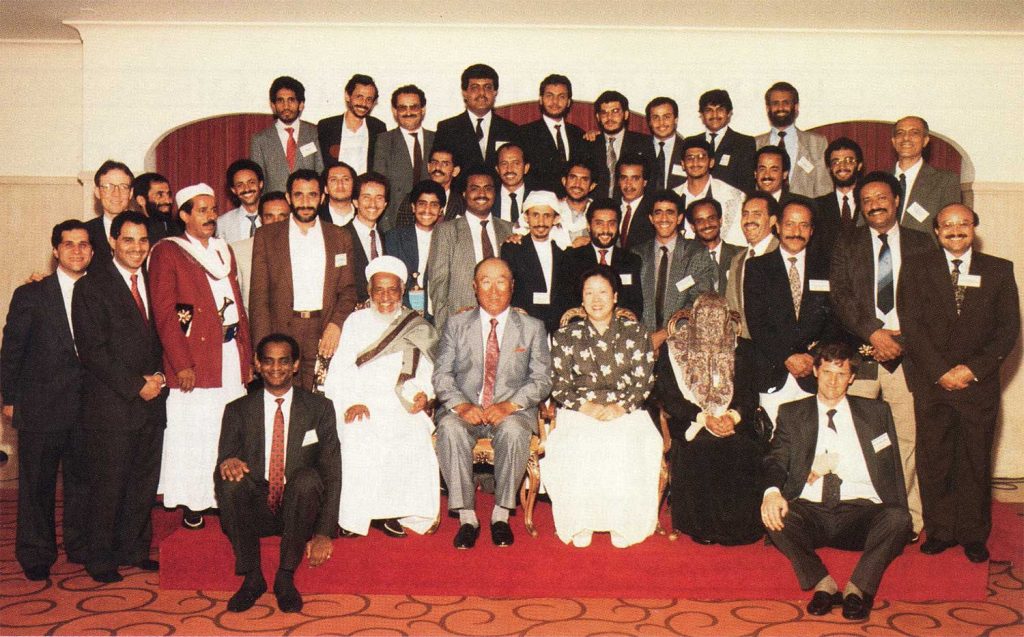
Interview with Sheik Ahmed Zabarah, Grand Mufti of Yemen
Conducted by: Mary Trifault
Interpreter for the Grand Mufti: Fritz Piepenburg
Thirty years ago, The Grand Mufti came with fellow Muslim leaders to the United States to hear the Divine Principle and meet True Father and Mothe. They stayed for 40 days. (See last week’s story.)
The Grand Mufti holds the highest religious position in a Muslim country. The responsibility of the Grand Mufti is to represent his country on a religious level. His daily work concentrates on making legal decisions by issuing the so called “fatwas,” which means responding to legal questions about everyday problems from an Islamic perspective. His decision is acknowledged by all parties involved in any given dispute.
Thank you for allowing us this interview and for sharing your heart and your wisdom with us.
Thank you.
Could you speak a little bit about your background: What kind of education did you receive?
First, I studied at the Grand Mosque of Sana’a. I was studying with great learned men. Then I also studied at something called the Scientific School. So basically my study concentrated on Islamic studies: the roots of Islam, explanation of the Koran, Islamic laws and so on. After studying in these two institutions for eight years, I then started to teach pupils either in the mosques or at home. At the same time, I continued my private studies with the learned men of the time. As a matter of fact, I am doing this to this day: teaching, but still learning from men around me. I also taught and studied in other important cities of Islamic learning such as Beirut, Cairo, and Dahran in Saudi Arabia. After successfully completing my studies, these religious men of learning from the various countries would give me a certificate of accomplishment.
Could you share about your family background: your parents and your childhood? What kinds of things were happening in your country at that time, and what you were thinking about?
I was born in an area that is to the east of the capital Sana’a called Holan, because my father was the supreme judge of this area he was given this position by the Imam at that time. The Imam is the king but also the spiritual head of the entire nation. My father was fighting against the Turkish occupation together with this Imam. The Turkish occupation ended at the end of the First World War; the Turks lost the war together with the Axis powers, so they also retreated from Yemen. Then this Imam entered the capital of Sana’a which had previously been occupied by the Turks. My father and my entire family, including myself, came with the Imam back to Sana’a. I was approximately 12 years of age then. From that time on my family continued to live in Sana’a. Yemen became the first country to gain independence from the Ottoman Turks, even before other countries like Egypt or Iraq.
I also traveled extensively to many other countries. For example, I traveled to the Soviet Union 25 times. All this came as a result of invitations given to me by the Muslims of the Soviet Union. I was invited by the Muslim Mufti of the Soviet Union. Also the Muslim religious community of China invited me; so I went to China 10 times.
I remember three generations of Muslim leaders in the Soviet Union; two of them have already passed away. Now I am dealing with the third generation of Muslim leadership. I have visited all the Arab countries of course, and again I was invited by the respective religious communities. This is how I got to know many other Islamic communities.
This is my third visit to the United States of America.
What element in your life caused you to be so interested in God and to study Islam so deeply?
I was involved with religion all of my life—from childhood to my old age—because when I was born, Yemen was a very closed society. There was not much else to learn. My father was a religious scholar and my grandfather before him, so I just took the same path. I started to study religion, natural science and so on. When I had completed my education, I was appointed a supreme judge of Yemen under Imam Ahmad and I stayed in this position for 15 years. Then the revolution came and the Imam was overthrown. But the republicans reinstated me and elected me the Mufti of the Republic which is the highest religious position of the modern republic.
I am sorry I did not have the chance when I was younger to study different subjects as well; I always had a desire to study foreign languages. But as a result of the circumstances of the age I was born in and where I grew up, I had no choice but to concentrate on the Islamic faith.
So I am happy that my children and grandchildren now have the opportunity to study modern sciences and other languages at university. I will continue to do my part of teaching them Islamic religious values in the mosques and at home.
I sometimes see foreign teachers at the modern university of Sana’a, some of whom are not even Muslims. This is an example of how Yemen is opening up.
As a religious leader, you have a lot of responsibility to teach young people and members of your society. What are some of your biggest challenges and some of the biggest joys derived from that responsibility?
It’s always a difficult educational process to come from one age to the other—an educational process filled with challenges. I feel the young people of Yemen are intellectual people so they have the ability to grasp new thinking and can harmonize with the challenges of the new age. One of the proofs is that these 40 people from Yemen came to the United States to listen to some new teaching and some new ideas, which they can take and absorb.
Yemen has gone through a complete revolution during the past few decades. The young people do not study like we did before; they have a different education system. They even dress differently than we did 50 years ago.
How did you first meet the Unification Church?
I call it the Unification Family. It is a very amazing movement that has come up in our age, because this Unification Movement has a strong belief in God and a strong belief in all the prophets of the past including the Prophet Mohammed. These are the essential points of religion: the belief in one God and the belief in all of His prophets.
Many ideas have come to this world; but only those which expressed ultimate truth prevailed. This is true for the various religions, while other ideas such as communism, Nazism or Fascism came to an end, proving they are actually false. But the religions remain. I see a great role and a great future for the Unification Movement because it affirms religious truth, but also goes beyond traditional religious truth by trying to establish bonds between religious truths that used to exist separately. It is something new and admirable that this Unification Movement seeks to combine these different religious truths into one harmonious unity.
This movement clearly aims at world peace. There are good chances that such a world peace can be achieved. I think the Gulf War is one of the last wars to be fought on this earth; people are tired of war. Former enemies, especially the superpowers, are beginning to understand and to sympathize with the teachings of Father Moon, who is calling for world peace. Father Moon met with President Gorbachev last year and has also been meeting with other former presidents, so there seems to be a readiness to understand the basic teachings of Father Moon and how lasting world peace can be achieved. God-willing this will be happening in the near future.
What is your relationship with Father Moon? How would you view him?
I love him very much. I have met him. And I’m sure I will continue to meet him in the future. He has a good nature and those who meet him are touched by his good heart.
Could you give some advice to our Unification Family? How to better follow God?
We had a chance to listen to several lectures during the course of these 40 days and we have also listened to the history of Christianity and their prophets. We also heard a lot about Jewish history and their prophets. We have not heard so much about Islamic history and the Prophet Mohammed. And this is something that members of the Unification Movement should give more attention to: the history of Islam, the life story of the Prophet Mohammed. There are approximately one billion Muslims in the world, so in order to relate to them and make them part of this noble effort, you will have to give more attention to the Islamic history and the Islamic contribution to history.
What do you see as the future of the 40 participants when they return to Yemen?
They will return with new ideas and broadened horizons. But also they should preserve their Islamic values and live a life as good and even better Muslims.
What part or area of the Prophet Mohammed’s life and teaching has touched your life the most? Or in what area do you feel closest to the Prophet?
There are some very well-known and respected Muslim scholars working with the Unification Movement. They include Grand Mufti Kuftaro from Syria and also the head of the Islamic community in Great Britain. These people know a lot about the life of the Prophet and the history of Islam, so the Unification Movement should really make good use of these sources of knowledge. It is very amazing how quickly Islam spread during the first Islamic centuries. It spread to North Africa; not only Islam but the Arabic language. This is why they now all speak the Arabic language. It spread to Asia where whole nations preserved their language but became Muslim nations. How was this possible? Everyone, including members of the Unification Movement, can learn something from Islam.
Also it is the belief of the Muslims that in Judaism or Christianity, some of the original teachings have been altered over the course of history, while the Muslims are proud to have kept the original teaching, the basic Koran, as an unchanging foundation of faith and belief.
When I went to China I saw a great renaissance going on within it. That made me believe the 21st century will belong to China and the Far East. It will be a century that is inspired by the example of the Far East; the same way we say that the 19th century was a century of British supremacy; the 20th century a century of American supremacy. I feel that the 21st century will belong to the East: I visited China most often, and I don’t know the other Fat Eastern countries well. However, now, after seeing the decline of communism and the result of the Gulf War, I feel America could play an important role during the 21st century, but only if America does not continue along the lines of world hegemony, attempting to dominate the world through economic, political and military supremacy. What America really needs is a more spiritual and moral approach and a change of attitude, serving the world instead of manipulating it. Once this change of attitude is effected, I am very certain that America will continue to play an important role in world affairs during the 21st century.
I also think that Father Moon’s idea of connecting the Eastern countries with each other through the highway project and furthermore connecting the Far East with the West will be of great significance for future development of the world.
I feel Father Moon’s view is always very worldwide and looking toward world unification. And I feel you have a very similar kind of spirit, which is perhaps why you can connect to him.
Yes, this is true; I feel exactly like Father Moon. I have the same vision for the future world where there will be no more wars and people can unite among each other, can follow the same principles and the same standard according to the Will of Love. I hope by the Will of God that this will be achieved in the near future.
I know that the weapons of the world are capable of destroying the earth ten times over and this cannot be the Will of God. The Will of God is that all of these weapons are destroyed and the world comes to a state of peaceful coexistence under the sovereignty of the one and only God.
The Grand Mufti and his wife received the Blessing at a special Interfaith Blessing Ceremony in April 1992 in Seoul.