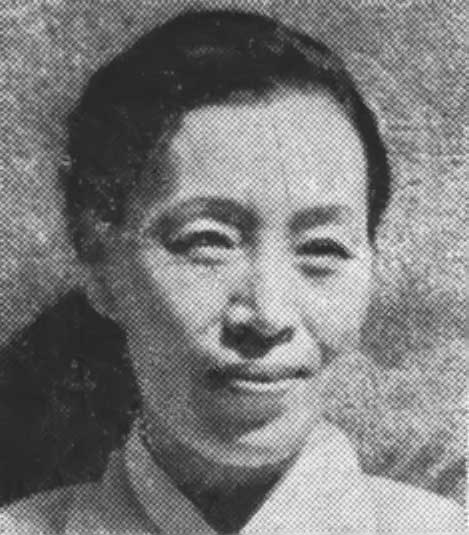
Mrs. Kang Sun-ae was born in Seoul in 1915. She graduated from Ewha College in 1937. She lived during a time when the role and value of women were changing in Korea. She had married and had children before she joined our church in 1958, without her husband. This is a testimony that evokes the Korea of a past time, and as such is a study of some of the values and sacrifices that characterized the spirit of the early period of our movement.
Part 4 (Click here to read Part 1 and Part 2 and Part 3)
God’s grace and blessings
On June 4, 1962, I helped as a staff member in the 72-Couple Blessing Ceremony and had the opportunity to read a written prayer during the event. Being a solemn event, my voice trembled as I read the prayer. My hands, which were holding the paper, shook to such an extent that I was deeply embarrassed.
On December 29, 1962, Hyo-jin was born. I was in South Jeolla Province when I heard the news. I was so overwhelmed that I ran to the church in tears. After writing a congratulatory message, I participated in the joyous dedication day, which we celebrated with milk and seaweed soup.[1]
I was later assigned to be part of the arrangement committee of the 124-Couple Blessing Ceremony, which took place on July 24, 1963. Our time was completely absorbed with preparing the ceremonial robes and bedding for the 248 brides and grooms. We had to classify the ceremonial robes and wedding veils by size, which we had to check several times. Nevertheless, two hours before the Blessing Ceremony, a bride came to us saying she did not have a veil. It was already time for the rehearsal, which Father himself was conducting. I became frantic and hastily searched for one, to no avail. I finally fashioned one from the sleeves of a hanbok jacket just in time for the Blessing Ceremony. At that moment, all the fruitful results I had obtained through the forty days[2] of hard work just evaporated. I felt as though I were going crazy.
After an intensive revival in downtown Daegu ended, I was instructed to stay in Daegu. Lecturers Kwak Jeong-hwan and Elder Jang and street evangelist Jeong Chan-bok also stayed in Daegu. Every single day, I went witnessing at Gyeongbuk University, Daegu University and Cheonggu University. I had Jeong Han-ung, who was in his second year of studies in the Department of Veterinary Medicine at Gyeongbuk University, rent a room close to his university’s main entrance. I took students there to listen to lectures from lecturer Kwak Jeong-hwan. When students would ask me to talk to them in school, we would have discussions in a classroom.
At the end of the revival period, I organized a group with around thirty university students that had become members. I decided to do a three-day fast out of concern for the group. I had hoped the group would naturally find stability. After the fast, the seaweed soup I was eating caused me great digestive problems. While I was writhing in much pain, Father suddenly paid a visit to Daegu. He was surprised to see the pain I was in and told me to go to a hospital. Later, Father was intending to give me some money through Rev. Lee Yo-han to buy a meal; however, weighing the possibility that I may not use it for food, Father instructed Rev. Lee to buy me a meal voucher instead. Having seen me eating rice porridge, a student named Kim Myeong-hwa, began making a big, boxed lunch at home that she brought to me every day.
On January 29, 1965, Father set off on his first world tour. I was planning to get some rest and to take medication during Father’s absence from Korea. However, I received a request from Mrs. Ji Seng-ryeon, wife of Lee Gi-seok, who was the leader of our Gangwon District, asking me to convert into full members some people they had witnessed to that were in their prime years.[3] I headed to Chuncheon as soon as I received the request. The church was in a good location and was a big building. I heard about the sacrifices that were made for the building to be acquired. Rev. Lee Gi-seok purchased the building through money he had saved running a cafeteria in a girl’s high school and through cutting expenses by eating only rough bran for some months even though it caused him to sometimes vomit blood. I feel that might have been why I felt so much grace and inspiration once I entered the main worship auditorium.
Every day, I met guests that had been witnessed to, conveying the word and having discussions. Seng-ryeon, Mrs. Choi Jeong-sun (the district director of the Red Cross) and I harmonized well, and we earnestly prayed to Heaven for the restoration of Gangwon Province. With this earnest desire, we conducted our activities, having lunch at Choi Jeong-sun’s place and two other meals of brown rice that we ate with kimchi and red pepper paste. Though our circumstances were very tough, the district leader’s life was even more impoverished. Though Seng-ryeon was pregnant, she ran both a cafeteria and the church.
One day, Choi Jeong-sun and I paid a visit to the governor of Gangwon Province, who had once listened to a lecture during one of our lecture tours conducted across Korea. Because he was very busy, we were allowed only three minutes to convey what we wished to do. We strongly requested permission to give a lecture to the public officials working in the Provincial Hall. We told him we felt this was very important. Fortunately, the governor easily accepted. We were completely overjoyed.
During the national revival tour, I followed Chung Su-won and Ahn Hyeong-gwan. Our Jeong-seon District in Gangwon Province was the least accessible place we had to visit. We walked up one mountainous trail that was reputed to be a dangerous trek in the winter, but I followed the trail without much difficulty. The members in that church diligently participated in activities while eating only rice mixed with corn. Their dedication moved God who was certainly dwelling with them. It was there that I witnessed to my spiritual son, Pak Won-gun.
To be continued…
[1] Traditionally Korean mothers eat seaweed soup to recover their health after the trials of childbirth. Apparently, the symbolism of milk and seaweed made them proper refreshments for celebrating the new birth.
[2] This may be a reference to the forty-day annual witnessing campaigns.
[3] In their forties