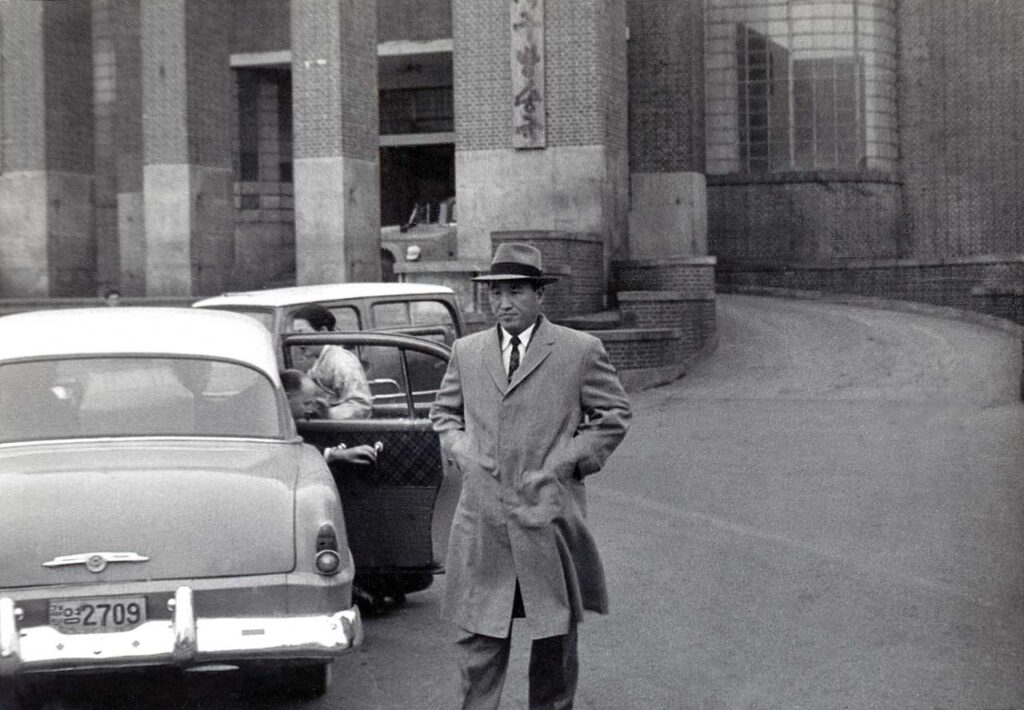
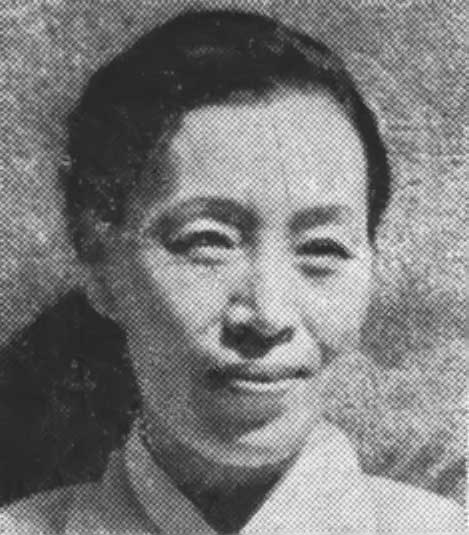
Mrs. Kang Sun-ae was born in Seoul in 1915. She graduated from Ewha College in 1937. She lived during a time when the role and value of women were changing in Korea. She had married and had children before she joined our church in 1958, without her husband. Thus, she represents one type among our early church pioneers. This is a testimony that evokes the Korea of a past time, and as such is a study of some of the values and sacrifices that characterized the early period of our movement.
Part 3 (Click here to read Part 1 and Part 2)
A package for the emperor
When I went to Tokyo, I got an apartment and shared it with Choi Bong-chun, who our missionary in Japan, and two single sisters. The number of members increased by the day. However, Missionary Choi had not told the members that the Principle had come from Korea. When the opportunity arose later, he confessed the truth to them. The members, in turn, replied that where the truth comes from does not matter; they would advance at the risk of their lives.
Because the members had united in heart, missionary Choi said he was invigorated a hundred-fold. As for me, I wrote down the revelations I had received until then and I sent them with the Divine Principle to the Japanese emperor. I supported the pioneering activities in four cities—Tokyo, Nagoya, Osaka, and Kyoto.
After printing three hundred copies of the Divine Principle, I could no longer extend my stay and had to return to Korea. I arrived in Korea just after the 5.16 Revolution.[1] I was sure I would be arrested for having stowed away. Additionally, during the party’s peak days, I had been the head of Democratic Party Wives Association.[2] I knew a detective would certainly be waiting for me at Gimpo Airport.
I was immediately taken to the Korean National Police, Public Order Division, where I stayed up the whole night sitting in a chair. The next morning, while being interrogated, a certain person came to me and said, “I am in a tight position and cannot help you much, but I’ll move you to the Yongsan Police Station. Go there and explain your situation well.” Soon after, I was transferred to Yongsan Police Station. One cell there accommodated around fifteen prisoners and every single one of them was an opium addict. The next day, that same person came again and spoke with the commissioned officer. Once he had gone, I was treated completely differently and was released within three days.
An evangelist and lecturer
That same year, I was assigned to lecture during the summer witnessing period in seven districts in North Jeolla Province and South Jeolla Province. I would be going to those provinces for the first time. When I went to say goodbye to Father before leaving, Mother gave me a handkerchief that Father used to wipe away perspiration. I realized her intention behind this, and set off for Geumsan in North Jeolla Province. Not knowing the location of the church, I lashed my trunk to a frame and carried it on my back as I looked for the church.
The person in charge of the Geumsan church was Kim Sun-rye, who was living in a non-heated, cold room with no food at all and conducting only Sunday school. Seeing the difficult reality of pioneering life, we both cried together. I had to leave after having Sunday school with the children the next day. Each step I took felt heavy as I departed for Jinan. Among the members there, a few of the young women had joined the church through Hong Gwang-cheol. He was the pastor and he seemed trustable. I went up a mountain near Jinan and met a spiritual person that had piled up stones in the form of dual characteristics, three disciples, twelve disciples and seventy elders. He had also received revelations from Heaven and had compiled them in a book, but no one had been able to understand those revelations.
When I went to Jeonju, I met the mayor and conveyed to him the work we were doing. Immediately, he summoned the man in charge of reconstruction promotion[3] and asked him to support our activities. The mayor gave us a signed pass that was of great help.
After touring the seven districts of Jeonbuk, I finally arrived in Gwangju. I went in search of the district headquarters and found it was a small makeshift wooden building. I heard that Hong Seong-pyo had used his university fees to construct the building, thus extending his college years.
I visited the mayor of Gwangju and requested his cooperation, showing him the signature of the mayor of the city of Jeonju. The mayor soon called his head of reconstruction promotion and asked him that we be given support. The mayor gave us his signature and even gave us public transportation discount coupons.
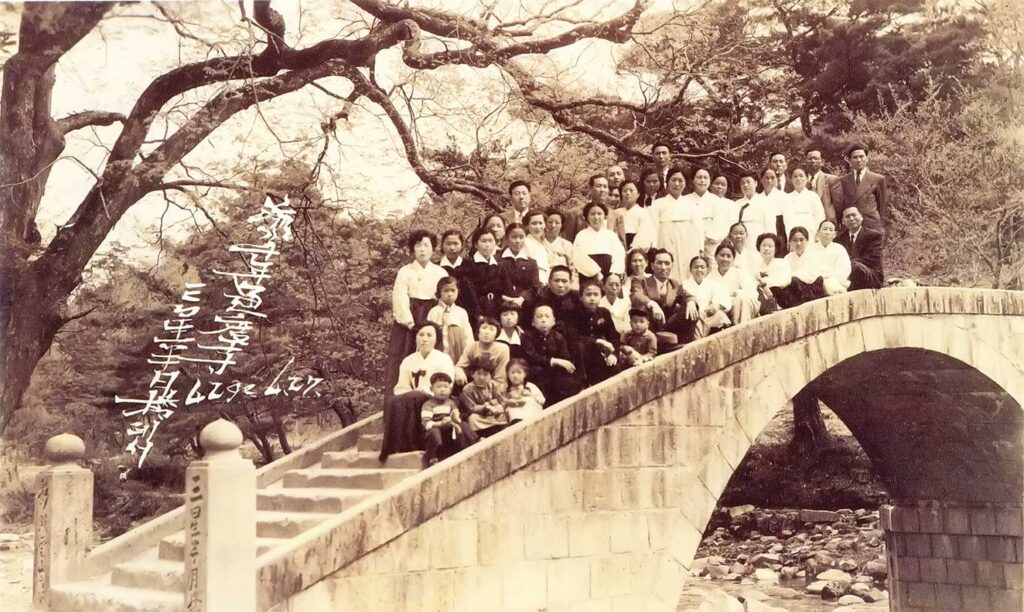
Camaraderie, struggles and euphoria
I took my trunk, walked down trails in the countryside and at times had to walk over steep mountains as I visited the different centers where our young members were. Whenever members met me, they were more pleased to see me than to visit for their own parents; they would reduce the portion of food they ate in order to keep some for me. They spread the word to their neighbors, causing them, too, to look forward to the lecture I was going to give. Whenever I saw the hard work of our members, I completely forgot my own fatigue and would speak all night long. I would have to rush to the next church area I was to visit as a result. At times, I felt physically drained, thinking of going over a mountain in the scorching heat. I would sit on the roadside and pray, which would invigorate me with power to go over the mountain. Sometimes I would become so overheated on the way that I would put my trunk down by a riverside and jump into the river in my underwear. I cannot describe the refreshing sensation of cooling my body down in the river.
Once, I had the opportunity to accompany Father in a car as he was heading to Jeonju with the leader of the Gokseong area. The happiness and gratitude I felt while accompanying Father throughout the long distance made me feel as though I were a child again. As we approached Jeonju, District Leader Hwang had ridden his motorcycle for some distance to meet us. When we met him, Father asked me, “Sun-ae, would you like me to buy you a motorcycle?” …
Once, I visited Hwaeomsa Buddhist Temple. There, I met and spoke to the temple’s chief monk. We talked about whether a celibate life was necessary and about problems that arise when couples stop having sexual relations during spiritual training. We agreed on some points.
Lee Mun-won and a woman church member that I had met on the road travelled with me all the way from Gokseong to Jeju Island. Once on Jeju Island, Lee Mun-won introduced me to his nephew and we stayed at his place. When we went to the district church headquarters, the deacon was delighted to see us, prepared lunch for us and called all the members. We held a worship service with sincere prayers. Afterward, I paid visits to the mayor, the head of reconstruction promotion and the different heads of organizations. The police chief drove us in a jeep all the way to a hotel. He had called the hotel himself to request that we be well cared for. The next day, the head of reconstruction promotion picked us up in a jeep, gave us a tour of Jeju Island, explained to us the way that reconstruction promotion was being conducted and treated us to lunch.
Though I am inadequate, Heaven, out of concern for me, seemed to be sending me to places and instructing someone to come to my support so I would not suffer too much. I could experience Father’s heart in this manner. Doing so immersed me completely in a hitherto unknown state of euphoria. For three years, I toured, here and there, all over South Jeolla Province.
To be continued…
[1] This was the May 16, 1961 bloodless coup led by a military junta, the Supreme Council for National Reconstruction, out of which Park Chung-hee emerged as the chairman on July 3. Park was acting president until December 1963 and president until his assassination on October 26, 1979.
[2] The head of the Democratic Party, Mr. Yun Po-sun, was the South Korean president ousted by the 5.6 coup (though he remained president as a figurehead until March 1962).
[3] It took decades for the nation to recover from the devastation of the Korean War.