Expert on freedom of religion and constitutional law calls verdict against Family Federation politically swayed, “deceptive and amateurish”
Tokyo, 25th December 2024 – Published as the 57th article in a series in the Japanese newspaper Sekai Nippo. Republished with permission. Translated from Japanese. Original article
The Supreme Court Denies the Value of Religion
by the Religious Freedom Investigative Team of the editorial department of Sekai Nippo
Prepared by Knut Holdhus
In an interview with this newspaper, published 3rd December 2024, Tomihiro Tanaka (田中富広), President of the Family Federation for World Peace and Unification (FFWPU, formerly the Unification Church) in Japan, emphasized, “In 2009, we issued a compliance declaration. We have repeatedly provided guidance that it is unacceptable to solicit donations by inciting anxiety over ancestral curses or to demand large donations that exceed individuals’ financial capacity.”
He also noted that as a result, lawsuits over donations have significantly decreased, and since the assassination of former Prime Minister Shinzo Abe (安倍晋三), the organization has implemented stricter verification processes for donations.
In this context, a landmark Supreme Court ruling was issued in July of this year, declaring invalid a “pledge” signed by a female member of the Family Federation in which she agreed not to seek refunds for donations made to the organization. This ruling overturned the Family Federation‘s victories in both the lower and appellate courts, and the case was remanded to the Tokyo High Court for further review.
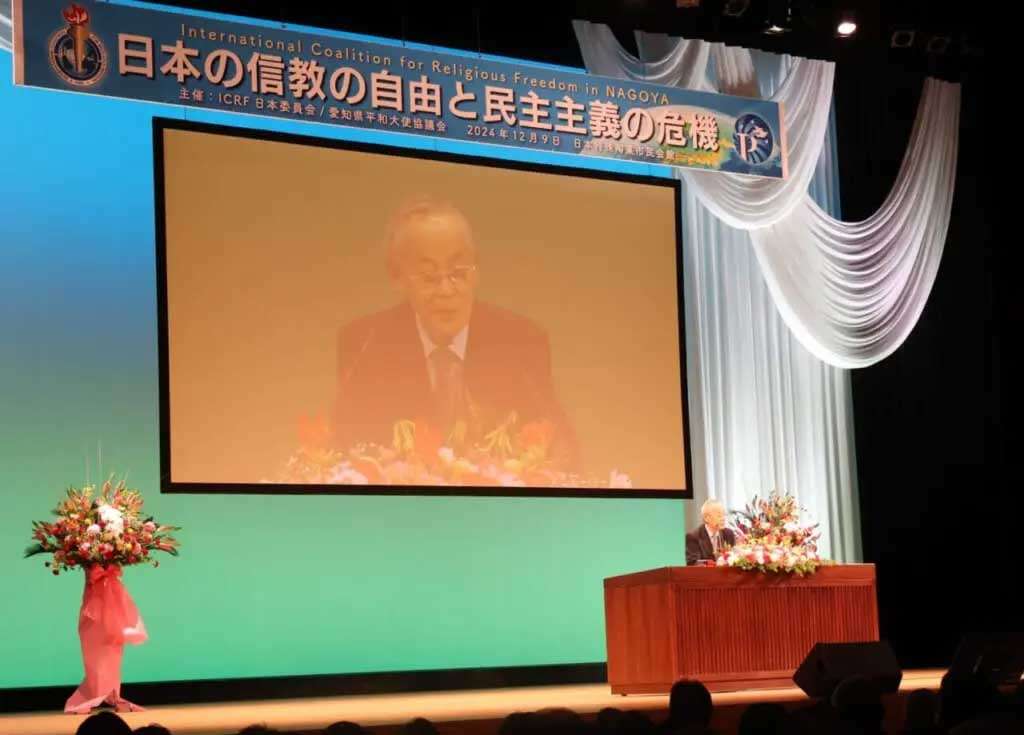
At a rally in Nagoya on 9th December, focusing on the theme of religious freedom, Seishiro Sugihara (杉原誠四郎), President of the International Historical Debate Institute and an expert on issues of freedom of religion and constitutional law, criticized the Supreme Court’s ruling, calling it “deceptive, amateurish, and politically motivated”.
The contested pledge was written in 2015 by a female member of the Family Federation, confirming that she would not seek refunds or compensation for her donations. This woman passed away three years ago.
The Supreme Court ruling stated that she was under the “psychological influence of the Family Federation” and was “in a state where it was difficult to make a calm judgment.” Seishiro Sugihara criticized this as reflecting a “very crude and shallow view of religion”, noting that anyone practicing a specific religion is at least somewhat under the psychological influence of their religious organization.
The ruling referenced the “Act on the Prevention of Unjust Solicitation of Donations by Corporations and Other Entities” (Unjust Donation Solicitation Prevention Act), enacted in December 2022. This law was cited as a basis for questioning the validity of the pledge. However, both the donations and the writing of the pledge occurred before the law was enacted. Sugihara argued that citing the law in this Supreme Court decision violated “the fundamental legal principle of non-retroactivity”.
By effectively declaring that donations made based on religious faith could be invalidated and reclaimed retroactively, the judiciary has seemingly given implicit approval for such actions. Sugihara expressed concern that both the law – enacted with an intent to target the Family Federation – and the Supreme Court ruling amounted to saying that “religion and faith have no value.” He argued that it would be unjust for the religious world to remain silent and urged the submission of critical opinions to the United Nations.
Amid increasing threats to the Family Federation‘s freedom of religion, its members organize rallies across Japan to advocate for this fundamental right and invite participation from various religious groups. These gatherings aim not only to denounce the perceived injustice of the dissolution order sought against the Family Federation, but also to strengthen solidarity among religious denominations in defense of freedom of religion.
While many religious figures are present at these events, few take the stage to speak out. A representative of a new religious movement attending a meeting in Osaka expressed opposition to the dissolution order and affirmed solidarity with the Family Federation.
However, he admitted refraining from public advocacy due to fear of being labeled as a supporter of the Family Federation in the eyes of public opinion. He explained that voicing support could lead to accusations of being “cut from the same cloth”, which deters open action. This cautious approach reflects the stance of the majority within Japan’s religious community, where concern for religious freedom exists alongside a deliberate distancing from the Family Federation.
Regarding the Family Federation’s appeals for religious freedom, its president, Tomihiro Tanaka, commented in this series: “Human rights activists worldwide are mobilizing for issues like Tibet and Xinjiang, yet if our organization only advocates for its own rights, it will fall on deaf ears. We must be genuinely committed to the freedom of religion for other faiths as well. The expectation is for our organization to engage sincerely with such broader themes.” (2nd December 2024)
Raising voices for religious freedom on behalf of Japan as a whole is seen as a crucial step toward restoring trust in the organization.
Featured image above: Seishiro Sugihara (杉原誠四郎) speaks at the International Coalition for Religious Freedom (ICRF) Nagoya Conference, 9th December 2024, in Nagoya. Photo: Tsuyoshi Toyoda (豊田剛).